
Japanese Whisky Pairing for Caviar, Food and Whisky Profiles
The best pairing caviar with Japanese whisky isn’t necessarily the boldest. Match the whisky’s body and flavour intensity to the food, then let texture guide your choice. Light, fruity or floral whiskies suit delicate seafood, while smoky or fuller-bodied styles can stand alongside grilled dishes and richer flavours. For a tasting, begin with lighter combinations and progress to more intense ones.
That balance makes a considered pairing rewarding: caviar’s cool, delicate texture can be overshadowed by an overly forceful whisky, while a well-chosen pour can bring its savoury character into focus. Learn how to match whisky profiles with caviar and other dishes, and how water, dilution and serving temperature can shape each sip. Start with lighter seafood and gentle flavours, then explore richer, smoky pairings. A simple tasting approach helps you notice how each combination changes on the palate.
Key Takeaways
- Choose a whisky whose weight and flavour intensity complement the dish, from delicate seafood to smoky or richly flavoured food.
- Use caviar’s texture and savoury character to guide your choice, beginning with gentler combinations before moving to bolder profiles.
- Taste the whisky on its own first, then notice how a bite of food changes its aromas and finish.
- Experiment with a few drops of water and thoughtful serving temperatures to reveal different nuances in the glass.
- Explore Siberian or White Sturgeon Caviar when selecting caviar for a considered tasting or gift.
1. Japanese Whisky and Food Pairing: Which Whisky Goes with Which Dish?
Japanese whisky can bring floral, fruity and elegant notes to a meal, with oak adding warmth and depth. Match its intensity to the dish: delicate seafood needs a lighter pour, while smoky flavours can stand alongside grilled or richly seasoned food. A whisky’s caramel, fruit or barrel character offers clues to the flavours it may complement.
For a first comparison, taste the whisky neat before serving food. Take a small sip, let it spread across your tongue, and notice its aromas and finish. Then try a bite followed by another sip. Fresh sashimi may emphasise floral notes, while grilled white fish can pair more readily with fruit and oak.
- Pair light, fruity or citrus-led Japanese whisky with sashimi, sushi, salmon or grilled white fish.
- Choose smoky whisky for grilled mackerel, smoked salmon, yakitori or slow-braised meat.
- Try sherry-cask or dried-fruit and nut notes with duck, braised pork, rich sauces or aged cheese.
- Pour a Japanese whisky highball with crispy, salty dishes such as tempura, karaage, gyoza or okonomiyaki.
Adjust the match by changing one element at a time. If a delicate dish disappears beside a smoky dram, return to a lighter, fruitier style. If a rich sauce overwhelms a soft whisky, try a fuller profile with dried-fruit or nut notes. This comparison shows whether the food and whisky enhance each other or create a pleasing contrast.
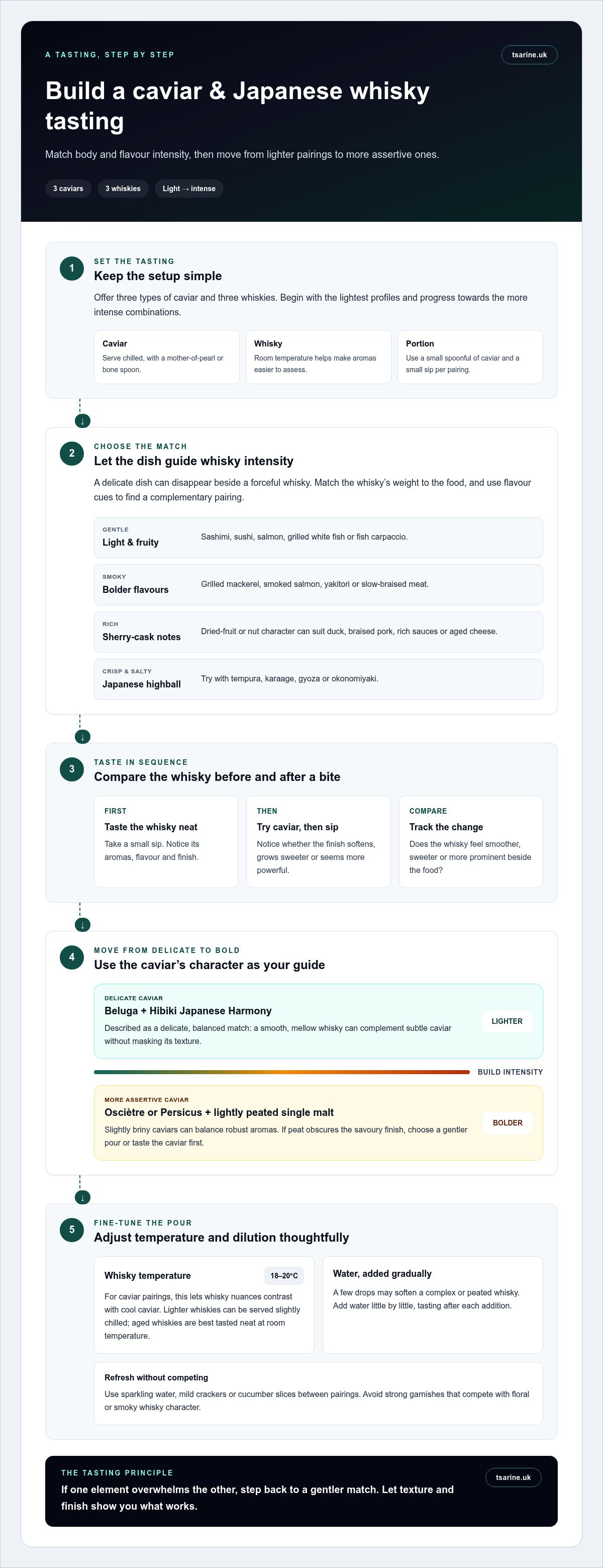
For a caviar tasting, offer three types of caviar and three whiskies, moving from lighter profiles towards more intense ones. Taste each whisky neat first, then take a spoonful of caviar and a small sip. Notice whether the whisky’s finish softens, grows sweeter or seems more powerful beside the caviar.
Keep accompaniments restrained: sparkling water, mild crackers and cucumber slices can refresh the palate between pairings. Serve caviar chilled, with a mother-of-pearl or bone spoon, so its delicate texture remains the focus. Avoid strong garnishes that compete with the whisky’s floral or smoky character.
How much should each person receive? For a tasting, serve a small spoonful of caviar and a small sip of whisky for each pairing. The total depends on the number of pairings and whether caviar is a tasting course or the centrepiece.
Room-temperature whisky makes its aromas easier to assess, while gentle swirling can help release them. A few drops of water may soften a complex or peated whisky; add them gradually, tasting after each addition. With delicate sashimi, this can temper the whisky’s intensity without obscuring its character.
2. Matching whisky body and texture to food richness
For a balanced pairing, match the whisky’s weight to the food’s richness. A light, fruity single malt can preserve caviar’s delicacy, while a fuller whisky stands more comfortably beside rich sauces, duck or blue cheese. Aim to enhance shared notes without letting either the dram or dish dominate.
UK readers can explore named Japanese whisky examples such as Hibiki Japanese Harmony, Yamazaki 12, Nikka Miyagikyo, Nikka From The Barrel and Nikka The Tailored. Think about flavour as well as body: fruit and vanilla can suit mild cheese, while a sherry cask profile’s dried-fruit character has affinity with duck, nuts and richer sauces.
For a delicate caviar pairing, begin with a lighter whisky and taste each in turn. Beluga caviar with Hibiki Japanese Harmony is described as a delicate, balanced match. It illustrates the principle: when the caviar is subtle, a smooth, mellow whisky can complement it without masking its texture.
More assertive caviar can meet greater whisky intensity. Slightly briny Osciètre and Persicus caviars can balance robust aromas, while lightly peated single malt offers a smoky counterpoint. Keep the combination measured: if the whisky’s peat obscures the caviar’s savoury finish, choose a gentler pour or taste the caviar first.
- Pair light, fruity whisky with delicate seafood, such as sashimi or fish carpaccio.
- Try richer, sherry-cask character with duck, braised pork, nuts or aged cheese.
- Match bold whisky with smoked food, blue cheese or other pronounced flavours.
- Move from lighter caviar and whisky to more intense pairings during a tasting.
Texture matters as much as flavour. A creamy, rich dish can soften a whisky’s sharper edges, whereas crisp or lean food may make the same dram seem more forceful. Compare a sip before and after a bite, noticing whether the whisky feels smoother, sweeter or more prominent. This helps distinguish a complementary pairing from one that overwhelms.
Temperature also changes the impression. Keep caviar chilled and serve whisky at room temperature to make its aromas easier to appreciate. A cool bite can contrast clearly with the whisky’s warmth, while a soft, rich accompaniment may make the combination feel more rounded.
For a tasting built around the caviar itself, Siberian Sturgeon Caviar offers a choice to consider alongside different whisky bodies and flavour profiles. Taste it with a lighter pour first, then compare a fuller or gently smoky style; the contrast can reveal which texture and intensity best suit your palate.
3. Water, dilution and serving temperature
Temperature changes how Japanese whisky’s flavours reach the palate, so set the pour before tasting. Whisky served at room temperature can reveal delicate aromas and subtle oak character. For pairing caviar with Japanese whisky, serving the whisky at 18–20°C lets its nuances contrast with cool caviar. Keep the caviar chilled, then pour the whisky separately at its chosen temperature.
Use the style as your guide. Lighter Japanese whiskies can be served slightly chilled, while aged whiskies are best tasted neat at room temperature. A cool pour may feel restrained beside warm, grilled food, while an aged whisky at room temperature can show more aroma and texture. Compare both approaches with the same small taste of caviar to see how temperature shifts the balance.
Water is an adjustment, not an obligation. Start with neat whisky, then add a few drops of water to a separate taste. This may open complex whiskies, especially peated varieties, and soften forceful flavours. With delicate sashimi, water can lower the alcohol content in the glass, making the whisky gentler beside the fish.
- Taste the whisky neat and note its aroma, texture and finish.
- Add a few drops of water, then pause and taste again.
- Try a bite of caviar or sashimi, followed by another small sip.
Change one detail at a time. If water makes a smoky whisky feel more balanced beside caviar, use that dilution for the next taste. If the whisky loses character, return to the neat pour. The same comparison works with grilled fish: its savoury edges may meet a softened peated dram differently from an undiluted one.
Ice and soda create more substantial dilution than drops of water, changing the pairing more dramatically. A Japanese whisky highball, commonly made with one part whisky to three to four parts soda, suits crispy, salty or grilled dishes. Chilled ice and soda can refresh the palate, but may conceal subtle whisky aromas beside delicate caviar.
For a considered tasting, keep the order consistent: neat first, diluted second, then food. Use sparkling water between combinations to clear the palate, rather than adding it directly to every glass. This makes it easier to distinguish changes in the whisky’s character from the cooling effect of caviar or the texture of a bite.
Room temperature is a useful starting point, not a reason to warm the glass by hand. Pour a small measure, let it settle, and reassess after the first sip. When pairing caviar with Japanese whisky, a slight temperature adjustment or a few drops of water can shift the balance, allowing the whisky’s flavours to sit more gracefully beside cool caviar.
4. Pairing Japanese whisky with caviar
Begin by matching caviar’s delicacy to the whisky’s intensity, then taste them together rather than judging either alone. Beluga caviar with Hibiki Japanese Harmony is a useful starting example, described as delicate and balanced. The caviar’s texture and the whisky’s smooth character can meet without either overpowering the other.
Which caviar varieties pair best with Japanese whisky? Beluga with Hibiki Japanese Harmony offers a gentle starting point, while briny caviars can contrast with more robust whisky aromas. Choose according to the whisky’s weight and the caviar’s savoury intensity, rather than relying on one universal match.
For the first taste, take a small sip of whisky, then a spoonful of caviar. Let the caviar rest briefly on your palate before tasting the whisky again. Notice whether its finish seems sweeter, smokier or more pronounced. Reverse the order next time, tasting caviar first, to discover how sequence changes the balance.
Serve caviar chilled, using a mother-of-pearl or bone spoon to avoid metallic interference. Keep accompaniments restrained: mild crackers or cucumber can add a quiet, crisp contrast, while strong seasoning may mask the caviar. Avoid lemon, sharp sauces and heavily flavoured garnishes when assessing the whisky and roe together.
For a UK tasting at different price points, build the experience around styles and quantities rather than assumed bottle prices. A modest arrangement can focus on one Japanese whisky and one caviar; a more elaborate tasting can add further whisky profiles and caviar varieties. The main cost factors are the caviar selected, the amount served and the whisky chosen.
Common mistakes are easy to correct. A heavily peated whisky can overpower delicate caviar, while a very sweet or sherry-led dram may compete with its briny finish. Begin with a lighter pairing, then introduce more assertive flavours. Avoid serving caviar warm or using a metal spoon, since temperature and metallic contact can distract from its taste.
Consider the rest of the menu, too. Japanese whisky and caviar can be served as a focused tasting or alongside mild seafood dishes that won’t eclipse their flavours. Keep strongly seasoned dishes separate. Smoked or grilled food can suit bolder whisky, but its intensity may overwhelm a delicate caviar pairing.
For a small gathering, set out each caviar and whisky separately, with sparkling water to cleanse the palate. Taste one combination at a time, recording a brief note about texture, sweetness and finish. This simple method helps identify which pairing creates harmony and which relies on contrast.
5. Whisky profiles for caviar pairings
Japanese whisky profiles range from light, fruity and floral to smoky, rich and oak-led. For delicate caviar, begin with a softer whisky whose aromas won’t overpower the roe’s savoury character. A fuller or lightly peated pour can contrast with brinier caviar, provided its intensity doesn’t obscure the caviar’s texture.
Which flavours in Japanese whisky complement or clash with caviar? Floral, fruity and gentle vanilla notes can complement caviar, while restrained oak adds warmth. Strong smoke or pronounced sweetness may overwhelm a delicate variety, though briny caviar can stand up to a robust, lightly peated profile.
Beluga caviar with Hibiki Japanese Harmony is described as a delicate, balanced combination. Its mellow profile offers a useful reference when choosing Japanese whisky for subtle caviar: look for smoothness and measured oak rather than an assertive finish. Taste the whisky first, then try it with a small spoonful.
Mizunara oak gives some Japanese whiskies a distinctive profile, often associated with sandalwood, incense, coconut and spicy wood. These aromas can add a fragrant counterpoint to caviar, but their layered character may draw attention away from especially delicate roe. Compare a small neat pour with the caviar before settling on this expressive style.
Smoky Japanese whisky offers a different culinary direction. Its assertive character can contrast with briny caviar, while lightly peated single malt keeps the smoke more measured. If smoke dominates the caviar’s finish, choose a softer whisky. If both flavours remain distinct, the contrast can feel composed rather than overpowering.
Vanilla and fruit notes can also guide the wider tasting menu. Japanese whiskies with fruit and vanilla can suit mild cheeses such as Brie or aged Gouda. Keep these accompaniments separate from the caviar tasting, then compare how each whisky profile works with cheese and roe. This reveals whether its aromas feel complementary or distracting.
Try a simple profile comparison: pour one floral or fruity whisky and one smoky or oak-led style. Taste each neat, then with the same caviar, noting which aromas remain clear and how the finish changes. Serve the caviar chilled, and use a mother-of-pearl or bone spoon to avoid metallic interference.
Choose a caviar for your tasting and explore how its texture meets Japanese whisky’s aromas. Explore caviar for a tasting, then compare a gentle profile with a bolder pour to find your preferred harmony.
For Beluga caviar, the page recommends smooth, lightly oaked bourbon or mellow single malt whisky. For Osetra caviar, it recommends sherry cask-aged Scotch whisky. For Sevruga caviar, it recommends peaty Scotch or high-rye bourbon. It also describes Scottish whiskies from the Highlands or Islay as particularly suited to caviar, citing smoky and vanilla notes.
TSARINE Caviar: Tsarine Caviar Luxury Gift Set
For a considered tasting or an elegant gift, the Tsarine Caviar Luxury Gift Set is a natural way to bring caviar to the table. Pair it with Japanese whisky by starting with a gentle, floral pour, then exploring a fuller profile to discover how each changes the caviar’s texture and finish.
For a tasting centred on sturgeon caviar, consider Siberian Sturgeon Caviar (Acipenser Baerii) or White Sturgeon Caviar (Acipenser Transmontanus). Wholesale Caviar Orders are also available for businesses planning a larger food experience.
Choose the offering that suits your occasion, whether you’re preparing a personal tasting, selecting a gift or arranging a wholesale order. To explore caviar for your table, visit tsarine.uk.
Make Your Next Tasting Personal
Let your next tasting be guided by curiosity rather than a fixed menu. Choose a whisky profile that interests you, then build the experience around the caviar’s texture and the flavours you enjoy most. A brief note after each pairing can help you remember which aromas emerged, which contrasts pleased you and what you’d like to explore next. Over time, pairing caviar with Japanese whisky becomes less about following a prescribed match and more about discovering your own palate.
For a special occasion, the Tsarine Caviar Luxury Gift Set offers a considered starting point. Siberian Sturgeon Caviar (Acipenser Baerii) and Wholesale Caviar Orders provide further options for personal or larger-scale plans. Keep the setting unhurried, the tasting deliberate, and each combination an invitation to notice something new.
Contact TSARINE Caviar to discuss pairings and plan a tasting that reflects your occasion. May your next pour bring a fresh note of discovery to the table.
Frequently Asked Questions
Japanese Whisky and Food Pairing: Which Whisky Goes with Which Dish?
Light, floral Japanese whisky works well with subtle seafood, while smoky styles suit grilled or smoked dishes. For a broader menu, try a highball with crisp tempura, or pair fruity, vanilla-led notes with mild cheese. A sherry-cask profile can complement duck or a rich sauce. For dessert, match soft vanilla or caramel notes with milk chocolate, and fruitier or smoky whisky with dark chocolate.
Which Japanese whisky styles pair best with caviar?
Floral, fruity or gently oaked Japanese whisky makes a graceful starting point for delicate caviar, while lightly peated whisky can offer contrast with brinier roe. A noted example is Beluga caviar with Hibiki Japanese Harmony, described as delicate and balanced. Taste the whisky before the caviar, then compare the finish; if smoke or oak overwhelms the roe, choose a softer profile.
Should Japanese whisky be served neat, with water, or on ice alongside caviar?
Begin neat so you can appreciate the whisky’s original aromas beside the caviar. Then add a few drops of water to a separate taste, especially with complex or peated whisky, and observe how the flavours shift. Ice chills and dilutes the whisky more substantially, which can mute subtle aromas. Save it for a more refreshing serve rather than your first comparison with delicate roe.
What serving temperature and glassware work best for whisky and caviar?
Serve caviar chilled and Japanese whisky near room temperature; around 18–20°C is a useful tasting reference for the whisky. A tulip or nosing glass concentrates its aromas, making floral, fruit and oak notes easier to assess. Keep the caviar in its own chilled serving dish, and use a mother-of-pearl or bone spoon to avoid metallic interference. Let the whisky rest briefly in the glass before tasting.