
Surprising Caviar and Food Pairings: Unexpected Matches to Try
A crisp potato crisp may be a more intriguing partner for caviar than a familiar blini. The best surprising caviar and food pairings aren’t a culinary stunt. They balance flavour and texture so the roe’s delicate brininess remains noticeable.
Unusual combinations can seem risky if a strong flavour or heavy texture might overwhelm the caviar. A useful rule of thumb is to complement, not compete. A little salt can echo its savouriness, creaminess can soften a bite, and crispness can add contrast.
This guide explores matches such as potato crisps, soft-scrambled eggs, burrata and melon, with practical tips for keeping caviar at the centre. Taste one pairing at a time: compare the texture and intensity, then decide which combinations you enjoy.
Key Takeaways
- Consider flavour intensity, texture, salt and temperature so the caviar stays noticeable.
- Try surprising caviar and food pairings as personal tasting experiments, from crisp potato crisps to creamy avocado and dark chocolate.
- Taste the caviar plain first, then add a small amount of one accompaniment and reassess the balance.
- Compare Siberian and White Sturgeon caviar using their current product descriptions rather than assuming either has a particular flavour profile.
- Keep accompaniments restrained and adjust portions to suit your preference.
Why Try Surprising Caviar and Food Pairings?
Classic accompaniments are dependable because they let caviar take centre stage. But trying something less expected can reveal a different side of its delicate, briny character. An unconventional pairing works best when the roe is still easy to notice, rather than buried beneath stronger flavours.
Salt, richness, texture and intensity all affect compatibility. Use these as guides, not as a formula that guarantees the same result for every palate. The Flavour Principles Behind Unexpected Caviar Pairings include the idea that ingredients with shared flavour components may work well together. That can be a useful way to think about a match, but it doesn’t guarantee you’ll enjoy it. Treat the suggestions here as experiments, with personal preference part of the tasting.
What makes an unconventional caviar pairing work?
Texture is a useful place to start. A crisp accompaniment contrasts with the soft pearls, while a creamy one can make the bite feel smoother and more cohesive. Tender foods sit gently alongside the roe without adding crunch. No texture is automatically better, so notice which combination you prefer.
Savoury depth, often described as umami, may complement caviar’s briny notes. Salt needs more care: if the accompanying food is strongly seasoned, its salinity can make the caviar harder to discern. Aim for a bite where both flavours come through instead of one overwhelming the other.
How should you taste an unfamiliar combination?
Start with a small taste of caviar on its own. Then add a modest amount of one accompaniment, keeping the roe easy to recognise. Comparing the two bites makes it easier to notice what the other ingredient changes.
Pay attention to aroma, texture, saltiness and the lingering finish. Does the accompaniment create a pleasing contrast, or does its flavour linger so strongly that the caviar disappears? There’s no need to like every combination. Adjust the proportions or move on to another pairing to find what suits your palate.
The Flavour Principles Behind Unexpected Caviar Pairings
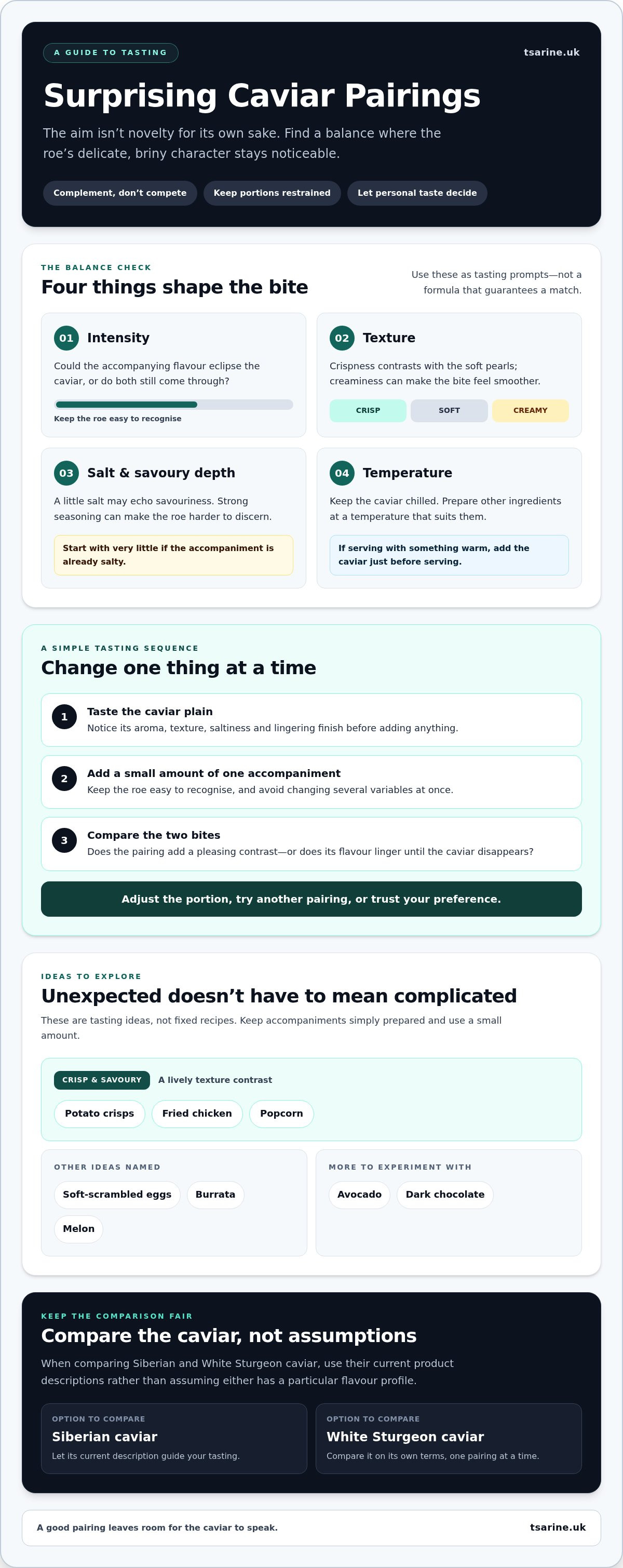
Novelty alone doesn’t make a pairing work. When exploring surprising caviar and food pairings, consider the strength of each flavour, the texture of each ingredient, their saltiness and the temperature at which they’re served. This framework won’t predict every preference, but it can help you spot combinations that may feel balanced or overpowering.
- Intensity: Is the accompanying food mild, or could it eclipse the caviar?
- Texture: Will it bring crispness, softness or creaminess to the bite?
- Salt: Is the food already salty enough to make the roe harder to taste?
- Temperature: Will the ingredients feel harmonious together while the caviar stays chilled?
Balance richness, salt and savoury depth
Rich foods can give a tasting bite a fuller impression, but they may also crowd out subtle flavours. A buttery or creamy accompaniment could soften the contrast between ingredients. Keep the portion small so you can still distinguish the caviar’s own character.
Pay particular attention to salt. If an accompaniment is already salty, begin with very little; too much can dominate the palate before the caviar’s more delicate qualities register. Umami means savoury depth, the rounded quality found in foods such as mushrooms or aged cheese. That depth may sit comfortably beside briny flavours, but it doesn’t guarantee a successful match. Treat it as a possibility to explore, not a rule.
Use contrast in texture and temperature
A crisp ingredient adds a lively snap, while a soft one keeps the bite gentle. Creaminess can make the mouthfeel smoother. These are different experiences, not a ranking. Compare one texture at a time to discover whether you prefer contrast or a more seamless combination.
Serve the caviar chilled and prepare the other ingredients at a temperature that suits them. A warm accompaniment may work, but add the caviar just before serving rather than leaving it out while you arrange the tasting. Changing one variable at a time, such as texture and then seasoning, makes it easier to judge what you enjoy. The same approach helps when comparing Siberian and White Sturgeon caviar: use the current product descriptions rather than assuming one has a particular flavour profile.
For a considered tasting at home, explore Siberian and White Sturgeon caviar as two options to compare, and let the caviar guide your choice of accompaniment.
Seven Surprising Caviar and Food Pairings to Explore
Approach these surprising caviar and food pairings as personal tasting experiments, not fixed recipes. Keep each accompaniment simply prepared, use a small amount and notice whether the roe remains distinct. If you’d rather begin with familiar serving ideas, read this guide to classic caviar pairings.
Crisp, savoury pairings: potato crisps, fried chicken and popcorn
A crisp base creates a lively contrast with caviar’s delicate texture. These informal ideas may suit a relaxed tasting, though strong seasoning can quickly take centre stage.
- Potato crisps: Personal tasting experiment. Try a plain, lightly salted crisp for a clean crunch. Start with a small piece, since extra salt may make the caviar harder to discern.
- Fried chicken: Personal tasting experiment. A small, plainly seasoned bite brings a crisp exterior and tender centre. Skip hot spices or a heavily flavoured coating, which could overwhelm the caviar.
- Plain popcorn: Personal tasting experiment. Its airy crunch offers a lighter contrast than a dense base. Use unsalted popcorn or very little seasoning, then see whether its crisp texture suits the caviar.
Creamy, briny and sweet contrasts: avocado, oysters, eggs and chocolate
These combinations explore softer textures and stronger contrasts. Keep portions modest: a small taste is enough to discover whether a pairing feels balanced to you.
- Avocado: Personal tasting experiment. A thin slice of plain, ripe avocado brings a soft, creamy texture. Avoid adding citrus, chilli or salt at first so you can judge the pairing itself.
- Oysters: Personal tasting experiment. This briny-on-briny comparison may appeal if you enjoy pronounced maritime flavours, but it won’t suit every palate. Taste the oyster and caviar separately before trying a little together.
- Soft scrambled eggs: Personal tasting experiment. A small spoonful of gently cooked eggs offers a tender, creamy base. Keep the seasoning simple and add the caviar just before tasting.
- Dark chocolate: Personal tasting experiment. This is the boldest suggestion, contrasting chocolate’s bitterness with caviar’s salinity. Taste a small piece separately first. The contrast may be too pronounced, so don’t expect the flavours to harmonise.
Try one idea at a time instead of arranging all seven together. Your preferred match may depend on the caviar variety as well as your own taste, so let curiosity guide the next small bite.
How to Choose and Serve a Pairing That Suits Your Caviar
A measured tasting makes surprising caviar and food pairings easier to judge. Start with the caviar, then introduce one accompaniment at a time. This gives each ingredient room to speak and helps you identify the textures and flavour intensities you enjoy.
- Taste it plain: Begin with a small taste of caviar on its own.
- Choose one contrast: Select a single food to explore, such as something crisp or creamy.
- Add a little: Keep the portion modest so the caviar remains discernible.
- Reassess: Notice what changed, then decide whether to adjust the amount or try another pairing.
Serve the caviar chilled and follow the storage and serving guidance provided with it. A non-metal spoon, such as one made from mother-of-pearl, is traditionally used to avoid affecting its delicate flavour. For more detail on serving technique, see this elegant guide to eating caviar.
Match the pairing to the caviar variety
Siberian and White Sturgeon caviar are two varieties you may encounter, but don’t assume one is automatically milder, richer or better suited to a particular food. Check the current product descriptions for verified notes on flavour, texture and intensity before choosing an accompaniment. If both varieties are available and have been stored as directed, a side-by-side tasting can help you notice how the same food works with each.
For background on the distinctions among varieties, consult the guide to types of caviar. Use the descriptions to inform your selection, then let your own tasting decide what works.
Build a simple tasting flight at home
For an unhurried tasting, serve the caviar on its own, followed by two or three contrasting foods in small portions. Compare one pairing at a time, keeping assertive flavours separate so they don’t carry over and cloud the next bite. Plain water between tastes can help refresh the palate if you wish.
A few notes can help you remember what worked: record which texture you preferred, whether the accompaniment seemed too salty or intense, and how the caviar’s finish came through. To explore the varieties available for your tasting, discover Siberian and White Sturgeon caviar.
Make Your Caviar Pairing Experience Personal
The pleasure of trying surprising caviar and food pairings lies in discovery, not in finding a combination everyone must enjoy. One person may appreciate how an accompaniment changes the caviar’s texture, while another may find its flavour too strong. Both responses are normal. Treat each tasting as an invitation, not a test with a right answer.
What to keep in mind when experimenting
A small, thoughtful tasting can tell you plenty without elaborate preparation. Choose a restrained accompaniment, taste the caviar first, then adjust the amount to suit your palate. If one flavour dominates, use less or set that combination aside.
Note the combinations you’d revisit and what appealed to you: perhaps a particular textural contrast, a gentle savoury quality or a balance that left the caviar easy to discern. Keep the notes simple. At a future tasting, you can adjust the portion or try the same idea with another caviar variety.
- Choose restrained accompaniments so the caviar remains noticeable.
- Taste the caviar first and give its own character your attention.
- Adjust portions to preference, making the accompaniment smaller if it takes over.
A graceful next step for curious tasters
If you’d like to keep exploring, choose a caviar whose current product information aligns with your interests rather than relying on an assumed flavour ranking. TSARINE Caviar offers Siberian Sturgeon and White Sturgeon caviar, sourced from a sustainable farm in Italy. Check the latest product details for descriptions and availability as you plan a tasting. Those details can help guide your choice, but they can’t guarantee that a particular food pairing will suit every palate.
Keep the tasting unhurried: taste, observe and return to the combinations you enjoyed. A few considered bites can be more revealing than an elaborate spread. If you’re curious to learn more about the available caviar, explore TSARINE Caviar.
Let Curiosity Guide Your Next Caviar Tasting
The most rewarding surprising caviar and food pairings begin with curiosity, not an expectation that every match must work. Taste the caviar on its own first, keep accompaniments restrained and notice how texture, salt and intensity shape each bite. Your response is the best guide to what deserves another taste.
A small, unhurried tasting can be more revealing than an elaborate spread. Compare one ingredient at a time, note the combinations you enjoy and adjust the proportions to suit your palate. The aim isn’t to follow a rigid rule, but to discover how caviar’s character comes through in company.
TSARINE Caviar offers Siberian and White Sturgeon caviar, sourced from a sustainable farm in Italy. Explore TSARINE Caviar and review the current product information to choose a variety for your next tasting.
Frequently Asked Questions
Can you pair caviar with potato crisps?
Yes. Plainly seasoned potato crisps can contrast with caviar’s delicate texture. Their familiar savoury flavour makes this an accessible experiment, but heavily salted or strongly flavoured crisps may overwhelm the roe. Taste the caviar on its own first, then try a small amount with a crisp. Whether the crunch and flavour appeal is a matter of personal preference, not a universal rule.
What are some unusual foods to eat with caviar?
Potato crisps, fried chicken, avocado, oysters, plain popcorn, soft scrambled eggs and dark chocolate each offer a different texture or flavour to explore. These surprising caviar and food pairings won’t suit every variety or palate, so treat them as experiments rather than established matches. Try one food at a time, keep the portion modest and notice whether the caviar remains perceptible.
Does caviar go with chocolate?
Dark chocolate is a bold combination to test, not a guaranteed match. Its sweetness and intensity may compete with caviar, so taste each ingredient separately before trying a very small amount together. If the chocolate masks the roe or the contrast feels unbalanced, enjoy them apart. The point is to discover your own response, not to prove that the flavours must harmonise.
Can you serve caviar with fried chicken?
Yes, you can try a little caviar with simply seasoned fried chicken for a crisp, savoury contrast. The coating, seasoning and temperature all affect the bite, and a heavily spiced or salty preparation may mask the roe. Keep the portion restrained and taste the caviar first, then decide whether the combination suits you. Think of it as an informal experiment, not a traditional serving recommendation.
How do you choose a food pairing for caviar?
Start by tasting the caviar alone, then choose one food whose texture or flavour you’d like to explore. Consider intensity, saltiness, richness and serving temperature, adding only a small amount so the roe stays discernible. Avoid testing several strong flavours at once, as it can be difficult to judge which one changed the taste. Your preferred pairing will depend on the caviar variety and your palate.
Is caviar good with avocado?
Avocado’s creamy texture and mild flavour may provide a pleasing contrast to caviar for some tasters, though preferences vary. Keep it simply prepared and try a small bite so extra seasoning doesn’t dominate. Taste the caviar separately first, then compare the two together. The result depends on the caviar and how the avocado is prepared, so treat it as a pairing to explore rather than a guaranteed favourite.
What should you avoid serving with caviar?
There’s no single list of foods everyone should avoid, but strongly seasoned, very salty or intensely flavoured ingredients can make delicate caviar harder to notice. Taste each component separately and begin with modest portions rather than ruling out particular foods. If the accompaniment dominates, simplify it, use less or serve the caviar on its own. The caviar variety and your personal preference both shape what feels balanced.