
The Art of the Roe: A Connoisseur’s Guide to the Exquisite Types of Caviar
What if the most expensive tin on the shelf is not, in fact, the one that will dance most harmoniously upon your palate? You surely understand that true indulgence is found in the quiet whispers of flavour rather than the loud proclamations of price; however, identifying the authentic types of caviar amidst a sea of lesser fish roes remains a challenge for even the most discerning host. It's a common frustration to feel a shadow of uncertainty regarding the ethical provenance of these dark gems, especially when discerning the 27 species of sturgeon that define the pinnacle of luxury.
We invite you to discover the nuanced world of sturgeon varieties, where you'll learn to distinguish between the buttery, silken textures of Siberian pearls and the legendary, majestic creaminess of the Beluga. This guide provides the clarity needed to navigate the 'Malossol' tradition with poise, ensuring you select a sustainable expression that resonates with the heritage of your event. We shall explore the sensory profiles and ethical sourcing standards of 2024 to ensure your next London gathering is imbued with the timeless elegance and imperial grandeur that only the finest roe can provide.
Key Takeaways
- Understand the essential distinctions between authentic sturgeon roe and common substitutes to ensure your next selection carries the true prestige of the imperial table.
- Navigate the nuanced flavour profiles of the most celebrated types of caviar, from the legendary, buttery Beluga to the delicate, sea-scented pearls of the Siberian sturgeon.
- Master the professional grading system to appreciate how size, firmness, and fragrance-rather than colour alone-define the ultimate sensory experience of the roe.
- Explore the modern renaissance of sustainable farming and why Italy has emerged as the global centre for ethical, high-art sturgeon cultivation in the 21st century.
- Gain the confidence to select the perfect expression for your next London celebration by matching caviar varieties to your guest list and the intricacies of your menu.
The Royal Lineage: Distinguishing True Sturgeon Caviar from Substitutes
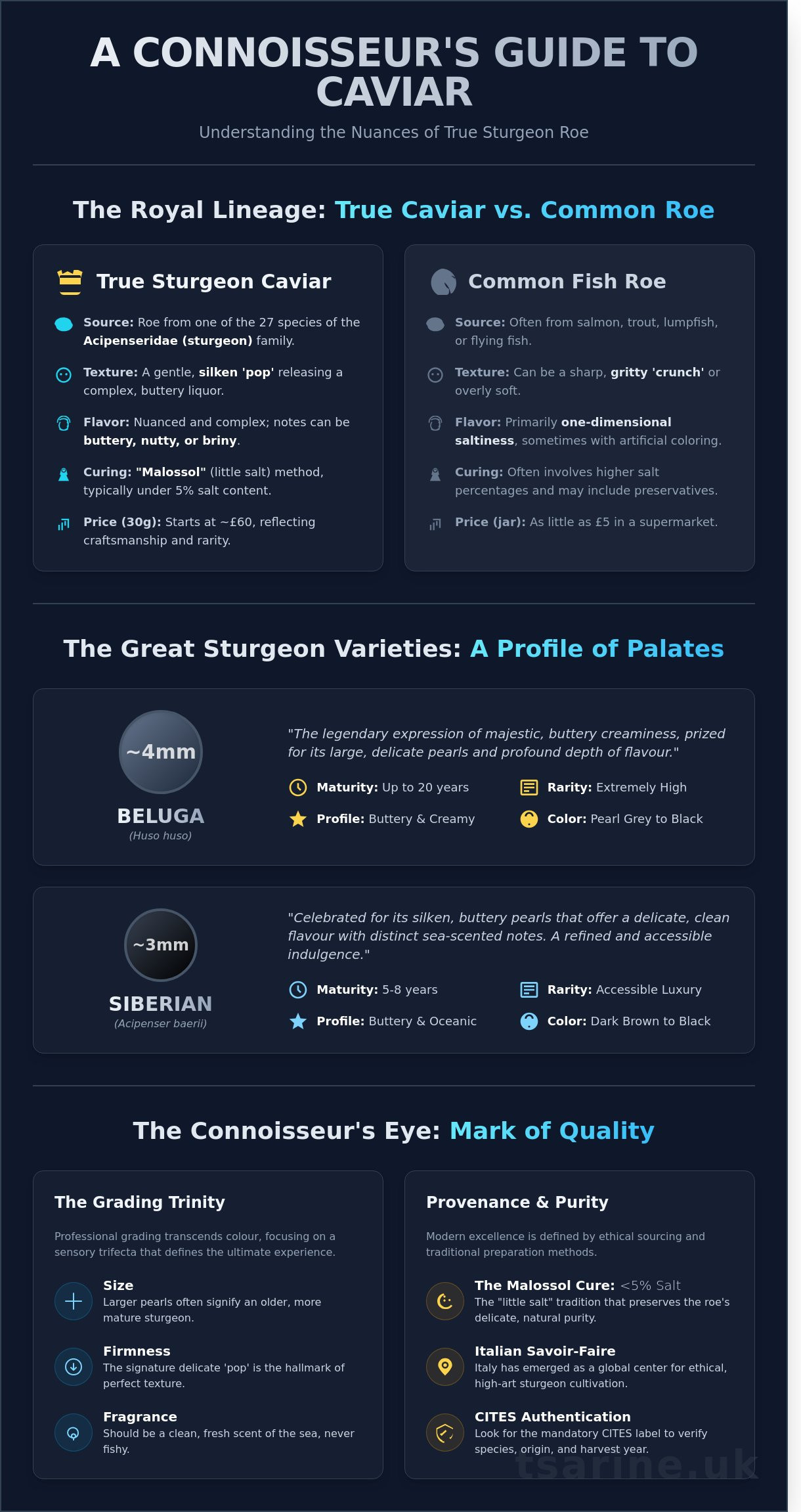
To the true epicurean, the word caviar evokes a specific, regal lineage that traces its roots back to the icy, deep waters of the Northern Hemisphere. While the term is often used loosely in modern gastronomy, the history and definition of caviar strictly limit this prestigious designation to the salted roe of the Acipenseridae family. This ancient family consists of 27 species of sturgeon, each possessing a unique genetic signature that dictates the size, colour, and flavour profile of the pearls they produce. When you explore the various types of caviar, you aren't merely tasting fish eggs; you're partaking in a culinary legacy that was once the exclusive preserve of the Russian Tsars and European royalty.
The Tsarine spirit dictates that the source of the roe defines its ultimate character, much like the terroir of a prestigious vineyard shapes the soul of a vintage champagne. This philosophy treats each tin as a vessel of history, where the water quality and the specific subspecies of sturgeon create a sensory narrative of elegance and grace. It's this dedication to origin that separates a masterpiece from a mere commodity. Malossol serves as the traditional 'little salt' curing method that preserves the roe's natural purity and delicate oceanic essence by ensuring the salt content remains below 5 per cent.
The Sturgeon Family: An Ancient Heritage
Sturgeons are remarkable living fossils that have remained largely unchanged for over 250 million years, surviving the extinction of the dinosaurs to grace the imperial tables of the 18th century. Their rarity stems from a biological patience that defies modern industrial speeds. Some species, such as the Beluga, require up to 20 years to reach maturity before they produce their first harvest of roe. This slow maturation creates a depth of flavour that's impossible to replicate. The Master Curer acts as a guardian of this lineage, using a refined savoir-faire to balance the delicate pearls with precise salinity, ensuring the heritage of the fish is honoured in every spoonful.
Caviar vs. Roe: Understanding the Hierarchy
The distinction between authentic sturgeon caviar and common fish roe is a matter of both law and sensory artistry. While salmon roe, often called red caviar, offers a vibrant aesthetic, it belongs to a different culinary category entirely. The experience of authentic sturgeon pearls is defined by a gentle, silken 'pop' that releases a complex, buttery liquor, whereas lesser varieties like lumpfish or flying fish roe often present a sharp, gritty 'crunch' and a one-dimensional saltiness. In the United Kingdom, discerning collectors must look for the CITES (Convention on International Trade in Endangered Species) label on the reverse of the tin. This mandatory coding identifies the species, country of origin, and harvest year, providing a transparent trail of prestige. You'll find that while a jar of lumpfish roe might cost as little as £5 in a local supermarket, a 30g tin of genuine Oscietra begins at approximately £60, reflecting the immense craftsmanship and time invested in its creation. Distinguishing between the 27 species and their types of caviar allows the connoisseur to navigate this hierarchy with the confidence of a seasoned host.
The Great Sturgeon Varieties: A Comparison of Profiles and Palates
The landscape of luxury in 2026 demands a profound understanding of provenance and the delicate biology that shapes each pearl, inviting the discerning palate to appreciate the artistry behind every harvest. When you explore the various types of caviar, you're engaging with a tradition that mirrors the meticulous ageing of a fine vintage from the House of Chanoine Frères, a legacy of excellence established in 1730. The final aromatic profile of the roe is a direct reflection of the sturgeon’s environment, where water temperatures maintained between 11°C and 14°C ensure the fat remains clean and the texture remains firm. Diet plays an equally vital role; sturgeons raised on natural, protein-rich nutrients develop those coveted creamy notes, while those mirroring wild conditions offer a sharper, oceanic saltiness. For those beginning this journey, this guide to caviar provides an excellent foundation for understanding how these nuances manifest on the palate. Understanding the different types of caviar is akin to mastering the nuances of a grand cru, where every detail contributes to a larger, more enchanting narrative of flavour.
Siberian Sturgeon (Acipenser Baerii): The Classic Choice
Siberian caviar is the favoured entry point for the modern gourmet, offering an accessible yet deeply refined experience that resonates with timeless elegance. Its beads are typically smaller, measuring between 2.2mm and 2.7mm, and possess a dark, glossy allure that hints at the clean, savoury depths within. You'll find a subtle whisper of woodland nuts and a finish that's remarkably pure, making it an ideal companion for a glass of Tsarine Brut. The Baerii’s delicate grain size requires a gentle touch, as the eggs are soft and yield easily to the tongue, releasing a burst of salt-kissed sophistication that feels both heritage-rich and contemporary.
White Sturgeon (Acipenser Transmontanus): The Creamy Elegance
Acipenser Transmontanus represents a bridge between continents, a North American heritage that has been perfected within the sophisticated aquaculture systems of Europe to produce a roe of unparalleled silkiness. These beads are larger and more velvety than their Siberian counterparts, ranging in colour from charcoal to a deep, resonant brown. The defining characteristic is a rich, buttery finish that lingers, a hallmark of the creamy profile that has become a symbol of modern elegance and poise. You may discover the specific charm of this variety on our dedicated White Sturgeon page, where the craftsmanship of the harvest is celebrated in detail, guiding you through its buttery depths and luxurious texture.
Beluga and Oscietra: The Legends of the Caspian
The legendary Beluga, or Huso Huso, remains the zenith of opulence, famous for its massive, steel-grey pearls and a texture so delicate it practically dissolves upon contact. While wild harvesting was strictly restricted by CITES in 2005 to protect these ancient giants, sustainable farming now produces alternatives that maintain that imperial grandeur without compromise. Oscietra, the Acipenser Gueldenstaedtii, is often the true connoisseur’s choice for its complex, fruity, and nutty depths. These eggs are firm and explode with a multifaceted flavour that demands a slow, deliberate tasting. They offer a sensory tapestry that evolves from a bright, briny start to a deep, toasted finish, embodying the very spirit of a Tsarine celebration.
The Tsarine collection acts as a curated journey through these species, ensuring that each tin reflects the soul of the sturgeon and the prestige of the House. Whether you prefer the clean precision of the Baerii or the majestic complexity of the Oscietra, each selection is a tribute to the harmony of nature and human savoir-faire.
The Connoisseur’s Eye: Deciphering Caviar Grades, Colours, and Cures
To truly understand the various types of caviar, one must approach the tin with the same reverence a guest might feel when entering the Winter Palace in 1730. Experts grade these precious pearls through a meticulous organoleptic process, focusing on the bead diameter, which typically ranges from 2.5mm to 3.8mm, and the clarity of the scent. A pristine tin should never smell of the sea; instead, it offers a faint, clean fragrance reminiscent of a fresh breeze over the Caspian. Grade 000 refers to the lightest coloured, most mature eggs in the sorting process.
While many novices chase the elusive golden bead, seasoned tasters know that colour is a matter of aesthetic preference rather than a strict hierarchy of quality. Dark, lustrous charcoal pearls often possess a depth of nutty complexity and a mineral finish that rivals the buttery sweetness of amber varieties. The sensory journey culminates in the "finish," a lingering aftertaste that should remain on the palate for several minutes. A high-quality selection leaves a clean, creamy residue without any trace of bitterness or metallic tang.
- Size: Larger beads, such as those from the Beluga, are often prized for their dramatic presence.
- Firmness: The egg must resist the tongue slightly before releasing its essence.
- Fragrance: A delicate, mossy, or nutty bouquet indicates superior handling.
- Lustre: The surface should shimmer like a polished gemstone under soft light.
The Spectrum of Colour: From Jet to Gold
Natural variation within a single species is a marvel of biology, influenced by the age of the sturgeon and its specific diet. The "Royal" or "Imperial" designations aren't merely marketing terms; they represent the rarest 5% to 10% of the harvest, featuring lighter hues of pale silver or warm gold. For the house of Tsarine, the visual beauty of the tin is the first step in a sensory experience. It mirrors the golden effervescence of a fine cuvée. These rare shades evoke a sense of imperial grandeur, yet the dark, obsidian eggs remain emblematic of the classic, robust caviar profile that many purists still favour for its intense brine.
Texture and Consistency: The Architecture of a Bead
The tactile experience of caviar is defined by the "pop," a structural release of flavour that occurs when the egg wall yields to the palate. Individual pearls should remain distinct and never mushy. This "egg separation" is a hallmark of expert processing. The Malossol cure, meaning "little salt" in Russian, typically involves a salt content of less than 3.7%. This delicate balance preserves the integrity of the membrane. Over time, the salt interacts with the fats in the roe to create a silkier texture. If the salt exceeds 5%, the delicate architecture of the bead collapses, resulting in a product that lacks the finesse required for a truly prestigious tasting. Each bead should feel like a tiny, liquid-filled jewel that demands to be savoured slowly.
Selecting between different types of caviar requires a refined palate and an appreciation for the artisan's savoir-faire. Whether you prefer the bold, dark intensity of a Siberian sturgeon or the creamy, light-hued elegance of an Albino Sterlet, the quality is found in the harmony of the cure and the freshness of the harvest. In the United Kingdom, where the luxury market demands transparency, look for CITES labelling to ensure your selection meets the highest standards of sustainability and heritage.
The Modern Renaissance: Sustainable Sourcing and the Italian Savoir-Faire
The transition from the wild, untamed waters of the Caspian to the meticulously managed estates of Europe marks a pivotal chapter in the history of this delicacy. Since the 1998 CITES regulation placed all 27 sturgeon species under international protection, the industry has undergone a profound transformation. Italy has emerged as the undisputed heart of this movement, producing over 50 tonnes of premium roe annually. In the fertile plains of Lombardy, the sturgeon finds a sanctuary that mirrors its ancestral home. Here, the crystalline waters of the Alpine springs flow through controlled environments, ensuring the fish thrive in conditions of absolute purity. This commitment to excellence reflects the Tsarine spirit, where French refinement meets the rigorous standards of Italian aquaculture to create a product of unparalleled grace.
Choosing sustainable pearls isn't merely an ethical decision; it's a pursuit of consistency and finesse that wild-caught varieties could rarely guarantee. Modern connoisseurs understand that the environment dictates the flavour. By mimicking the natural riverbeds and maintaining precise oxygen levels, Italian artisans produce types of caviar that possess a clean, creamy finish devoid of the muddy undertones often found in unregulated sources. This controlled harmony allows the natural character of the Siberian or Ossetra sturgeon to shine with a brilliance that evokes the imperial banquets of the 18th century.
From Farm to London: A Traceable Journey
Authenticity is the cornerstone of the Tsarine experience. Every tin arriving in London carries a mandatory CITES code, a biological passport that details the species, source, and harvest year. Since 2006, this universal labelling system has ensured that 100% of our selection is fully traceable. We utilise non-invasive ultrasound technology to monitor fish health, ensuring each sturgeon reaches peak maturity before harvest. This blend of science and tradition ensures that "sustainable" remains the ultimate benchmark for luxury in the United Kingdom's discerning market.
The Art of the Italian Cure
The secret to the exquisite texture of our selection lies in the Italian mastery of the Malossol technique. This traditional "little salt" method requires a delicate touch, using less than 4% salt to preserve the egg's structural integrity while enhancing its complex bouquet. Our London headquarters operates a seamless cold-chain logistics network, maintaining a constant temperature of -2°C from the Italian atelier to your doorstep. This precision ensures the effervescence of the sea remains intact. You can explore our dedication to these environmental standards through our Sustainable Indulgence pillar.
Tsarine treats every harvest as a vintage, a unique expression of time and terroir. The synergy between the Italian landscape and our French heritage creates a sensory journey that is both timeless and responsible. We don't just offer a product; we invite you to partake in a legacy of conservation. By prioritising these ethical pathways, we ensure that the different types of caviar remains a symbol of celebration for generations to come, mirroring the enduring elegance of our iconic fluted bottles.
Experience the height of ethical luxury by exploring our curated selection at Tsarine Caviar.
Selecting Your Signature: A Guide to Choosing Caviar for Every Occasion
Selecting the perfect accompaniment for a London evening requires an appreciation for the subtle harmonies between the sea and the cellar. Whether you're hosting an assembly of twenty distinguished guests or a private moment for two, the various types of caviar you present will define the atmosphere of the occasion. A host must consider the weight of the menu; a delicate starter demands the finesse of a lighter roe, while a bold main course allows for a more assertive, briny profile. For a gathering of ten people, a 250g tin provides a lavish centrepiece that invites conversation and shared delight. Every selection is an invitation to step into a world of imperial grandeur, where the legacy of the Russian court meets the modern elegance of a Mayfair townhouse.
The ritual of service is as vital as the selection itself. In the United Kingdom, luxury catering standards suggest allocating between 30g and 50g per person for a dedicated tasting course. When the guest list grows, the logistical grace of the service becomes paramount. You'll find that the most successful events are those where the host treats the delicacy not merely as food, but as a guest of honour. This perspective ensures that every detail, from the ambient temperature of the room to the weight of the glassware, aligns with the prestige of the pearls being served.
The Intimate Evening vs. The Grand Soirée
For a romantic encounter under the soft flicker of candlelight, the White Sturgeon offers a buttery, velvet texture that whispers of quiet luxury. Its mildness doesn't overwhelm the palate, making it a sublime partner for the crisp effervescence of a Tsarine Cuvée. Conversely, the Siberian Sturgeon is the vibrant heart of a grand soirée. Its darker pearls and robust, earthy notes stand firm when served atop blinis or intricate canapés at a cocktail party. To truly honour the Tsarine spirit, serve your selection alongside a carafe of vodka chilled to exactly -18°C, or a bottle of prestige Champagne kept in a silver bucket at 8°C. This ensures the temperature contrast elevates the sensory experience to a high art.
The Art of Gifting Premium Caviar
Presenting a gift of sturgeon roe is an act of profound respect and sophisticated storytelling. A luxury set should always include Mother of Pearl spoons, as metal utensils can oxidise the delicate oils and tarnish the pure flavour of the pearls. Look for collections that provide elegant cooling accessories to maintain the optimal temperature of 0°C to 4°C during transit and presentation. When you choose a variety for a friend, consider their culinary journey; a seasoned connoisseur will cherish the complexity of an Oscietra, while a newcomer may prefer the accessible creaminess of a Baeri. It's a gesture that transcends the material, offering a moment of pure, ephemeral beauty. You can Discover our curated Luxury Gift Sets for London delivery to find the perfect expression of your esteem.
Each tin is a Tsarine in her own right, a regal presence that demands to be savoured with deliberate grace. Treat every opening of a lid as a coronation of the senses. The ritual of the first taste, the gentle pop of the grain, and the lingering finish are all parts of a heritage that spans centuries. In the quiet moments of a London night, these treasures remind us that true luxury is found in the harmony of craftsmanship and history. As you explore the different types of caviar, remember that you aren't just consuming a product. You're participating in a timeless celebration of excellence that has graced the tables of empresses and connoisseurs since the 18th century.
Embrace the Imperial Legacy of Your Next Celebration
Mastering the nuances of the various types of caviar transforms a simple tasting into a storied ritual of sensory delight. You've explored the delicate lineage of true sturgeon, the intricate grading of colours, and the sustainable Italian savoir-faire that defines the modern renaissance of this 18th-century craft. Selecting the perfect roe isn't merely about taste; it's about a harmony of texture and heritage that elevates every shared moment into a high-art experience. Our collection, sourced from 100% sustainable Italian farms and expertly curated within the heart of London, offers a prestige that's both rare and inviting.
Each selection is presented in our iconic fluted aesthetic, mirroring the grace of the Russian empresses who once graced the imperial courts. Whether you're hosting a grand gala or an intimate evening, our commitment to quality ensures a world of finesse is delivered directly to your door. We provide next-day delivery across the UK to ensure your celebration never loses its effervescence. Explore the Exquisite Tsarine Collection and Order for London Delivery to begin your own chapter of this timeless narrative. It's time to savour the craftsmanship you deserve.
Frequently Asked Questions
What are the four main types of caviar available today?
The four quintessential types of caviar that grace the tables of the world's most discerning hosts are Beluga, Oscietra, Sevruga, and the delicate Sterlet. While scientists recognise 27 distinct species of sturgeon, these four varieties represent the pinnacle of luxury and historical prestige. Each pearl offers a unique sensory journey, from the large, velvet-soft grains of the Huso huso to the smaller, intensely flavoured beads of the Sevruga.
Which type of caviar is considered the most expensive and why?
Beluga caviar remains the most expensive variety in the United Kingdom, often commanding prices upwards of £8,000 per kilogram due to its extreme scarcity. The Huso huso sturgeon requires a minimum of 20 years to reach maturity. This lengthy biological cycle, combined with strict CITES quotas established in 2000, ensures that every tin of Beluga is a rare and precious treasure that's savoured by royalty and connoisseurs alike.
What is the difference between Beluga and Oscietra caviar?
The primary distinctions between Beluga and Oscietra lie in the size of the pearl and the complexity of the aromatic profile. Beluga offers a grand, buttery texture with large grains that melt effortlessly on the palate, whereas Oscietra provides a firmer pop and a sophisticated, nutty finish. While Beluga takes 20 years to harvest, Oscietra sturgeon mature in 9 to 11 years, resulting in a more varied palette of amber and bronze hues.
Is there a difference in taste between black and golden caviar?
There's a profound difference in taste between these hues, as golden caviar typically possesses a creamier, more subtle profile compared to the mineral-rich intensity of darker varieties. Rare golden pearls, such as those from the Albino Sterlet, are prized for their delicate finesse and lack of traditional brininess. These golden eggs often come from sturgeon aged over 60 years, making them an emblematic choice for celebrations where only the most refined flavours will suffice.
How can I tell if the caviar I am buying is real sturgeon caviar?
You can verify the authenticity of your purchase by examining the CITES label on the bottom of the tin, which has been a mandatory requirement for all legal trade since 1998. This specific code identifies the species, such as 'GUE' for Siberian or 'HUS' for Beluga, alongside the country of origin and the year of harvest. Real sturgeon roe will also have a distinct 'eye' or dark spot within each translucent pearl, a feature absent in many imitations.
What does 'Malossol' mean on a caviar tin?
On a caviar tin, 'Malossol' is a traditional Russian term meaning 'little salt', indicating that the roe has been preserved using the most delicate methods. This process requires a salt content of less than 3.7% to ensure the natural, sophisticated flavours of the various types of caviar remain the focal point of the experience. It represents a commitment to craftsmanship, allowing the pure, oceanic essence of the sturgeon to shine without the distraction of excessive salinity.
Which type of caviar is best for a first-time taster?
For those embarking on their first sensory exploration of this delicacy, a refined Siberian Baerii or a classic Oscietra offers the most welcoming introduction. These varieties provide a harmonious balance of sea-salt freshness and creamy richness. Starting with a 30-gram tin allows the novice to appreciate the subtle nuances of the pearls. It's best paired with a glass of chilled champagne to cleanse the palate between bites.
How long does fresh caviar last once the tin is opened?
Once you've opened a tin of fresh sturgeon roe, it's best to consume the contents within 48 hours to preserve its delicate texture and aromatic finesse. For the best experience, keep the tin nestled in a bed of crushed ice at a temperature between -2°C and 2°C. After 72 hours, the delicate membranes of the pearls begin to soften, and the pristine, clear flavours that define high-quality caviar will start to diminish.