
What Does Caviar Taste Like? A Beginner's Guide to Its Exquisite Flavour
The world of fine caviar is one of whispered reverence and exquisite allure, yet for many, it remains an intimidating mystery. The fear of a simple, overwhelmingly salty taste, or the apprehension of investing a significant sum in an unknown pleasure, can often prevent one from partaking in this celebrated ritual. But to truly understand what does caviar taste like is to embark on a sensory journey far beyond these common misconceptions, into a realm of profound complexity and delicate finesse that has captivated connoisseurs for centuries.
In this guide, we shall demystify the experience, unveiling the delicate, buttery, and nutty notes that define true sturgeon roe. We will explore the subtle 'Caspian pop' of its texture and the elegant, lingering finish that has earned its place as the ultimate delicacy. Prepare to have your perceptions transformed as we reveal the harmonious flavours that await, empowering you with the confidence to select and savour this imperial treasure for the very first time.
Key Takeaways
- Discover that true sturgeon caviar transcends mere saltiness, offering instead a delicate harmony of buttery, nutty, and oceanic notes that linger elegantly on the palate.
- The authentic caviar experience is as much a textural delight as it is a gustatory one, defined by the signature, delicate 'pop' of each pearl rather than any unwelcome consistency.
- To truly understand what does caviar taste like, one must explore the unique symphony of flavours offered by different sturgeon species, each revealing a distinct profile shaped by its heritage.
- Master the art of appreciation with simple tasting rituals that allow you to discern the intricate nuances of this delicacy, ensuring your first encounter is one of pure refinement.
The First Impression: Deconstructing the Core Flavours of Caviar
To truly appreciate the answer to the question, what does caviar taste like?, one must first set aside the persistent and misguided myth of an overpowering, brash saltiness. Instead, one should envision a sensory experience more akin to the reverent appreciation of a vintage champagne or a perfectly aged Comté cheese. It is a sublime journey of evolving complexity, a delicate harmony where the subtle aroma and the signature, gentle 'pop' of the pearls are as integral to the moment as the taste itself. The experience is never a singular, static note, but a magnificent symphony of nuanced flavours that unfold gracefully upon the palate.
A Breath of the Sea: The Briny Essence
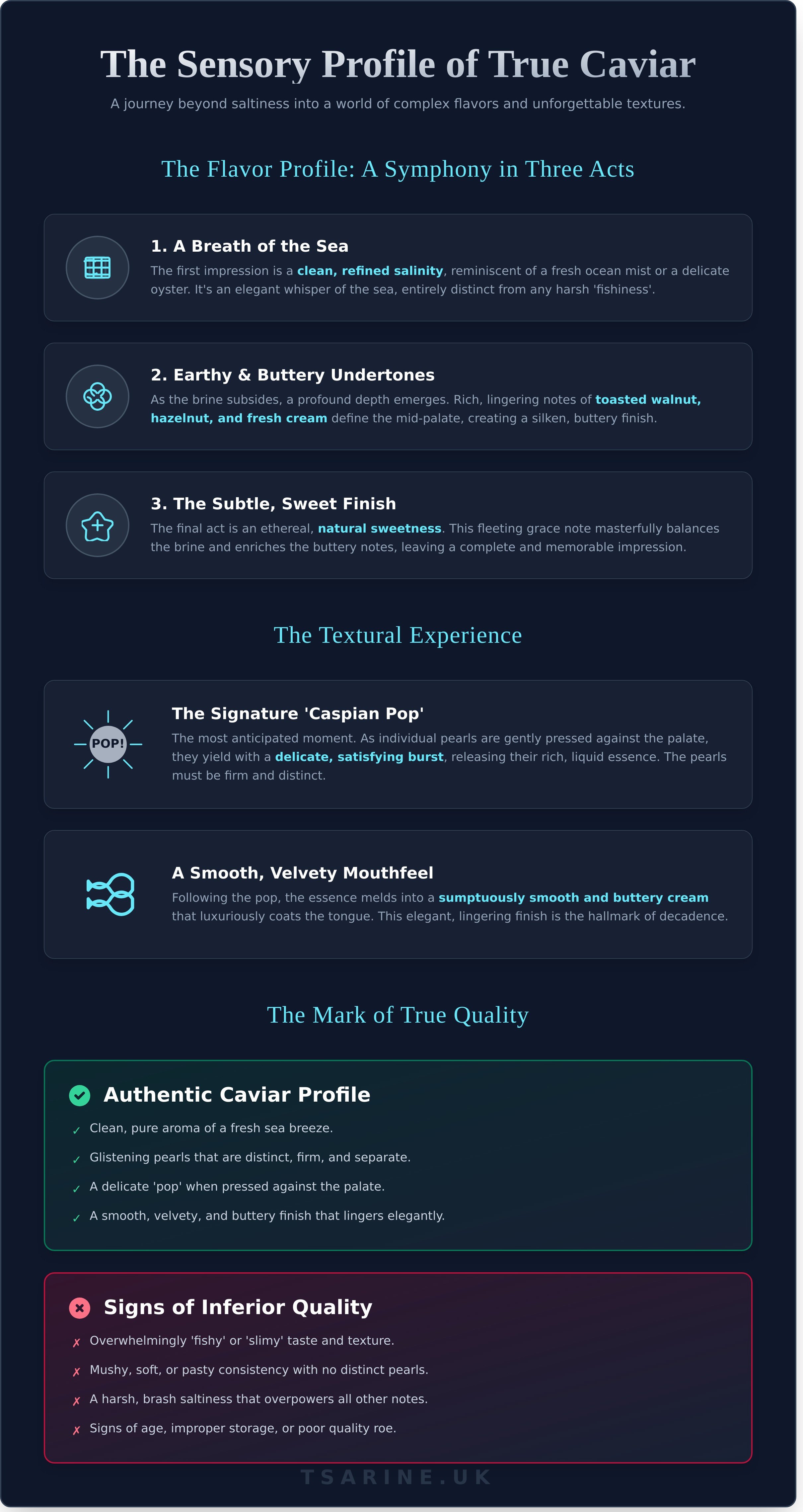
The very first impression to grace the senses is a pure, clean salinity-not a coarse wave of salt, but rather the refined and invigorating essence of a fresh ocean mist or the delicate brine of a freshly shucked oyster. This elegant whisper of the sea is an authentic reflection of the sturgeon’s pristine aquatic origins, a flavour profile that is entirely distinct from any pronounced or undesirable 'fishiness', offering instead a sophisticated and uplifting opening note.
The Earthy Undertones: A Hint of Nuts and Butter
As this initial maritime freshness gently subsides, a remarkable and profound depth begins to reveal itself on the mid-palate. This is the moment where the true, emblematic character of superior caviar emerges, unfurling with rich, lingering notes of toasted walnut, delicate hazelnut, or even the silken smoothness of fresh, cultured cream. This buttery, lingering finish, a testament to the meticulous savoir-faire involved in its preparation, is precisely what distinguishes an exceptional tasting. For those wishing to delve into the heritage of this delicacy, understanding the answer to 'What is Caviar?' provides a fascinating context for its celebrated complexity.
A Subtle Sweetness: The Delicate Finish
The final, enchanting element in this magnificent flavour composition is a subtle, almost ethereal sweetness that brings the entire experience into perfect equilibrium. This is not an artificial flavour derived from additives, but a natural, intrinsic quality of the finest roe. It is a fleeting grace note that masterfully balances the initial brine and enriches the buttery undertones, leaving a rounded, complete, and utterly memorable impression that connoisseurs cherish as the signature of true finesse.
Beyond Taste: The Unforgettable Texture and Signature 'Pop'
To truly comprehend the sensory world of this imperial delicacy, one must look beyond flavour alone. The question of what does caviar taste like is answered as much by its extraordinary texture as by its taste. It is a duet of sensation, where the physical form of the roe is inextricably linked to the unfolding of its flavour-a journey that begins the moment the pearls grace your palate and culminates in a finish of unparalleled elegance.
The Sensation of the 'Caspian Pop'
The most anticipated moment of any caviar tasting is the signature 'Caspian Pop', often enjoyed at home thanks to premium caviar delivery London services that guarantee freshness. This is the first act in a magnificent performance. As the individual, glistening pearls are gently pressed against the roof of your mouth, they yield with a delicate and satisfying burst. This is not a confrontation but a graceful release, liberating the rich, liquid essence held within each perfect sphere. The pearls must remain distinct and firm until this point; any hint of softness or mushiness signals a departure from the standards of true craftsmanship.
A Smooth, Velvety Mouthfeel
Following this delightful effervescence, the caviar transforms, revealing a second, more languid character. The contents of the pearls meld into a sumptuously smooth and buttery cream that luxuriously coats the tongue. This velvety finish, entirely devoid of the coarse or grainy quality found in lesser roe, is what imparts that profound sense of decadence. It creates a long, elegant finish that lingers with exquisite subtlety, a testament to the sturgeon's pristine environment and the master's art.
Why True Caviar is Never 'Fishy' or 'Slimy'
A common apprehension among novices is the fear of an overwhelmingly 'fishy' taste or an unpleasant, 'slimy' consistency. Allow us to reassure you: these are not the calling cards of authentic, high-grade caviar. Such undesirable traits are unequivocal signs of inferior quality, improper storage, or age. True, fresh caviar offers a clean, pure aroma reminiscent of a fresh sea breeze, and its texture is a delicate balance of firmness and fragility. While the vast array of Different Types of Caviar each possess their own unique character, what unites them at the highest level of quality is this pristine profile-a world away from the mass-market roe that has unfortunately shaped these common misconceptions.
A Symphony of Flavours: How Different Sturgeon Caviars Compare
To truly understand what does caviar taste like, one must appreciate its profound diversity, much like a connoisseur distinguishes between the noble grape varieties of Champagne. Each sturgeon species, shaped by its unique lineage, age, and the aquatic terroir it inhabits, yields pearls with a distinct personality and a singular flavour profile. The world of sturgeon is vast and fascinating, as detailed in Britannica's guide to caviar, and exploring it reveals a spectrum of sensory delights. At TSARINE Caviar, we have curated a selection that represents the pinnacle of this diversity, allowing you to discover the nuances that define true luxury.
Siberian Sturgeon (Acipenser Baerii): Crisp, Clean, and Nutty
For those beginning their journey into this exquisite world, the Siberian Sturgeon offers a most graceful introduction. Its flavour is defined by a beautiful clarity-a clean, crisp profile with remarkably pure notes of toasted hazelnut and a whisper of the sea. The pearls, a constellation of dark grey to near-black, possess a satisfyingly firm texture that yields a gentle pop upon the palate. It is an expression of straightforward elegance, a perfect harmony of taste and texture. Explore the refined taste of our Siberian Sturgeon Caviar.
White Sturgeon (Acipenser Transmontanus): Buttery, Mild, and Delicate
The White Sturgeon presents a study in sublime subtlety and creamy indulgence. Celebrated for its exceptionally smooth character, this caviar features generously sized, glistening pearls that melt in the mouth with very little salinity. Its taste is gentle and mild, unfolding into a long, lingering finish of pure butter and cream. This variety is a testament to finesse, an ideal choice for the discerning palate that appreciates a more delicate and nuanced experience.
The Legendary Beluga: A Benchmark of Creaminess
No exploration of caviar would be complete without acknowledging the legendary Beluga, the historical benchmark against which all others are measured. Famed for its exceptionally large, delicate pearls and an incomparably creamy, buttery flavour, Beluga has long been the epitome of indulgence. Due to the critically endangered status of the Huso huso sturgeon, wild Beluga is a protected treasure. This heritage of unparalleled creaminess, however, continues to inspire the world of aquaculture, paving the way for magnificent and sustainable alternatives that honour its legacy while protecting its future.
Your First Taste: How to Appreciate Caviar's Nuances
Embarking on your first caviar experience is to partake in a storied ritual, a moment of sensory discovery far removed from rigid rules. The journey to understanding what does caviar taste like begins not with a complex recipe, but with a simple, elegant ceremony. The true art lies not in strict etiquette but in creating an atmosphere where the caviar’s soul can be fully expressed, empowering you with the savoir-faire to appreciate every subtle nuance with confidence and grace.
The Purist's Method: The 'Caviar Bump'
For the connoisseur seeking the most unadulterated expression of flavour, the ‘caviar bump’ is an emblematic tradition. A small spoonful is placed upon the clean, delicate skin between the thumb and forefinger, where your body's gentle warmth coaxes the pearls to release their ethereal aromas. Before tasting, observe their lustre. Then, allow the glossy beads to roll upon your tongue, sensing their texture, before gently pressing them against the roof of your mouth to release that signature, exquisite burst of the sea.
Serving Temperature and Utensils
The delicate character of fine caviar demands a certain reverence in its presentation. It should always be served exquisitely chilled, nestled upon a bed of crushed ice, yet never frozen, which would irrevocably damage the fragile eggs. Of paramount importance is the choice of utensil; reactive metals such as silver or steel can impart an undesirable metallic taste, tarnishing the caviar's purity. Instead, one must choose a traditional, non-reactive spoon crafted from mother-of-pearl, bone, or gold to ensure the tasting experience remains pristine.
Classic Pairings That Elevate, Not Overwhelm
While a purist’s tasting reveals the fundamental character of caviar, classic accompaniments can create a beautiful harmony. Light, fluffy blinis with a touch of crème fraîche provide a neutral, creamy canvas that allows the caviar’s salinity to shine without competition. For a first encounter, we advise setting aside assertive flavours like raw onion or lemon. Instead, embrace a pairing steeped in imperial tradition: a measure of crisp, chilled vodka or, for an experience of unparalleled elegance, a glass of fine brut Champagne. The fine, persistent effervescence beautifully cleanses the palate, preparing you for the next delightful spoonful and elevating the entire occasion into a true celebration. Discovering the perfect cuvée to accompany your tasting is a journey in itself, and the Tsarine collection offers a magnificent starting point.
This principle of elevating a meal into a celebration extends to all fine dining. For those inspired by the delicate flavors of the ocean, you can discover Baan Dum Oceanfront Seafood, a restaurant that exemplifies this philosophy through its historic setting and exquisite dishes.
An Invitation to a World of Sensory Delight
To truly understand what does caviar taste like is to move beyond a simple description of saltiness, embracing instead a complex harmony of rich, buttery notes and a subtle, nutty finish. We have seen how its true character is revealed not only in its flavour but in the delicate, signature 'pop' of each pearl upon the palate, and how this symphony of sensations varies with magnificent subtlety from one sturgeon to the next.
This exploration is, however, merely the beginning of a profound sensory journey. As specialists in the finest Siberian and White Sturgeon caviars, we extend a personal invitation to experience this luxury firsthand. Our commitment to excellence is reflected in our sustainably and ethically farmed pearls from Italy, brought to you from our London home with elegant and reliable delivery across the UK. The next chapter of your epicurean story awaits.
Discover the world of exquisite flavour with our curated caviar collection.
Frequently Asked Questions About the Taste of Caviar
Is caviar supposed to taste very 'fishy'?
Contrary to a common misconception, the finest sturgeon caviar should never present an overtly 'fishy' aroma or taste. Instead, its profile is one of remarkable subtlety and finesse, a delicate whisper of the pristine waters from which it came. A truly superior caviar offers a clean, fresh bouquet reminiscent of a gentle sea breeze, culminating in a complex, buttery, and nutty finish that lingers gracefully on the palate. Any overpowering fishiness is often an unfortunate indicator of lesser quality or improper handling.
Why is some caviar much saltier than others?
The varying levels of saltiness in caviar are a direct reflection of the traditional preservation method and the artisan's touch. The most coveted preparations are labelled 'malossol,' a Russian term meaning 'little salt,' where only a minimal amount is used to gently cure the eggs and enhance their intrinsic flavour. More heavily salted varieties are often prepared to extend their preservation, a practice which, while effective, can sometimes mask the delicate, nuanced harmony of the roe itself.
What is the best type of caviar for a beginner to try first?
For those embarking on their first caviar journey, Siberian Sturgeon (Acipenser baerii) offers a most welcoming and harmonious introduction. Its medium-sized, dark pearls present a wonderfully balanced flavour profile, with clean, buttery notes and a subtle hint of nuttiness that is both accessible and deeply satisfying. This variety provides a quintessential experience for understanding what does caviar taste like, allowing the palate to appreciate the celebrated texture and refined taste without being overwhelmed.
How is the taste of true sturgeon caviar different from salmon or trout roe?
The distinction lies in a profound complexity and finesse. While salmon and trout roe offer a delightful, straightforward burst of salty flavour with larger, firmer eggs, true sturgeon caviar presents a far more intricate sensory tapestry. The smaller, more delicate pearls melt on the tongue, releasing a layered, evolving flavour that can range from creamy and nutty to briny and rich. It is this sublime, lingering finish that separates it and defines the true caviar experience.
Is the high price of caviar really justified by its flavour?
The considerable price, often upwards of £50 for a small tin in the UK, is a reflection not merely of flavour, but of immense rarity, time, and meticulous craftsmanship. Sturgeon require many years, sometimes decades, to mature before they can produce roe, a patient journey that cannot be rushed. This, combined with the artisanal expertise required for harvesting and curing, elevates caviar from a simple food to an emblem of celebratory luxury, where the price signifies an investment in an unparalleled sensory experience.
How can I tell if caviar is good quality just by looking at it?
A visual appraisal can reveal much about the caviar's quality. Seek out individual pearls, or 'berries,' that are distinct, firm, and whole, not appearing crushed, mushy, or overly oily. The surface should possess a brilliant, lustrous sheen, like polished gems, indicating freshness and proper handling. High-quality caviar will have a consistent colour and size, with the pearls gently separating when the tin is tilted-a testament to the care taken from harvest to presentation.