
What is Caviar? A Connoisseur’s Guide to the Jewel of the Sea
Not all that glistens is gold, and certainly, not all that is roe can be called caviar. It’s a world shrouded in mystique, where confusing terminology and the fear of a costly misstep can overshadow the pure sensory delight of the experience. You are right to seek clarity, to desire an encounter that honours the centuries of tradition behind this legendary indulgence, a delicacy once reserved for the tables of Russian Tsars and prized above almost all others.
This connoisseur’s guide promises to answer the fundamental question of what is caviar, illuminating the storied history, refined biology, and sensory artistry that define this jewel of the sea. Together, we will uncover the nuances that distinguish true sturgeon caviar, from the legendary Beluga to the golden Osetra, ensuring you can select and savour each precious, glistening pearl with the grace and absolute confidence of an expert.
Key Takeaways
- Grasp the definitive answer to what is caviar, understanding its exclusive origin from the noble sturgeon family and its storied ascent into luxury.
- Learn to discern with a connoisseur's confidence the difference between true caviar and other fish roe by identifying their unique visual and textural characteristics.
- Develop your palate by discovering the sensory markers of excellence, from the diverse, jewel-like hues of the grains to the signature textural 'pop' that defines the finest quality.
- Understand the importance of sustainable craftsmanship in the modern era and how ethical aquaculture ensures the future of this revered delicacy for gourmets in the United Kingdom and beyond.
Defining the Jewel: What Exactly is Caviar?
To truly understand what is caviar is to appreciate a culinary jewel steeped in millennia of tradition, a delicacy whose name alone conjures images of imperial courts and extravagant celebrations. Its story begins not in a grand ballroom, but on the ancient shores of the Caspian Sea. The term itself is believed to possess Persian roots, derived from khâviyâr, meaning “egg-bearing,” a simple yet poetic descriptor for what would become the world’s most sought-after luxury. At its essence, caviar is the salt-cured roe harvested exclusively from the majestic sturgeon, a prehistoric fish belonging to the Acipenseridae family. It is this noble lineage that separates true caviar from all other fish roes, elevating it to an unparalleled status in global gastronomy.
The Legal and Culinary Distinction
The term "caviar" is not merely a suggestion; it is a legally protected appellation of origin, fiercely guarded by international law to preserve its integrity and prestige. Since 1998, regulations enforced by bodies such as CITES (the Convention on International Trade in Endangered Species of Wild Fauna and Flora) have mandated that only the roe from sturgeon can be marketed and sold as caviar. This ensures that when you see the name, you are guaranteed an authentic experience. Roe from other fish, such as salmon or trout, must be identified by the species, for instance, "salmon roe." For those seeking a comprehensive overview of caviar and its complex classifications, the legal framework provides a fascinating insight into its protected world. Caviar represents the exquisite culmination of time and tradition, harvested from the ancient sturgeon.
A Brief History of Imperial Grandeur
The journey of caviar from a humble fisherman’s sustenance to an emblem of aristocracy is a narrative of pure romance and refinement. While consumed for centuries by fishing communities along the Caspian and Black Seas, its ascent into legend began with the Russian Tsars. Within the opulent halls of the Russian Court, caviar became synonymous with the "Tsarine spirit," an expression of lavish hospitality and discerning taste, most famously championed by empresses like Catherine the Great. It was the ultimate symbol of power and pleasure, served on ice in magnificent presentations.
Yet, it was the masterful touch of 18th-century French artisans that perfected its delicate preservation, introducing the malossol, or "little salt," method. This refined technique, which uses minimal salt, allowed the nuanced, buttery flavours of the roe to emerge, transforming it into the sophisticated delicacy we cherish today. This evolution mirrors the rise of French savoir-faire in luxury, a period when the great Champagne houses were also establishing their enduring legacies. Through this union of Russian tradition and French craftsmanship, caviar was cemented as an emblematic treasure, a timeless marker of life’s most precious moments.
Looking ahead, the story continues to evolve. The year 2026 is anticipated to mark a new era in caviar appreciation, as many of the world’s leading sustainable aquaculture farms, established following the wild sturgeon trade restrictions of the early 2000s, will see their premier stocks reach optimal maturity. This watershed moment promises a future where this imperial indulgence can be savoured with a clear conscience, heralding a golden age of sustainable luxury.
The Noble Lineage: Which Fish Bestow This Delicacy?
To truly grasp what is caviar, one must first journey back through epochs, to an age when dinosaurs roamed the earth. It is here we meet the sturgeon, an extraordinary creature whose lineage has remained almost unchanged for over 200 million years. This prehistoric "living fossil" is the sole and sacred progenitor of true caviar. Indeed, while many fish produce roe, only the salt-cured eggs of the Acipenseridae family can carry this revered name, a distinction upheld by purists and reinforced by official FDA guidelines.
The life of a sturgeon is a slow, majestic affair, and this patient maturation is inextricably linked to the quality of its roe. A fish that has spent a decade or more, sometimes up to 20 years, navigating cool, pristine waters will yield eggs of unparalleled complexity and a firm, satisfying texture. The environment itself imparts a unique signature; the mineral composition of the riverbed and the ambient temperature of its habitat subtly influence the final bouquet of the roe, creating a nuanced terroir much like that of a fine vineyard. It is this profound connection between the creature and its element that begins the story of flavour long before the tins are ever filled.
In our modern era, a deep respect for this ancient species has given rise to sustainable aquaculture. Farms dedicated to species like the White Sturgeon now allow connoisseurs to indulge with a clear conscience, ensuring this delicacy can be savoured by generations to come without imperilling the wild giants of the Caspian and Black Seas.
The Great Sturgeon Species
While over 27 species of sturgeon exist, a celebrated few are held in the highest esteem by gourmands in London and beyond:
- Siberian Sturgeon (Acipenser Baerii): Hailing from the cold, fresh waters of its namesake region, this caviar is cherished for its bold, nutty profile. The medium-sized, dark grey grains possess an earthy finesse and a clean finish that is both assertive and refined.
- White Sturgeon (Acipenser Transmontanus): A triumph of sustainable American farming, this species offers a buttery, large-grained delight. Its exceptionally smooth, clean flavour and large, pearlescent grey beads make it a sophisticated and approachable choice for both new and seasoned palates.
- Beluga (Huso Huso): The legendary giant of the Caspian Sea, Beluga is the very emblem of caviar. Its scarcity, a result of crucial conservation efforts since 2005, has only amplified its mythic status. Known for the largest and most delicate grains, its flavour is a sublime symphony of creamy, buttery notes that lingers enchantingly.
The Art of Curing: Understanding Malossol
Upon encountering a tin of fine caviar, you will almost certainly see the word "Malossol," a hallmark of premium sturgeon caviar craftsmanship This is not a type of sturgeon but a time-honoured Russian method that translates to "little salt." It signifies the highest grade of caviar, where the salt content is meticulously kept below 5%, and often as low as 3.5%. Here, salt is not a blunt preservative but a delicate catalyst, used with an artist’s precision to awaken and enhance the roe's intrinsic flavours. The craft requires immense savoir-faire; too little salt and the flavour remains dormant, too much and the gossamer-thin membrane of each precious grain is compromised. This delicate balance, which preserves the signature "pop" and creamy essence of the roe, finds its perfect partner in the crisp effervescence of a prestige cuvée, a harmony of taste and texture we endlessly celebrate in our own champagne pairings.
Caviar versus Roe: Navigating the Nuances of Fine Seafood
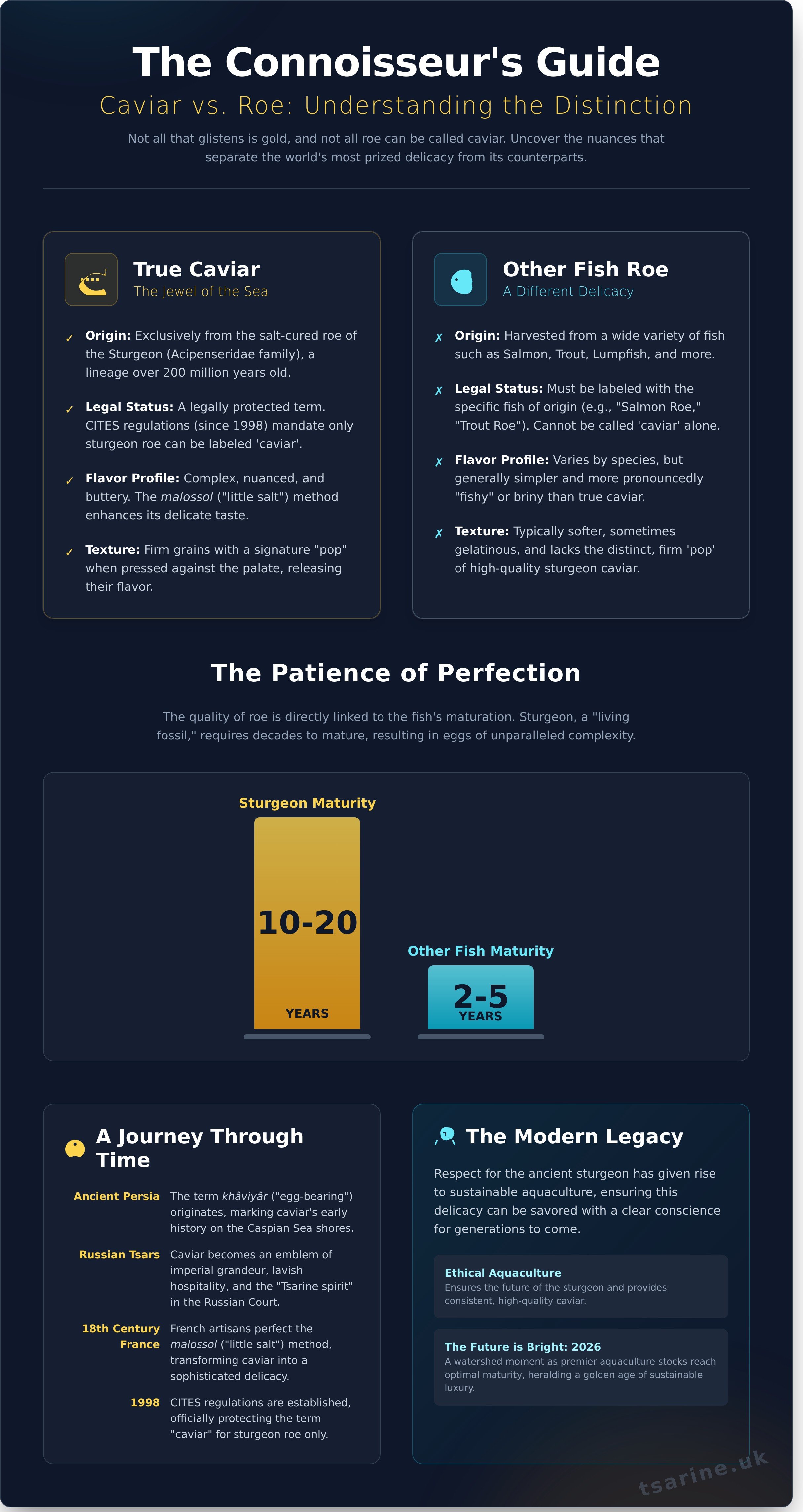
To embark on a journey into the world of fine seafood is to learn a language of subtle yet profound distinctions. A central tenet of this lexicon is the elegant hierarchy that separates caviar from common roe. The simple truth, whispered in the world’s finest dining rooms, is that while all caviar is roe, not all roe is granted the honour of being called caviar. This designation is reserved exclusively for the salt-cured eggs of the Acipenseridae family, the majestic sturgeon. To truly appreciate the answer to what is caviar, one must first understand what it is not.
This distinction is not merely a matter of semantics; it is a standard protected by tradition and regulation. The official FDA definition of caviar, a benchmark respected globally, stipulates that the term "caviar" alone refers only to sturgeon roe. Any other fish egg product must identify the species of fish, such as "salmon roe" or "trout roe," preventing the dilution of a name synonymous with ultimate luxury.
The Spectrum of Fish Eggs
The vast ocean offers a vibrant palette of fish eggs, each with its own character. You will undoubtedly have encountered the brilliant, jewel-like orbs of salmon roe, often called ikura. These large pearls, typically 5-7mm in diameter, possess a dramatic 'pop' that releases a burst of fresh, slightly sweet, and oceanic flavour. Similarly, trout roe offers a smaller, crunchier alternative with a vivid sunset-orange hue. Then there are the diminutive eggs used more as a garnish than a centrepiece: the tiny, crisp eggs of the flying fish (tobiko) that adorn sushi, and the black or red dyed lumpfish roe, a common sight in London supermarkets, offering a briny crunch for a modest price, often under £5 for a small jar.
Why Sturgeon Remains Supreme
The supremacy of sturgeon roe is a story of time, complexity, and rarity. Its inimitable flavour profile is born from a complex tapestry of amino acids, which impart a deep, lingering umami quality that is buttery, nutty, and astonishingly long on the palate. This is a sensory experience that simpler roes, with their straightforward salty notes, cannot replicate.
This experience, however, demands patience. The price of true caviar, which can range from £100 for 30 grams of fine Ossetra to several thousand for Beluga, directly reflects an immense investment of time. A Siberian sturgeon requires 8 to 10 years to reach maturity, while the legendary Beluga sturgeon may live for two decades before it can produce its first harvest. This decade-long wait is a testament to the dedication required for a single, precious yield.
Finally, there is the matter of finesse in preservation. True caviar is prepared malossol, a Russian term meaning "little salt." This delicate curing process, using less than 5% salt, preserves the egg's subtle flavours but results in a fragile product with a short shelf life, demanding meticulous cold storage. In contrast, many common roes are pasteurised or contain more salt and preservatives, granting them a longevity that, while practical, sacrifices the nuanced, ephemeral beauty that defines authentic caviar.
A Symphony of Senses: The Flavor and Texture of Excellence
To truly comprehend what is caviar is to embark upon a journey that engages every sense, a delicate performance of sight, touch, and taste that unfolds with regal grace. It begins not with the palate, but with the eyes. The sturgeon’s roe presents a mesmerising palette of colours, a constellation of tiny jewels ranging from the deep, obsidian gleam of Sevruga to the sophisticated charcoal grey of Beluga. Ossetra, ever the artist, offers shades of burnished gold and rich olive green, each pearl shimmering with a natural lustre that promises unparalleled quality. This visual allure is the first note in a grand composition, a prelude to the sensory crescendo that awaits.
The experience deepens with the legendary "Caspian Pop," a tactile sensation that is the hallmark of impeccably prepared roe. It is a gentle, satisfying burst as each individual grain yields against the palate, releasing the precious, flavourful oils held within. The aroma, too, is a study in subtlety and elegance; it whispers of its marine origins with a clean hint of sea spray, yet it is entirely devoid of any overt fishiness. Instead, one discovers a complex bouquet of toasted nuts, fresh cream, and a subtle, lingering brininess that cleanses the palate. To preserve this delicate harmony, the temperature of the serving vessel is paramount. Caviar should always be presented exquisitely chilled, traditionally nestled in a mother-of-pearl server over a bed of crushed ice, a practice which ensures its delicate oils remain stable and its flavour profile pristine.
The Tasting Ritual
The ceremony of tasting is steeped in a tradition designed to honour the caviar’s finesse. A mother-of-pearl spoon is not merely an aesthetic choice; it is an essential instrument. Unlike silver or other metals, which can oxidise the roe and impart a harsh, metallic taint within minutes, the inert nature of the pearl shell preserves the caviar’s pure, unadulterated flavour. Once served, the grains should be gently pressed against the roof of the mouth with the tongue, allowing them to "break" and release their full character. The finish is the final testament to its quality: a sublime, buttery aftertaste that lingers gracefully, leaving the palate clean and refreshed.
Grading the Harvest
The world of caviar has its own lexicon of quality, a system of grading that speaks to the rarity and character of each harvest. While larger grains, such as those from the Beluga sturgeon which can exceed 3.5mm, are often highly prized, true connoisseurs understand that size is not the sole arbiter of excellence. The most sought-after tins are defined by three core attributes:
- Grain Size: While Beluga is famed for its large pearls, the medium-sized grains of a mature Ossetra can offer a more complex and nutty flavour profile.
- Colour Consistency: The rarest and most coveted grades are those with exceptionally light and uniform colour. "Imperial" or "Gold" Ossetra, harvested from the oldest sturgeons, represents less than 10% of the yield and can command prices upwards of £6,000 per kilogram in London’s finest establishments.
- The Firmness Test: The roe must display a perfect resilience. The individual pearls should be separate and firm, rolling easily in the tin without being mushy or overly tough, a sign of meticulous processing and freshness.
This dedication to perfection ensures every tin is a masterpiece of flavour and texture. To elevate this experience to its highest form, one must consider its perfect partner. We invite you to discover the harmony of our curated caviar and champagne pairings, where effervescence and elegance meet.
The Modern Legacy: Sustainable Craftsmanship at Tsarine
The grand story of caviar, once whispered in the gilded halls of Russian palaces, has gracefully evolved. For the discerning modern connoisseur, the question of what is caviar is answered not merely by its imperial past, but by the profound integrity of its journey. At TSARINE Caviar, we believe true luxury is a delicate harmony between heritage and responsibility. It’s a commitment to preserving the majesty of the sturgeon for generations to come, ensuring that this celebrated delicacy can be savoured with a clear conscience and an appreciative palate. This philosophy is the very soul of our craft, connecting timeless tradition with pioneering ecological stewardship.
Our devotion to this principle led us to the tranquil, spring-fed waters of Northern Italy, home to one of the world's most respected sustainable sturgeon farms. Here, in an environment that mirrors the purity of their native habitats, our sturgeon thrive. It is a journey of meticulous care, from the pristine Italian waters to the sophisticated tables of London, ensuring every lustrous pearl of TSARINE Caviar is an emblem of quality, ethics, and unparalleled flavour.
Sustainable Indulgence
The era of reliance on wild-caught sturgeon from the Caspian Sea has passed, a necessary evolution prompted by the CITES protections enacted in 1998 to save dwindling natural populations. Our aquaculture represents the future, a sanctuary where these magnificent fish are raised with profound respect. Within our controlled, closed-loop systems, every variable, from water purity to a nutrient-rich diet, is perfected. This not only guarantees a consistent, year-round quality of roe but also minimises environmental impact by recycling water and preventing disruption to local ecosystems.
This dedication to sustainable artisanship is what defines the future of luxury. Our Siberian (Acipenser baerii) and White Sturgeon (Acipenser transmontanus) varieties are a testament to this vision. The Siberian offers a delicate, buttery finesse with notes of the sea, while the White Sturgeon presents a larger, bolder pearl with a wonderfully creamy and smooth finish. They are not simply alternatives; they are the new benchmark for excellence, born from a deep commitment to ethical harvesting and CITES compliance, ensuring every tin is fully traceable and certifiably sustainable.
Bringing the Experience Home
The art of the gift finds its ultimate expression in a tin of fine caviar. It remains an unparalleled gesture of esteem, a silent acknowledgement of a shared appreciation for life’s most refined pleasures. To ensure this experience is flawless, we have perfected the journey to your residence. Our commitment to freshness is absolute, with an unbroken cold chain meticulously maintained from our Italian farm to your London doorstep. Each order is dispatched in thermally insulated packaging with cooling elements, guaranteeing it arrives in perfect, chilled condition, ready for your celebration.
Allow us to bring this world of refined taste and conscious luxury directly to you. Experience the grace and finesse of TSARINE Caviar’s Luxury Gift Sets and discover a caviar that honours both its imperial legacy and its ecological future.
Experience the Imperial Majesty of Caviar for Yourself
Your journey through the world of this oceanic jewel has revealed its deepest secrets, from the noble sturgeon that bestows it to the delicate nuances that distinguish it from common roe. You now understand that the answer to what is caviar extends far beyond a simple definition; it’s an appreciation for a legacy of taste and tradition, a symphony of flavour savoured by connoisseurs for centuries.
At Tsarine, we honour this imperial heritage with a modern commitment to excellence. Our caviar is sustainably sourced from a celebrated artisanal farm in Italy, ensuring each pearl is a testament to ethical craftsmanship. From our London-based home, we provide reliable UK delivery, presenting this delicacy in our signature fluted tins whose design is a tribute to imperial history. This isn't just a purchase; it's an invitation to a grander world.
We invite you to begin your own tradition of refinement. Discover the Tsarine Collection: Premium Caviar Delivered Across the UK, and allow your table to be set for a moment of unparalleled elegance.
Answering Your Caviar Curiosities
Is caviar healthy to eat?
Indeed, caviar is a treasure of nutrition, celebrated for its richness in beneficial omega-3 fatty acids, which are known to support heart and brain health. A single tablespoon provides approximately 1 gram of these essential fats. It is also an excellent source of vitamin B12, selenium, and iron, making it a delightfully indulgent yet surprisingly nourishing delicacy. Its composition offers a rare harmony of decadent flavour and genuine wellness benefits, a true jewel of the sea.
Why is sturgeon caviar so expensive?
Sturgeon caviar’s extraordinary price reflects the majestic fish's own patient maturation, a process that can span from 8 to 20 years before it yields its precious roe. The CITES regulations, which govern the trade of endangered species, strictly limit supply from sustainable aquaculture farms. At London's esteemed purveyors like Petrossian in South Kensington, a 30g tin of fine Ossetra can command over £150, a price embodying decades of craftsmanship and rarity.
How long does an unopened tin of caviar last?
An unopened tin of fresh, malossol caviar, when properly refrigerated at a constant temperature between -2°C and 2°C, will retain its exquisite character for up to four weeks from the packing date. This precise chilling is paramount to preserving the delicate texture and nuanced flavour of the pearls. Once the vacuum seal is broken, its vibrant life is fleeting; it should be savoured within 72 hours to experience its intended quality and celebratory spirit.
What is the best way to serve caviar for beginners?
For a first tasting, the purest approach is the most rewarding, allowing the caviar's true character to reveal itself. Serve a small amount, about 15g per person, on a mother-of-pearl spoon to avoid any metallic influence on its flavour. Accompany it with simple, neutral canvases like traditional Russian blinis or unsalted crackers. A small dollop of crème fraîche can soften the intensity, creating a beautiful introduction to this celebrated delicacy.
Can you eat caviar during pregnancy?
Expectant mothers in the UK are advised to only consume caviar if it is pasteurised, a process which eliminates potential listeria risks in line with NHS food safety guidelines. Most high-quality, fresh caviar is unpasteurised to preserve its delicate texture, making it unsuitable. Always verify the label for the word "pasteurised" before indulging. For absolute assurance, consulting with your General Practitioner offers the most responsible guidance during this precious time.
What drink pairs best with premium sturgeon caviar?
The quintessential pairing for premium sturgeon caviar is, without question, a brut Champagne whose crisp acidity and fine effervescence elegantly cleanse the palate between each pearlescent spoonful. A Champagne with finesse complements the caviar’s rich, nutty notes without overwhelming its delicate structure. For those who prefer spirits, a premium, ice-cold vodka, served neat, offers a clean and pure counterpoint that allows the caviar’s full, majestic character to unfold.
Does caviar taste fishy?
High-quality sturgeon caviar should never present a strong or overtly "fishy" taste; instead, its profile is a complex and graceful symphony of flavours. One should expect a clean, fresh essence of the sea, followed by subtle notes that can range from buttery and nutty to creamy and sweet, with a satisfyingly mild briny finish. Any overpowering fishiness is often an unfortunate indicator of a product that is past its prime or of inferior quality.
What is the difference between black and red caviar?
The fundamental distinction lies in their noble origins; true black caviar is the revered roe of the sturgeon, celebrated for its complex, buttery flavours and a delicate 'pop'. In contrast, the vibrant red caviar, with its larger, more pronounced pearls and distinctly fresher taste, is sourced from fish in the salmonidae family, such as salmon or trout. While both are luxuries, understanding what is caviar in its most classic sense means appreciating the unparalleled heritage that only sturgeon roe provides.