
What Is CITES Certification and Why Does It Matter for Caviar?
A CITES label can help trace caviar through regulated wildlife trade, but it isn’t a seal of quality or proof of sustainability. That distinction is central to what is CITES certification and why it matters: the term may sound like an endorsement, when CITES is instead an international framework for controlling trade in listed species.
Permits, labels and responsible-sourcing claims can blur together, but each has a different role. Knowing the difference helps you read caviar information with greater confidence. This guide explains what CITES regulates, how permits and labels support traceability, and what they can’t tell you about quality or a farm’s environmental practices. TSARINE sources its caviar from a sustainable farm in Italy. That sourcing claim is distinct from what CITES documentation establishes. With the distinction clear, you can assess the evidence behind a caviar’s trade history without mistaking regulatory controls for a promise of taste or sustainability.
Key Takeaways
- Understand what is CITES certification and why it matters, while recognising that the phrase usually refers to trade controls rather than a universal quality credential.
- Learn how permits and caviar identification labels serve different purposes in tracing regulated international trade.
- See why species, source, destination and purpose can affect which trade controls apply.
- Separate evidence of legal trade and traceability from claims about caviar quality, conservation outcomes or farming practices.
- Use a simple sourcing checklist to consider species identification, farm origin and the documentation behind a claim.
What Is CITES, and Why Does It Apply to Sturgeon Caviar?
The word “certification” can suggest a seal of approval, but CITES has a different purpose. It is an international agreement that regulates cross-border trade in listed species of wild animals and plants, including products made from them. Caviar is relevant because it comes from sturgeon, a group whose species are subject to CITES controls.
So, what is CITES certification and why it matters? The phrase is often used as shorthand for permits and identification labels associated with regulated trade, not for an independent assessment of a caviar’s flavour, grade or sustainability. Keeping those roles separate helps distinguish evidence about trade and traceability from claims about quality or responsible farming.
What does the CITES acronym stand for?
CITES stands for the Convention on International Trade in Endangered Species of Wild Fauna and Flora (CITES). It is an agreement between governments that uses controls on international trade to help ensure that trade in listed animals and plants does not threaten their survival.
A convention provides a framework for governments; it is not a product certificate issued to certify an individual tin of caviar. Each country puts the agreement into effect through its own laws and authorities. Documents used in a particular trade route are part of that regulatory system. They don’t, by themselves, award a quality or sustainability mark to the food.
Why are sturgeon and caviar relevant to CITES?
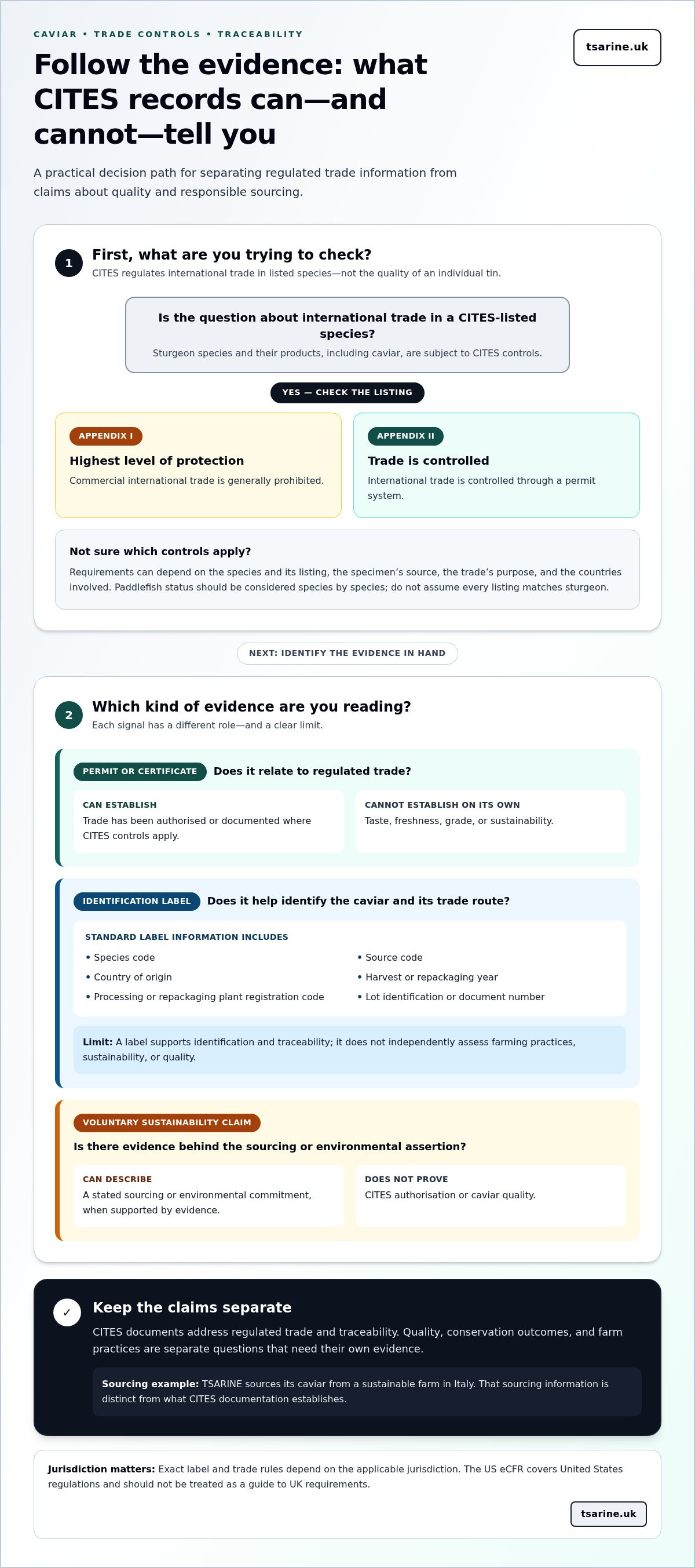
Sturgeon populations have faced conservation pressures, while caviar has long been traded internationally. CITES therefore regulates international trade in sturgeon species and their products, including caviar. The CITES listings cover sturgeon species, with most listed in Appendix II and some in Appendix I. The classification matters: Appendix II trade is controlled through a permit system, while Appendix I species receive the highest level of protection and commercial international trade is generally prohibited.
Requirements aren’t identical for every species or transaction. The species, its listing, the source of the specimen and the countries involved can all affect which controls apply. Paddlefish are related to sturgeon within the order Acipenseriformes, but their status should be considered species by species rather than assumed to match every sturgeon listing.
For consumers, the essential point is simple: CITES addresses whether international trade in a listed species is controlled, not whether caviar is delicious, expertly prepared or sustainably farmed. A farm’s origin and practices are separate sourcing questions that must be assessed on their own evidence.
CITES Certification, Permits, and Labels: What Is the Difference?
“CITES certification” is familiar shorthand, but it can blur three distinct things: government trade documents, identification labels on caviar containers, and voluntary claims about sustainability. None is a universal product-quality credential. To understand what is CITES certification and why it matters, consider what each form of evidence can establish and where its limits lie.
What does a CITES permit or certificate demonstrate?
Where CITES controls apply, permits or certificates form part of the official process for authorising or documenting trade in a listed species. Document requirements depend on factors such as the species, source and circumstances of the transaction, so paperwork for one route shouldn’t be assumed to apply to every caviar product. A document relates to regulated trade; it doesn’t grade the roe or verify its flavour, freshness or quality.
What can a caviar label tell you?
A CITES identification label is a separate traceability tool, affixed to the primary container to help identify the caviar and its route through trade. Standard label information includes a species code, source code, country of origin, harvest or repackaging year, processing or repackaging plant registration code, and lot identification or document number. The precise rules depend on the applicable jurisdiction. The US eCFR sets out caviar labeling and trade regulations for the United States; it shouldn’t be treated as a guide to UK requirements.
Labels help with identification and traceability, but they don’t independently assess farming practices or sustainability. A voluntary sustainability claim is different: it makes an environmental or sourcing assertion that should be supported by evidence beyond a CITES label or trade document.
| Item | What it can establish | What it cannot establish on its own |
|---|---|---|
| CITES permit or certificate | That regulated trade has been authorised or documented where applicable | Taste, freshness, grade or sustainability |
| Caviar identification label | Information that supports species identification and traceability | A quality rating or full assessment of environmental practices |
| Voluntary sustainability claim | A stated sourcing or environmental commitment, when supported by evidence | CITES authorisation or proof of caviar quality |
Read each signal for what it is. TSARINE sources its caviar from a sustainable farm in Italy; that sourcing information is distinct from what CITES documentation establishes. To explore the caviar varieties, visit Siberian and White Sturgeon caviar.
How CITES Controls International Caviar Trade
CITES controls are applied through a sequence of checks, rather than through one universal document that accompanies every tin in the same way. The relevant species, its source, the purpose of the trade and the countries involved can all shape which requirements apply. That is why what is CITES certification and why it matters is best understood through the trade pathway, not as a simple quality mark.
- Identify the species. The scientific identity of the sturgeon matters because CITES listings and controls are species-specific.
- Establish the source. Information indicating whether the caviar comes from a wild or captive-bred source can affect how the trade is assessed. Farmed caviar is not automatically exempt from CITES controls.
- Consider the transaction. The countries of export and import, the purpose of the trade and the circumstances of the shipment help determine which rules and documents may apply.
- Apply relevant documentation and labelling rules. Where required, permits or certificates and container labels provide evidence and identification for the regulated trade. The required documents depend on the specific case.
How do species and source affect trade controls?
Species identification is the starting point: a common name alone may not be enough to determine the applicable listing. Source information matters too. Caviar from a farmed sturgeon may be treated differently from caviar sourced from the wild, but its origin does not by itself remove the need to consider CITES requirements. Codes and documentation should be read in the context of the applicable rules, not assumed to mean the same thing for every species and shipment.
What should UK readers know about CITES rules?
CITES is an international agreement, while its requirements are put into effect through national laws and authorities. For UK readers, current permit guidance and application processes are provided through the UK government, with the Animal and Plant Health Agency (APHA) involved in CITES permit administration. Requirements can depend on the route and transaction; UK guidance is the appropriate reference for a specific movement.
The UK and EU operate their own systems for implementing CITES, so a route involving the EU should not be assumed to follow precisely the same administrative process as a movement within the UK. Check the relevant UK government CITES guidance for current requirements. This overview explains the process, but is not a shipment-by-shipment legal checklist.
What CITES Does, and Does Not Tell You About Caviar
CITES has an important conservation role, but its purpose is narrower than some product descriptions imply. It helps regulate international trade in listed species; it doesn’t grade caviar, assess its taste or certify that a farm meets a particular sustainability standard. A trade document can provide evidence relevant to an authorised transaction, but it cannot, by itself, prove that every stage of a supply chain has delivered a positive conservation outcome.
Does CITES prove that caviar is sustainable or high quality?
No. CITES controls and traceability information address trade in listed species, while farming practices, environmental performance and culinary quality are separate questions. A label or permit shouldn’t be read as a guarantee of freshness, texture, flavour or responsible aquaculture. Nor does one document alone establish the sustainability of an entire supply chain.
CITES documentation can support the traceability or authorisation of regulated wildlife trade, but it cannot by itself certify caviar quality, sustainable farming or conservation outcomes.
That distinction doesn’t diminish the value of CITES. Controls can help monitor and manage international trade in protected species, but their existence is not proof that a particular farm’s practices are environmentally responsible. Likewise, “sustainable” is a separate sourcing claim that calls for its own clear, relevant evidence.
How can readers assess a CITES-related claim?
Look for precise language rather than a broad assurance that caviar is “CITES certified”. Useful details may identify the species and source, and explain how the product is linked to trade documentation or traceability information. Then consider what the statement actually supports: evidence about regulated trade is not automatically evidence about farming methods or the condition of wild populations.
- Species: Is the sturgeon identified clearly, rather than described only with a general name?
- Source: Does the claim distinguish farmed from wild origin where relevant?
- Traceability: Is the role of any label or trade document described accurately?
- Sourcing: Is a sustainability statement supported by information about farming or environmental practices, rather than relying on CITES wording alone?
For a fuller look at the separate evidence behind sourcing claims, read the guide to sustainable caviar sourcing. TSARINE sources its caviar from a sustainable farm in Italy; that sourcing statement is distinct from what CITES documentation establishes.
With the distinction in view, explore Siberian and White Sturgeon caviar as you consider species and sourcing information together.
Choosing Caviar with Traceability and Responsible Sourcing in Mind
A considered choice begins by asking what each piece of information actually tells you. Species identification, farm origin and trade documentation are related, but they answer different questions: what sturgeon the roe comes from, where and how it was sourced, and whether relevant regulated trade has been documented. None should be treated as a substitute for the others.
What questions help distinguish traceability from sustainability?
Use this short, non-legal checklist to read sourcing claims with greater clarity:
- Is the species clearly identified? A specific species name gives more useful context than a broad reference to sturgeon alone.
- Is the source described? Look for clear information about whether the caviar is farmed or wild-sourced, and where it originates.
- What does the documentation relate to? CITES-related paperwork and identification information concern regulated trade and traceability where applicable, not a general assessment of farm practices.
- What supports a sustainability statement? Treat this as a separate sourcing claim. Look for relevant information about farming or environmental practices rather than assuming a trade document proves it.
These questions help distinguish the kinds of evidence being presented, but they aren’t a way to independently verify every stage of a supply chain. Pay attention to precise, appropriately framed claims, and avoid reading more into a label or document than it establishes.
How does responsible sourcing complement CITES controls?
CITES controls and responsible sourcing can support related aims, yet they address different parts of the picture. Trade controls help regulate international commerce in listed species. Sourcing information can describe a farm’s origin and practices. Together, these details may provide a fuller account, but CITES documentation alone doesn’t prove that a farm is sustainable or that conservation outcomes have been achieved.
TSARINE sources its caviar from a sustainable farm in Italy. That is the business’s sourcing context, distinct from what CITES documentation establishes and not a claim that CITES certifies the farm. Species also matters to the choice itself: Siberian Sturgeon and White Sturgeon are distinct varieties, and understanding their differences adds another layer to an informed selection. Explore the guide to the different types of caviar for more on the varieties.
With the distinction between traceability and sourcing in mind, explore TSARINE caviar.
Choose Caviar with Confidence and Clarity
Understanding what is CITES certification and why it matters begins with a useful distinction: CITES regulates international trade in listed species, while permits and labels can support authorisation and traceability where applicable. They don’t grade caviar or, on their own, establish that farming practices are sustainable.
For a more considered choice, read species details, sourcing information and trade documentation as separate pieces of the story. Each answers a different question, and responsible-sourcing claims deserve evidence beyond regulatory paperwork. TSARINE sources its caviar from a sustainable farm in Italy, with Siberian Sturgeon and White Sturgeon varieties in its range. That origin is sourcing context, not a CITES endorsement.
With the distinctions clear, appreciate both the provenance and pleasure of caviar without mistaking one for the other. Discover TSARINE Caviar and explore the varieties for your next moment of refined indulgence.
Frequently Asked Questions
Is CITES certification the same as a CITES permit?
No. “CITES certification” is often used informally, but it isn’t a universal product-quality certificate. A CITES permit or certificate is an official document used to authorise or document regulated trade where applicable. The paperwork depends on the species, source and transaction. It can relate to compliance with wildlife-trade controls, but it doesn’t certify a tin’s flavour, freshness, grade or sustainability.
Does CITES apply to farmed sturgeon caviar?
It can. Farmed origin doesn’t automatically exempt sturgeon caviar from CITES controls. The relevant requirements depend on factors including the species, its source and the countries involved in the trade. A source code may help distinguish captive-bred from wild-sourced caviar, but it should be interpreted alongside the applicable rules rather than taken as proof that no controls apply.
Does CITES certification mean caviar is sustainable?
No. Understanding what is CITES certification and why it matters means recognising that CITES regulates international trade in listed species; it doesn’t certify a farm’s sustainability or grade caviar quality. Permits and labels can support regulated trade and traceability where required. Claims about farming practices or environmental responsibility are separate and need relevant sourcing evidence beyond CITES documentation alone.
What information appears on a CITES caviar label?
Where the relevant labelling rules apply, a CITES caviar label can include a standardised species code, source code, country of origin, harvest or repackaging year, processing or repackaging plant registration code, and lot identification or CITES document number. These details help identify and trace the product. Exact requirements depend on the applicable rules, and a label isn’t a sustainability assessment or quality rating.
Do I need CITES documents to buy caviar in the UK?
For an ordinary purchase from a UK retailer, consumers don’t generally apply for CITES permits themselves. CITES documentation is relevant to regulated trade and may be required for particular international movements or transactions. Requirements vary with the species, source and route, so buying, importing, exporting or travelling with caviar can raise different questions. Check current UK government guidance for the specific circumstances.
How can I check whether caviar has been legally traded?
Look for clear species and source information, and for any relevant identification label or trade documentation. Where documents are required, their details should relate to the species and transaction in question. These clues can help you assess a claim, but a consumer may not be able to verify every supply-chain step independently. For a specific shipment or movement, consult current guidance from the relevant official authority.
Which sturgeon species are covered by CITES?
All sturgeon species are listed under CITES, but their Appendix classifications and trade controls aren’t identical. Most are in Appendix II, while some are in Appendix I, which provides a higher level of protection and generally prohibits commercial international trade. Paddlefishes are also relevant to CITES controls. For any particular caviar, species identification is essential because the applicable requirements depend on the species and circumstances.