
What to Do If Your Chilled Delivery Is Delayed
The tracking page has stopped moving, dinner is planned, and a chilled parcel of caviar is still somewhere in transit. If you’re wondering what to do if your chilled delivery is delayed, don’t judge its safety by the delay alone. Assess the parcel and its contents when they arrive.
It’s understandable to worry that the food may no longer be safely cold, especially when it’s intended for a special meal or a thoughtful gift. A late arrival doesn’t automatically tell you whether the food is safe to eat. A few careful checks can help you make a more informed decision.
This guide explains what to look at straight away, how to handle the parcel while you assess it, and when it’s wiser not to eat the food. You’ll also learn how to record the delay and contact TSARINE with clear order details. If you’re awaiting Siberian or White Sturgeon caviar, these steps can help you respond calmly and protect both the food and your plans without relying on guesswork.
Key Takeaways
- For what to do if your chilled delivery is delayed, start with the latest tracking update and keep your order details to hand.
- Assess the parcel on arrival. Check the insulation, seals and packaging for damage or signs of tampering.
- Choose your next step based on what you know: monitor tracking, contact TSARINE, or report damage and temperature concerns.
- For chilled caviar, follow the product’s storage instructions and chill it appropriately after receipt unless the label or retailer advises otherwise.
- For future deliveries, choose a suitable date, provide accurate access details and review the delivery information before ordering.
What to do first when your chilled delivery is delayed
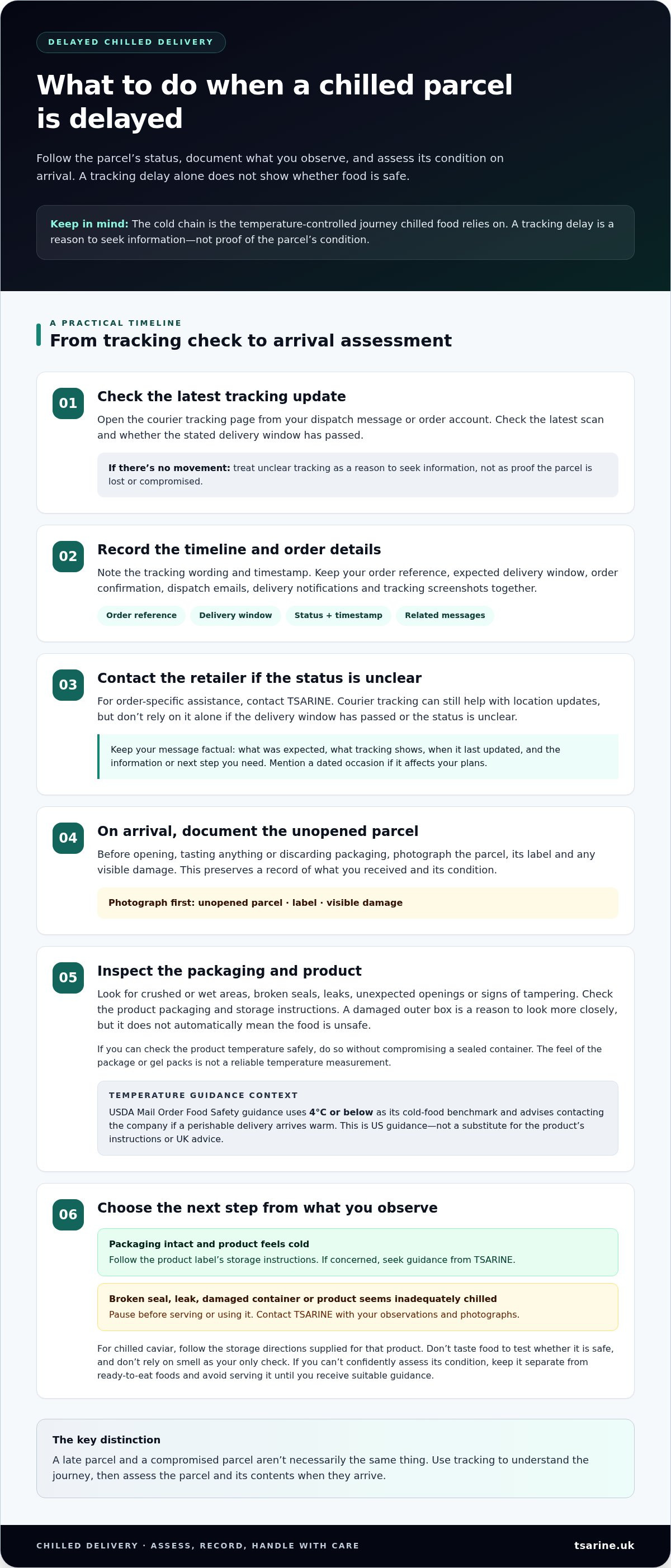
A delay is unsettling, especially when the parcel contains food for a planned occasion, but it doesn’t establish whether the food remains safe. First, find out what’s happening to the order and keep a clear record. The cold chain describes the temperature-controlled journey chilled food relies on. A tracking delay is a reason to seek information, not proof of the parcel’s condition.
Take these steps before deciding what to do next:
- Check tracking. Open the courier’s tracking page using the link in your dispatch message or order account.
- Note the latest update. Record its wording and timestamp, including if there’s been no movement or the delivery window has passed.
- Save your order details. Keep the reference number and related messages together so you can explain the issue clearly.
If tracking stops updating or doesn’t explain the parcel’s status, contact TSARINE about your order. Before opening the parcel, tasting anything or discarding packaging, document what you can see. Photograph the unopened parcel, its label and any visible damage. These images can help you describe the delivery and its condition. A late parcel and a compromised parcel aren’t necessarily the same thing, so avoid drawing conclusions before you have more information.
Which details to gather before reporting a delay
Have the order reference, expected delivery window, current tracking status and timestamp ready. Save the order confirmation, dispatch emails, delivery notifications and screenshots of tracking updates, particularly if the status changes. These details make it easier to follow the parcel’s progress and explain the timeline accurately.
Explain the practical impact plainly. If the chilled order is intended for a birthday dinner, celebration or other dated occasion, say so and give the relevant date. Keep your message factual: what was expected, what tracking currently shows and what information or next step you’re seeking.
Who to contact first: retailer or courier?
For order-specific assistance, contact the retailer first. TSARINE can respond to questions about your purchase, while courier tracking remains useful for location updates. Use both, but don’t rely on a tracking page alone if the delivery window has passed or the status is unclear.
Write courteously and stick to what you know. For example: “My order was due within this delivery window, but tracking has shown no update since this timestamp. Could you advise on its status and the next step?” Clear, calm details make it easier to discuss a delayed caviar delivery, particularly when timing matters.
How to assess a delayed chilled parcel when it arrives
A late delivery doesn’t reveal by itself whether the food has remained safely chilled. Assess the parcel you received rather than treating the tracking delay as a verdict. Inspect the outside, then check the product packaging and storage instructions. Look for crushed or wet areas, broken seals, leaks, unexpected openings or signs of tampering. A damaged outer box doesn’t automatically mean the food is unsafe, but it is a reason to look more closely and keep a record.
Follow the product label and current UK food-safety advice when deciding how to handle the food. If you can check the product temperature safely, do so without compromising a sealed container. Don’t treat the feel of the package as a reliable measurement. The USDA’s Mail Order Food Safety guidance uses 4°C or below as its cold-food benchmark and advises contacting the company if a perishable delivery arrives warm. This is US guidance, not a substitute for the product’s instructions or UK advice.
What insulated packaging and gel packs can tell you
Insulated liners and gel packs are intended to help protect chilled goods in transit, but their presence doesn’t prove the food stayed at a safe temperature throughout the journey. Note whether the packs still feel cold, but don’t use touch alone to decide whether the product is safe. Before removing or rearranging anything, photograph the parcel, liner, cooling materials, seals and any visible damage. These images preserve a record of the condition on arrival.
When to keep the product chilled and when to pause
If the product and packaging appear intact and it feels cold, follow the label’s storage instructions while seeking guidance from TSARINE if you’re concerned. With chilled caviar, take particular care to follow the storage directions supplied for that product. If there’s a broken seal, a leak, damage to the container or the product seems inadequately chilled, pause before serving or using it. Contact TSARINE with your observations and photographs.
Don’t taste food to test whether it’s safe, and don’t rely on smell as your only check. Neither can confirm that chilled food has been handled safely. If you can’t confidently assess its condition, keep it separate from ready-to-eat foods and avoid serving it until you’ve received suitable guidance. If you’re expecting TSARINE Siberian or White Sturgeon caviar, keep the product label and notes about its condition together to make your order query clearer.
Delayed chilled delivery: compare your practical next steps
The right response depends on whether the parcel is still in transit or has arrived, and what you can observe about its condition. For what to do if your chilled delivery is delayed, let the parcel’s status guide your next step rather than assuming it’s lost or safe based on tracking alone.
| Parcel status | Practical next step |
|---|---|
| Still in transit, tracking recently updated | Check the latest scan and stated delivery window, then monitor for the next update. |
| Expected window passed or tracking appears stalled | Contact TSARINE for an order-specific update and ask what to do next. |
| Arrived intact and apparently chilled | Follow the product’s storage instructions; contact TSARINE if you remain concerned. |
| Arrived warm, leaking, damaged or with a broken seal | Photograph the condition, keep the packaging and pause use while seeking guidance. |
If tracking is delayed but the parcel has not arrived
Check the courier’s latest scan and any delivery window before sending another query. If the window has passed or tracking appears stuck, contact TSARINE about your order. Ask for an update on the parcel’s status and the next practical step. A gap in tracking doesn’t, by itself, establish that the parcel is lost.
If the parcel arrives late, warm or damaged
Photograph the outer packaging, label, seals and any visible damage. Keep the packaging and delivery records. Describe what you observed, such as a leak or a product that feels warm, rather than diagnosing its safety or assigning blame. Keep the food separate from ready-to-eat items while you seek advice, and don’t serve it if its condition is uncertain. The USDA mail order food safety guidance advises caution with perishable food that arrives warm. As US guidance, it should be read alongside the product label and applicable UK food-safety advice.
When you contact TSARINE, include your order reference, delivery timeline, tracking details and photographs. Depending on the circumstances and the applicable policy, possible resolutions may include a replacement, refund or another response. The outcome and timing aren’t automatic, so keep the conversation focused on the evidence and the practical resolution you’re requesting.
How to protect chilled caviar after a late delivery
Caviar needs careful handling after arrival, but a delivery delay doesn’t tell you on its own whether the product is safe to serve. Follow the storage and handling instructions supplied with the specific product, rather than relying on a general rule or guessing how long it may have been outside refrigeration. If the label and retailer’s guidance differ from what you expected, pause and ask TSARINE for advice before opening or serving it.
Once you’ve received the parcel, prioritise appropriate chilling in line with the product label, unless the label or retailer instructs otherwise. Don’t guess at a storage temperature, exposure limit or serving deadline. Those details should come from reliable product-specific directions or current official guidance. When deciding what to do if your chilled delivery is delayed, preserve the product as instructed while its condition is assessed. Don’t taste it as a test.
Caviar storage steps after the parcel reaches you
If the parcel’s condition raises concern, inspect the tin and seals without opening them. A damaged or compromised seal is a reason to pause and contact TSARINE. Opening the container can make it harder to document the product as received. Keep the packaging and label together, and follow the product’s instructions for refrigeration and handling. If you’re uncertain about the condition, don’t serve the caviar until you’ve received suitable guidance.
For further practical advice on presenting a gift, see the guide to gifting luxury caviar.
If the caviar was meant for a gift or gathering
A late parcel can unsettle a carefully planned occasion, so contact TSARINE promptly if timing affects your plans. Share the order reference, expected delivery window and current parcel status, then ask about the next practical step. Keep your recipient or guests informed with a simple, honest update. Avoid promising a replacement or revised arrival time until it’s confirmed.
If the product’s condition is uncertain, make a contingency plan before serving anything. Set aside another suitable item for the occasion or adjust the menu rather than allowing the pressure of a dinner or gift presentation to influence a food-safety decision. A considered alternative is preferable to serving caviar whose condition hasn’t been established.
For an occasion where presentation matters, explore TSARINE Caviar gift sets as part of your planning. Whatever the occasion, let the product’s own instructions and confirmed guidance, rather than the calendar, determine whether it’s ready to be enjoyed.
Prevent another chilled delivery delay and resolve your order
Thoughtful preparation can make a chilled-food delivery easier to receive and any delay simpler to resolve. Before ordering, review the delivery information, including the stated delivery window and any instructions for receiving the parcel. If you’re deciding what to do if your chilled delivery is delayed, accurate order details and a clear record of the parcel’s condition will also help you explain the issue calmly.
A simple checklist before placing a chilled-food order
- Choose a suitable delivery date. Consider whether you or someone you trust can receive the parcel during the stated window. Avoid leaving it unattended if that can be avoided.
- Check the address carefully. Confirm the postcode, flat or building details, entry instructions and contact number so the courier has the information needed to reach you.
- Plan for an important occasion. For a celebration or gift, allow practical flexibility and avoid relying on an arrival time unless it’s clearly stated. A little room in your plans can make a delay less disruptive.
- Read delivery information before ordering. Check the delivery windows, receiving instructions and guidance on what to do if an order is delayed.
These checks can’t guarantee a parcel will arrive exactly as planned, but they can reduce avoidable confusion and help you know where to turn for an update.
What to include in a clear order-support message
If a TSARINE order is delayed, contact TSARINE and make your message easy to follow. Include the order reference, expected delivery date or window, latest tracking update and a concise description of what has happened. If the parcel has arrived damaged or its condition concerns you, attach photographs of the packaging, label or damage.
Keep the parcel and its packaging until you receive guidance on the next step, and describe only what you observed. For example, note that tracking hasn’t changed since a particular update or that the outer box arrived visibly damaged. Then ask a direct question, such as what the current status is and what you should do next. Clear, courteous details keep the conversation focused without presuming the cause of the delay or the resolution.
For a future occasion, explore TSARINE Caviar and its selection of Siberian and White Sturgeon caviar. Review the delivery information alongside your plans and choose a suitable time to order, while leaving room for the unexpected.
Make your next step with confidence
A delayed chilled parcel calls for careful assessment, not assumptions. The delay alone can’t tell you whether food is safe. Check the parcel and product information when it arrives, follow the storage instructions, and pause before serving anything if its condition concerns you.
If you’re deciding what to do if your chilled delivery is delayed, keep the order details and photographs together, then contact TSARINE with a clear account of what happened. This makes it easier to discuss the parcel’s status and a sensible next step, while food-safety decisions remain guided by the product information and appropriate advice.
For a future table or thoughtful gift, explore TSARINE’s premium Siberian and White Sturgeon caviar, sourced from a sustainable farm in Italy. Explore TSARINE Caviar and discover a considered selection for occasions worth savouring.
Frequently Asked Questions
What should I do if my chilled delivery is delayed?
Check courier tracking, note the latest scan and timestamp, and compare these with the stated delivery window. If the window has passed or tracking appears stalled, contact TSARINE with your order reference. If the parcel arrives, photograph its condition before opening or changing the packaging. A delay alone doesn’t establish whether the food is safe, so assess the product and follow its storage instructions.
Is chilled food safe if a delivery arrives late?
Not necessarily, but lateness alone can’t tell you whether the food is safe or unsafe. Check the parcel and product for damaged packaging, broken seals, leaks or signs that the contents aren’t appropriately chilled. Follow the label and current food-safety guidance. If the food seems warm or its condition is uncertain, don’t serve it until you’ve received suitable advice from TSARINE or an appropriate food-safety source.
Can I eat caviar if the chilled parcel arrives warm?
Don’t eat caviar that arrives warm until its condition has been assessed and you’ve received appropriate guidance. Keep the tin sealed if possible, follow the product’s storage instructions and contact TSARINE promptly with your order details and observations. A warm-feeling parcel doesn’t establish the product’s full temperature history, while smell or taste can’t confirm safety. If you remain unsure, don’t serve it.
How long can a chilled delivery be delayed before the food is unsafe?
There isn’t a single delay duration that determines whether every chilled product is safe. The outcome depends on the food, its packaging and the conditions it experienced during transit, not simply the number of hours shown on tracking. Don’t use a general time limit to judge a specific parcel. Check the product information and condition on arrival, and contact TSARINE if it seems warm or compromised.
What should I do if my chilled parcel is damaged or leaking?
Photograph the parcel, label, seals and visible damage before handling it further, and keep the packaging and delivery records. If the product container is leaking, broken or unsealed, avoid opening, tasting or serving the food. Keep it separate from ready-to-eat items while you contact TSARINE with a concise description and your order reference. Follow the guidance you receive about what to do with the product and packaging.
Should I contact the courier or the retailer about a late chilled delivery?
Use courier tracking to see the latest location or scan, but contact TSARINE first for help with your specific order. Include your order reference, the expected delivery window and the tracking update. Keep your message courteous and factual, and avoid assuming the parcel is lost before its status has been clarified.
What should I do if caviar arrives late before a dinner or gift occasion?
Contact TSARINE promptly if the delivery timing affects your plans, sharing the order reference, tracking status and occasion date. Don’t promise guests or a recipient a revised arrival time or replacement until it’s confirmed. If the caviar’s condition is uncertain, follow its storage instructions and don’t serve it while seeking advice. Consider an alternative for the meal or gift so the occasion doesn’t depend on an unresolved delivery.