
Caviar Supplier for Restaurants: How to Choose the Right Partner
The right caviar supplier for restaurants isn’t simply the one with the grandest name. It’s the partner whose provenance, range and wholesale supply suit your kitchen. When each variety needs to earn its place on the menu, clear product information and a relevant selection make the decision easier. TSARINE Caviar is London-based, sources caviar from a sustainable farm in Italy and supplies restaurants with Siberian Sturgeon and White Sturgeon caviar.
Choosing caviar should feel considered, not complicated. Assess a supplier’s sourcing information, match varieties and formats to your dishes and style of service, and plan a wholesale relationship around your restaurant’s needs. The aim is a confident choice: caviar with a clear role on the menu, provenance your team can describe accurately and a supply partner suited to the way you serve guests.
Key Takeaways
- Learn what clear provenance and traceable product information can tell you about a caviar’s sourcing.
- Assess a caviar supplier for restaurants by considering product range, communication and your kitchen’s needs.
- Explore ways to match Siberian and White Sturgeon caviar to different menu roles and styles of service.
- Build a practical supply routine by documenting menu needs, anticipated use and communication with your kitchen team.
- See how TSARINE Caviar’s Italian farm sourcing and wholesale range can support restaurant and hospitality menus.
Why choosing the right caviar supplier matters to a restaurant
For a restaurant, a caviar supplier is more than a source of product. The relationship brings together sourcing, selection and wholesale supply, helping the kitchen choose caviar that fits the menu and can be presented with confidence. Provenance informs the story behind each serving, while a suitable product range gives chefs options for shaping dishes. Clear product information also helps front- and back-of-house teams describe the menu consistently.
The right fit depends on your restaurant’s format, menu and service rhythm. A tasting menu, a seafood-led à la carte offering and a hotel lounge may each use caviar differently, from a composed dish to a finishing touch. Start with the role caviar will play, then assess whether the supplier’s sourcing, range and wholesale service suit the way your restaurant operates.
What restaurants need from a caviar supplier
Restaurants need product information chefs can use in menu planning and staff can turn into accurate descriptions for guests. A range suited to the kitchen’s style can support different dishes and service formats. A clear wholesale relationship helps the restaurant coordinate purchasing with its requirements. Unlike a personal or gift purchase, a restaurant’s choice needs to work across menus, service teams and guest expectations.
TSARINE Caviar supplies wholesale caviar to restaurants and hospitality businesses, including Siberian Sturgeon and White Sturgeon. Based in London, TSARINE serves wholesale clients across the UK and internationally. These details give restaurant buyers a concrete starting point for assessing how the supplier’s location, sourcing and range align with their operation.
Why provenance belongs in the sourcing decision
Species and origin are part of a caviar’s identity, and knowing them helps a restaurant describe its menu accurately. A useful starting point is to explore Caviar varieties, then consider how each product’s species and stated origin relate to the experience you want to create. For a closer look at sturgeon options, see this guide to types of sturgeon caviar.
Responsible sourcing is an important procurement consideration. Look for clear product information about species and origin, and use those details in purchasing notes and menu descriptions. TSARINE sources its caviar from a sustainable farm in Italy, so buyers can consider its stated provenance alongside their menu requirements. This gives the kitchen a specific sourcing story to communicate without relying on vague claims.
How to evaluate a caviar supplier for restaurants
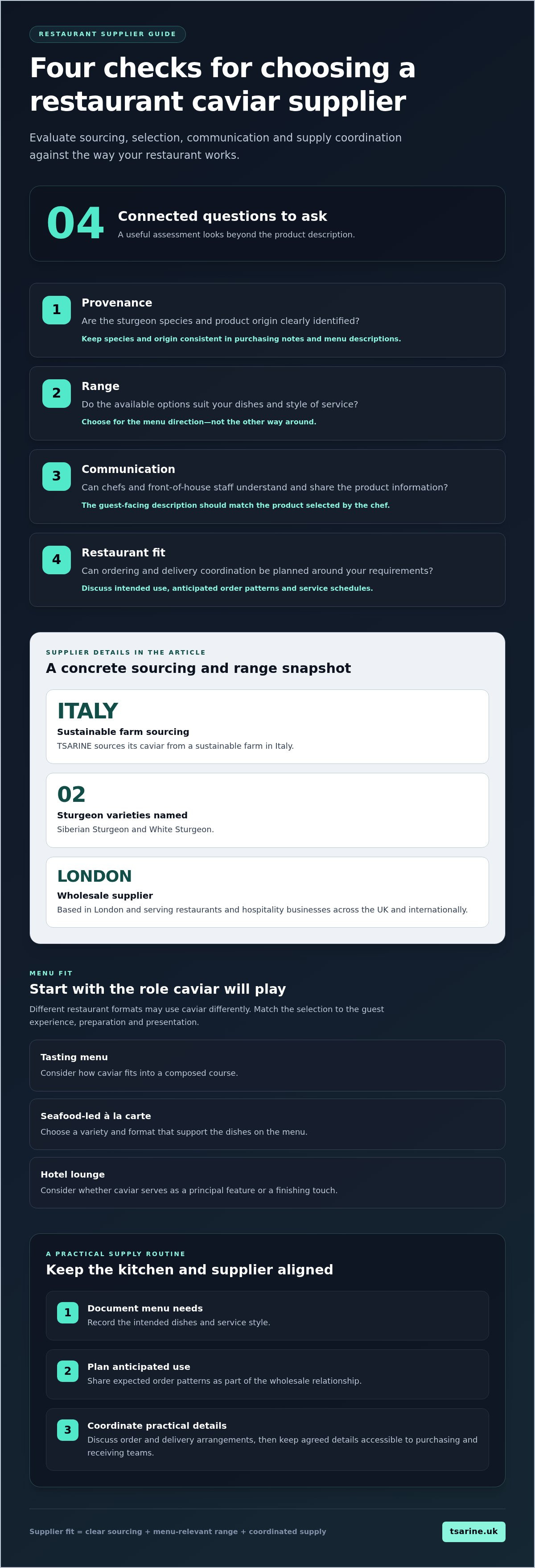
A useful assessment looks beyond an appealing product description to the way sourcing, selection and supply support your restaurant in practice. Consider four connected questions: is the product’s provenance clear, does the range suit your menu, can your team use the product information, and can wholesale supply be coordinated around your operation? Together, these criteria help you judge whether a caviar supplier for restaurants is a good fit, rather than simply a source of attractive tins.
- Provenance: Are the sturgeon species and product origin clearly identified?
- Range: Do the available options suit your dishes and service style?
- Communication: Can chefs and front-of-house staff understand and share the product information?
- Restaurant fit: Can ordering and delivery coordination be planned around your requirements?
Which provenance and product details should buyers understand?
Species and origin give a restaurant a sound basis for purchasing decisions and accurate menu language. Keep those details consistent across purchasing notes, kitchen references and front-of-house briefings. This helps ensure the story shared with guests matches the product selected by the chef.
Sustainability deserves the same care. Use specific sourcing information rather than broad marketing language when describing a product. TSARINE sources its caviar from a sustainable farm in Italy and offers Siberian Sturgeon and White Sturgeon. These details give buyers a clear starting point for considering origin and range.
How can a restaurant judge communication and supply fit?
Assess whether product information is useful beyond the purchasing decision. Chefs should be able to relate the range to planned dishes, while front-of-house staff need clear language for describing those dishes. A restaurant planning a composed starter may have different selection priorities from one considering caviar as a finishing touch. The supplier’s range should support the menu direction, not dictate it.
Communication also means explaining practical requirements, including intended use, anticipated order patterns and the coordination your service schedule calls for. Discuss order and delivery arrangements as part of the wholesale relationship, then keep the agreed details accessible to the people responsible for purchasing and receiving. Cornell University’s restaurant revenue management course includes choosing suppliers suited to a business’s needs; its guidance reinforces the value of taking time to build a practical restaurant caviar supply relationship.
TSARINE is a London-based wholesale supplier serving restaurants and hospitality businesses across the UK and internationally. Explore TSARINE wholesale caviar and consider how its Italian farm sourcing and Siberian and White Sturgeon range align with your menu.
Match caviar varieties and formats to your restaurant menu
Caviar earns its place on a menu when the variety and format serve a clear culinary purpose. A delicate accent on a composed dish calls for a different approach from a course where caviar is the principal feature. Begin with the guest experience you want to create, then consider how the kitchen will prepare, present and describe the dish. A considered menu test can show whether the caviar works in service, rather than simply sounding luxurious on paper.
Siberian Sturgeon and White Sturgeon caviar on a menu
TSARINE offers Siberian Sturgeon Caviar (Acipenser baerii) and White Sturgeon Caviar (Acipenser transmontanus). Either can be considered for a featured dish, a tasting-menu course or a finishing element, depending on the chef’s concept. Don’t assume that species alone determines the best role. Consider how each option works with the dish’s other ingredients, presentation and place in the menu.
| Species | Possible menu role | Considerations |
|---|---|---|
| Siberian Sturgeon | Accent or featured component | Assess against the dish, menu language and intended guest experience. |
| White Sturgeon | Accent or featured component | Use product information to guide selection and staff descriptions. |
The table is a planning framework, not a claim that one species has a particular flavour, texture or appearance. Keep descriptions grounded in product details, and brief front-of-house staff with the same language the kitchen uses. For serving inspiration, explore this guide to how to eat caviar.
Choosing a format for your restaurant’s service
Format is a practical menu decision as much as a purchasing one. Consider whether caviar will appear in a tasting menu, garnish a dish during à la carte service or take the lead in a dedicated course. Each use brings different requirements for preparation, presentation and coordination. Estimate anticipated use from your menu plan and service patterns rather than relying on a fixed portion assumption.
During menu testing, observe how easily the kitchen can execute the dish and whether the caviar remains integral to its balance and presentation. Record the intended use and relevant product details in purchasing and service notes, giving the team a shared reference as the menu evolves. A caviar supplier for restaurants should provide clear product information to support that decision-making, while the final selection remains guided by your menu and service style.
How to build a practical restaurant caviar supply relationship
A considered supply relationship begins before the first order and continues through menu changes, receiving and repeat purchasing. A shared plan helps the chef, purchasing team and front of house work from the same understanding of the product and its intended place in service.
Plan requirements before placing a wholesale order
Use this sequence to turn menu ideas into a clear purchasing plan:
- Define the menu role. Decide whether caviar will feature in a dedicated course, complement a dish or serve as a finishing touch.
- Estimate likely use. Consider the menu, expected service patterns and how often the dish will be offered. Base estimates on your own operation rather than a universal serving quantity.
- Align the team. Have chefs, purchasing and front-of-house agree on product selection, menu wording and the guest experience you want to create.
- Record the choice. Keep the product name, species, origin and relevant supplier information with the intended menu use. This makes repeat ordering and staff briefings more consistent.
This simple process helps prevent a carefully selected ingredient from becoming an afterthought in purchasing. It also gives the team a reference point when dishes or service patterns change.
Coordinate delivery, handling and repeat supply
Build receiving and product handling into the restaurant’s routine. Assign responsibility for checking incoming orders, recording product information and sharing relevant details with the kitchen team. Follow the supplier’s product-specific handling and storage instructions rather than relying on assumptions drawn from another product.
For repeat supply, use your records to plan around the menu and coordinate order requirements and delivery arrangements through the wholesale relationship. Set these details according to your restaurant’s requirements rather than assuming fixed order quantities or delivery schedules. If the menu changes, review anticipated use and update purchasing and service notes so the team stays aligned.
Provenance can also form part of the restaurant’s purchasing record and the story shared with guests. Read more about sustainable caviar sourcing as you consider how sourcing information fits your approach.
A suitable caviar supplier for restaurants supports a thoughtful process, from selecting products for the menu to coordinating practical wholesale supply. Explore TSARINE wholesale caviar for your restaurant as you shape a supply relationship around your kitchen’s needs.
Why TSARINE Caviar is a considered supplier for restaurants
A thoughtful restaurant caviar programme brings provenance, menu intention and supply coordination into a single conversation. TSARINE Caviar is a London-based wholesale supplier to restaurants and hospitality businesses, offering caviar sourced from a sustainable farm in Italy. Its range includes Siberian Sturgeon Caviar (Acipenser baerii) and White Sturgeon Caviar (Acipenser transmontanus), giving chefs two varieties to consider as they shape dishes and service.
For restaurant buyers, this offers a practical starting point: stated sourcing origin, a defined species range and wholesale supply for hospitality businesses. TSARINE serves wholesale clients across the UK and internationally, with delivery arrangements coordinated around restaurant requirements.
A sourcing story grounded in an Italian farm
TSARINE sources its caviar from a sustainable farm in Italy. Clear origin information gives chefs and purchasing teams a useful foundation for understanding what they select, while helping front-of-house staff communicate the product’s provenance accurately to guests. Keeping menu language tied to the stated sourcing details makes the story informative and precise.
That clarity can lend a dish a richer sense of place without overwhelming its culinary purpose. Whether caviar appears as a considered accent or takes a more prominent role, the restaurant can connect its sourcing information to the menu in language that feels informed and natural.
Take the next step with TSARINE wholesale caviar
Use three questions to assess a supplier: does its provenance fit your purchasing standards, does its range suit the menu, and can supply coordination fit your operation? TSARINE’s Siberian and White Sturgeon caviar gives chefs options to evaluate against those priorities, while its wholesale supply serves restaurants, hotels and catering businesses.
Choosing a caviar supplier for restaurants is ultimately about creating a relationship that supports each service, from considered product selection to clear communication across the team. Explore TSARINE Caviar’s wholesale caviar offering and consider how its sourcing and range could find a place on your menu.
Choose a supply partner that suits your menu
A thoughtful caviar programme begins with a clear sense of what belongs on your menu, then brings provenance, product selection and practical supply coordination together. Look for product information your team can communicate confidently, varieties that complement your dishes and a wholesale relationship shaped around your restaurant’s needs. These are the foundations for choosing a caviar supplier for restaurants with confidence.
TSARINE Caviar supplies wholesale caviar to restaurants, hotels and catering businesses. Sourced from a sustainable farm in Italy, the range includes Siberian Sturgeon and White Sturgeon caviar, offering chefs two varieties to consider in the context of their menu and service style.
Ready to explore a wholesale option for your kitchen? Explore TSARINE Caviar for your restaurant and discuss a supply relationship shaped around your menu and purchasing needs.
Frequently Asked Questions
How do restaurants choose a caviar supplier?
Restaurants choose a caviar supplier by assessing provenance, product range, communication and fit with their menu and service. Start by identifying the dishes where caviar may appear, then review the species and origin information for each option. Consider whether chefs and front-of-house staff can use the product details confidently, and plan how ordering, receiving and handling will fit the restaurant’s routine. The right partnership supports both the food and the service around it.
What should a restaurant look for in a caviar supplier?
Look for clear product information, a range relevant to your menu and communication that helps your team plan with confidence. Species and origin support informed purchasing and accurate menu descriptions, while useful supplier guidance helps the restaurant coordinate ordering and product handling. Consider whether the available options suit your dishes and service style, rather than choosing on prestige alone. Record the selected product details so purchasing, kitchen and front-of-house teams share a consistent reference.
Can restaurants buy caviar wholesale directly from a supplier?
Yes. Restaurants can buy caviar wholesale directly from suppliers that serve hospitality businesses. TSARINE Caviar offers wholesale caviar orders for restaurants, hotels and catering businesses. A direct wholesale relationship lets restaurant buyers plan product selection around their menu and purchasing requirements. Before ordering, organise the intended menu use, anticipated demand and relevant product information, then coordinate order and delivery details around the restaurant’s needs.
Which caviar varieties are suitable for restaurant menus?
The best variety depends on the dish, service format and experience the restaurant wants to create. TSARINE’s range includes Siberian Sturgeon Caviar (Acipenser baerii) and White Sturgeon Caviar (Acipenser transmontanus). Chefs can assess either for a featured course, a component of a composed dish or a finishing touch. Use product information to guide menu descriptions, and test the selection in the kitchen before finalising how it will be presented to guests.
How should restaurants handle and store caviar?
Restaurants should follow the product-specific handling and storage instructions supplied for the caviar they purchase. Avoid applying assumptions from another product, since guidance may differ. Build a clear receiving routine: assign responsibility for checking product information, passing it to the kitchen and storing the caviar as directed. Keep relevant instructions accessible to the staff who handle and serve it, so the team follows a consistent process throughout service.
Does TSARINE supply caviar to restaurants across the UK?
Yes. TSARINE Caviar is based in London and serves wholesale clients across the UK and internationally. Its wholesale caviar orders are available to restaurants, hotels and catering businesses. The range includes Siberian Sturgeon and White Sturgeon caviar, sourced from a sustainable farm in Italy. Restaurant buyers can consider these options in relation to their menu and coordinate delivery requirements as part of their wholesale purchasing plans.
What information should restaurants include when planning a caviar order?
Include the intended menu role, selected variety, anticipated use and relevant product information in your planning notes. Align the chef, purchasing team and front-of-house staff on the dish, menu wording and service expectations. Keep order and delivery coordination details with the product record, then update them when the menu or service pattern changes. This shared reference can make repeat purchasing and team communication more consistent.