
Common Mistakes Serving Caviar: A Connoisseur’s Guide to Avoiding Sacrilege
What if the simple act of choosing a utensil could strip away the decades of artistry contained within a single tin of sturgeon roe? While you likely understand that these dark, glistening pearls represent the zenith of gastronomic luxury, the subtle, common mistakes serving caviar can instantly transform a moment of regal indulgence into a muted, metallic disappointment. It's entirely natural to feel a sense of trepidation when approaching such a high-value treasure, particularly when conflicting advice regarding traditional pairings and thermal storage threatens to cloud the clarity of the sensory experience.
Discover how to protect the delicate integrity of every pearl by avoiding the errors that diminish the regal experience of fine sturgeon roe. We'll explore the technical science behind why specific materials are favored by connoisseurs, the vital importance of maintaining thermal integrity between 28 and 32 degrees Fahrenheit, and the art of selecting accompaniments that celebrate rather than mask the complex profile of the harvest. By refining your ritual, you'll gain the confidence to present a TSARINE Caviar-level tasting at home, ensuring your guests are welcomed into a world of prestige, tradition, and sensory delight.
Key Takeaways
- Protect the exquisite texture of your Siberian or White Sturgeon caviar by mastering thermal integrity, ensuring these delicate pearls never fall victim to the destructive "freezer fallacy."
- Understand the chemical reaction between silver and sturgeon oil to avoid the common mistakes serving caviar that impart an unwanted metallic bitterness to the palate.
- Elevate your hosting by moving beyond "garnish overload," choosing instead the graceful accompaniments that allow the roe's natural buttery notes to shine as the focal sensory event.
- Perfect the physical ritual of consumption by learning why these regal treasures should be gently pressed against the palate rather than chewed to release their full aromatic profile.
- Ensure a seamless evening of luxury by mastering the "Gentle Reveal" technique for opening vacuum-sealed tins and calculating portions with the connoisseur’s "30g per person" rule.
The Sacred Ritual: Why Caviar Demands Such Particular Care
To hold a tin of Siberian or White Sturgeon roe is to hold a decade of silent, aquatic history in the palm of your hand. The sturgeon is a noble female figure of the deep, a biological miracle that often requires between seven and twenty years of patient maturation before she yields her glistening, dark treasures. This long gestation ensures that every pearl is a concentrated essence of the sea, yet this very concentration makes the harvest susceptible to the most common mistakes serving caviar. When we understand What is Caviar? in its truest sense, we recognize it's not merely a foodstuff but a living, breathing art form of preservation.
Most fine harvests are cured using the "Malossol" technique, a traditional Russian term meaning "little salt." This artisanal method, which typically involves a salt content of less than 5%, preserves the pure, buttery soul of the roe but leaves the delicate membranes exceptionally fragile and prone to damage. One of the most frequent errors is treating this exquisite harvest as a mere appetizer, a fleeting precursor to a main course. In reality, caviar is a focal sensory event that demands our full, unhurried devotion. By rushing the experience or serving it as a secondary thought, the host risks obscuring the technical mastery and high status that defines the TSARINE Caviar soul.
The Atmospheric Error: Ignoring the Sensory Environment
The environment where you host your tasting must be as refined as the roe itself. A common oversight involves ignoring the sensory landscape of the room. Strong perfumes, scented candles, or the heavy aroma of a nearby kitchen act as invisible barriers between the taster and the delicate oceanic notes of the sturgeon. To truly experience the nuances of the oil, you must create a "palate of silence" where lighting is soft and background noise is hushed. This deliberate stillness allows the subtle textures and complex aromatic profiles to sing clearly to the senses without competition.
The Narrative of the Founding House
Luxury loses its luster when it's stripped of its story. Serving a bowl of anonymous pearls ignores the regal festivities of the 18th-century nobility that first championed this delicacy as the ultimate symbol of prestige. When you share the lineage of your White Sturgeon Caviar, you aren't just providing information; you're inviting your guests into a historical narrative of grace. The mistake of anonymity turns a high-art encounter into a simple snack. Instead, treat the vessel as a work of art and the provenance as a secondary flavor profile that enriches the entire sensory journey.
Thermal Integrity: The Perils of Improper Temperature and Storage
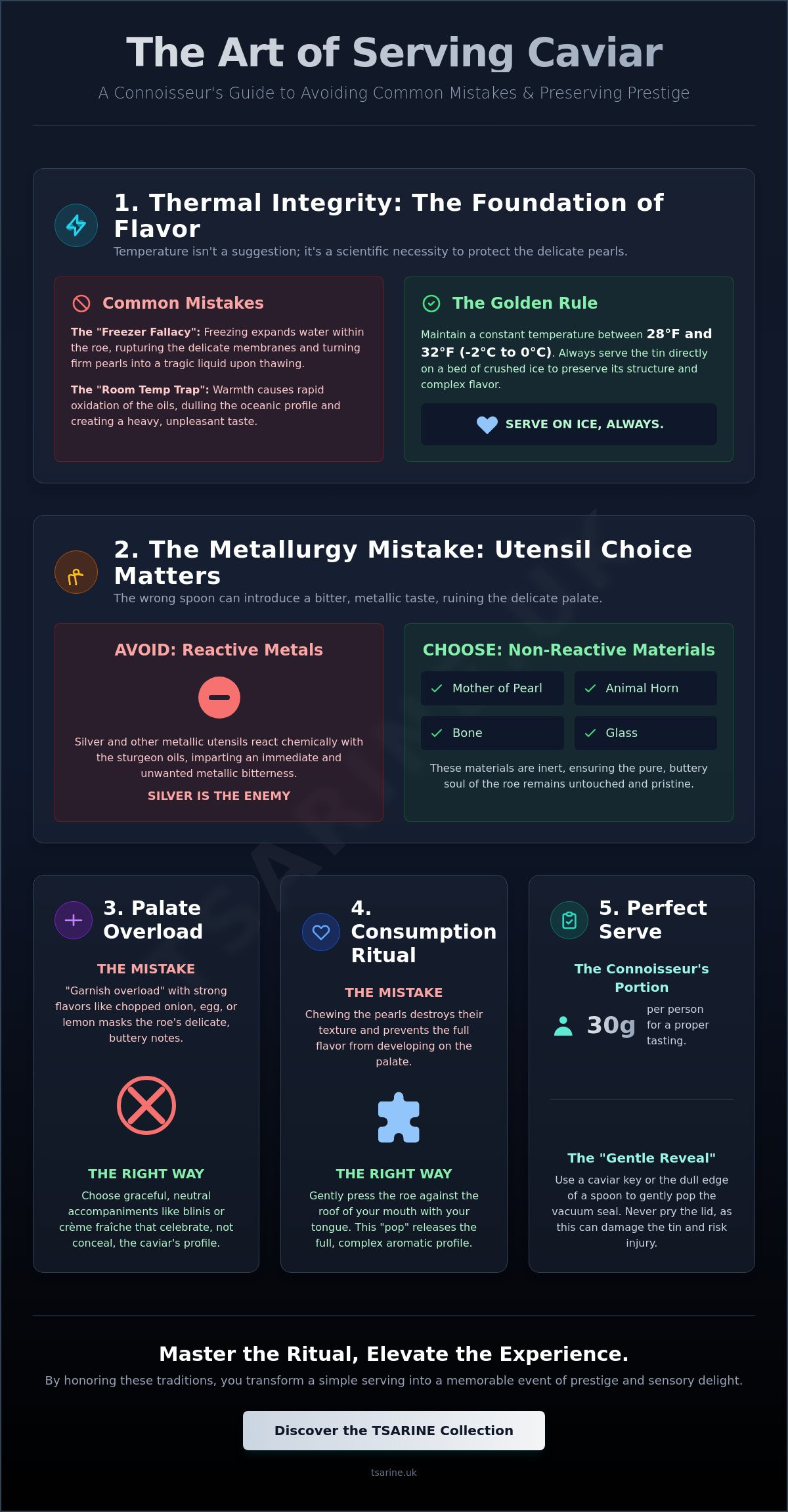
The sturgeon's bounty is a temperamental mistress, demanding a climate of constant, shivering grace to maintain her structural perfection. One of the most heartbreaking and common mistakes serving caviar is the "Freezer Fallacy," a misguided attempt at preservation that results in the crystalline destruction of each pearl. When the water within the roe freezes, it expands with a silent violence, rupturing the delicate membranes that define the texture of our Siberian Sturgeon Caviar. Once thawed, the once-firm pearls collapse into a tragic, uninspired liquid, stripped of the characteristic pop that signifies technical mastery.
Equally perilous is the "Room Temperature Trap," where the warmth of a celebratory room causes the rapid oxidation of the complex lipids found in sturgeon oil. Within minutes of exposure to heat, the vibrant, oceanic profile begins to dull, replaced by a heavy, oily sensation that masks the sophisticated aromatic notes. To avoid this, an ice bed is not a mere aesthetic choice but a scientific necessity. The tin must remain in direct contact with crushed ice to maintain a temperature between 28 and 32 degrees Fahrenheit, a standard often emphasized in expert caviar service. For those seeking to host with such precision, the TSARINE Caviar Luxury Gift Set provides the perfect vessel to ensure your presentation remains as chilled as the deep waters from which the roe emerged.
The 15-Minute Rule: Timing the Reveal
Patience is a virtue, but timing is the soul of the tasting. You should never break the vacuum seal more than fifteen minutes before the first guest is invited to indulge. If left exposed for too long, the caviar begins to "sweat," a visual signal that the precious oils are separating from the roe. This loss of freshness is irreversible, turning a moment of prestige into a race against the clock. Keep the lid resting lightly atop the tin until the very moment of service to preserve the cool, saline kiss of the sea.
Storage Sins After the Seal is Broken
Once the seal is broken, the clock of perfection begins a rapid descent. While an unopened tin may rest gracefully in the coldest reach of your refrigerator for weeks, an opened vessel has a true window of only twenty-four hours before its character begins to shift. A frequent error is relying on the original tin lid alone, which rarely provides an airtight barrier once disturbed. To protect the remaining pearls, press a small piece of plastic film directly onto the surface of the roe before sealing the lid, ensuring no air can tarnish the delicate profile. If the aroma shifts from a clean, oceanic breeze to something overtly fishy, the moment of grace has passed. Recognizing these common mistakes serving caviar is the first step toward becoming a true steward of the sturgeon's legacy.
The Metallurgy Mistake: Why Silver is the Enemy of the Sturgeon
To introduce a silver utensil to a tin of Siberian Sturgeon Caviar is to invite a chemical saboteur into a royal court. While silver is often associated with the most prestigious dining traditions, it is among the most egregious and common mistakes serving caviar due to its high reactivity with organic compounds. When the delicate, sulfur-rich oils of the roe meet silver, an immediate oxidation occurs. This reaction doesn't just tarnish the spoon; it imparts a sharp, metallic bitterness that clings to the tongue and masks the clean, oceanic finish intended by the technical mastery of the producer. To truly honor the harvest, one must understand that the choice of service ware is a matter of both science and soul.
It's a frequent misconception that all metals are strictly forbidden. While silver is the primary antagonist, high-quality stainless steel is technically inert and won't leach flavor into the pearls. However, stainless steel lacks the historical soul and tactile grace of traditional materials that have graced noble tables for centuries. To truly protect the sensory experience, the mother of pearl spoon remains the gold standard. This iridescent tool is a functional necessity rather than a mere aesthetic flourish. Its calcium carbonate composition remains entirely neutral, allowing the complex aromatic profiles of the White Sturgeon Caviar to bloom on the palate without any metallic interference. For those who wish to explore beyond shell, bone, horn, and even 24-karat gold offer similar palate-neutral properties that respect the artisanal heritage of the founding house.
The Chemistry of Oxidation
Silver acts as a potent catalyst for the rapid breakdown of the fragile lipids within the sturgeon oil. This reaction doesn't merely dull the flavor; it actively alters the chemical structure of the roe's delicate membrane. Even a five-second contact with silver can leave a permanent metallic residue on the palate. This lingering taint is the antithesis of the sensory delight we strive to create, turning a high-art encounter into a muted disappointment.
Handling the Pearls: The "No-Crush" Policy
Beyond the choice of material, the manner in which you lift these treasures from their ornamental vessel is paramount. One of the common mistakes serving caviar is a heavy-handed approach that treats the roe like a common spread rather than a collection of fragile glass spheres. You should never stir or press the pearls within the tin, as this ruptures the membranes prematurely. Instead, use a gentle, vertical lifting motion to scoop the roe, preserving the structural integrity of each individual bead. This meticulous care ensures that the signature "pop" occurs only when the pearl is pressed against the roof of your mouth, releasing its saline essence in a single, melodic burst of flavor.
Composing the Palate: Avoiding Overpowering Pairings and Texture Errors
To orchestrate a tasting is to compose a symphony of subtle notes, where the sturgeon remains the undisputed soloist of the evening. One of the most persistent and common mistakes serving caviar is the tendency toward "Garnish Overload," where pungent red onions, capers, and sharp lemon wedges are permitted to drown out the delicate, nutty butteriness of the roe. While these aggressive additions were historically used to mask the flavor of lesser-quality or poorly preserved harvests, they serve only to obscure the technical mastery of a premium tin. A true connoisseur understands that the accompaniments should act as a quiet frame for the masterpiece, rather than competing for the palate's attention.
The physical act of consumption is a ritual that demands a specific, unhurried grace. Chewing is a cardinal sin. To bite down on these pearls denies the tongue the opportunity to fully explore the roe's complex aromatic profile. Instead, you should gently press the roe against the roof of the mouth, allowing the pressure to coax a single, melodic release of saline essence. This "pop" is the crescendo of the experience, and it's easily lost if the pearls are served on a base that's too thick or too flavorful. The "Blini Balance" is essential; the base should be a mere whisper of texture, ensuring the sturgeon remains the star of the show.
Beverage selection is another area where many well-intentioned hosts falter. Heavy red wines, with their assertive tannins, or overly sweet cocktails clashing with the brine, create a discordant experience that can feel almost abrasive. The goal is a neutral companion that respects the sea's saline kiss. To begin your own journey into these refined pairings, explore our curated collections at Tsarine.
The Art of the Pairing
Traditionalists favor ultra-dry Champagne or ice-cold Vodka because these spirits cleanse the palate without introducing conflicting sugars. A subtle error often made is serving warm accompaniments in close proximity to the chilled roe, which can inadvertently raise the temperature of the tin and hasten oxidation. Instead, use a dollop of crème fraîche as a "fatty bridge," providing a velvety cushion that carries the salt across the palate with effortless elegance.
Texture and the "Pop"
Every species possesses its own character, from the firm, assertive snap of Osetra to the creamy, lingering melt of Siberian Sturgeon. Mixing these different grades in a single bite is a common mistake serving caviar that prevents the taster from appreciating the unique lineage of each house. To maintain the integrity of the tasting, ensure a clean palate between varieties, perhaps with a sip of water or a neutral cracker.
The Tsarine Experience: Mastering the Art of the Perfect Serve
To host a caviar tasting is to step into the role of a cultured curator; one who understands that the final presentation is the bridge between artisanal heritage and a guest’s enduring memory. One of the final yet most common mistakes serving caviar involves a simple lack of preparation regarding quantity. To ensure every guest feels the weight of regal indulgence without the scarcity that prompts hesitation, the connoisseur’s rule of 30 grams per person should be your guiding star. This generous portion allows for a truly sensory-rich experience, ensuring the noble Siberian or White Sturgeon roe remains the focal point of the conversation rather than a fleeting whisper.
The physical act of opening the tin is where many hosts lose their composure. A vacuum-sealed vessel protects the soul of the harvest, but a forceful or impatient hand can cause the tin to slip, damaging the fragile pearls or leading to an ungraceful spill. The "Gentle Reveal" requires a steady, rhythmic approach. Use a specialized caviar key or a sturdy, flat-edged tool to slowly break the seal at multiple points around the rim. Listen for the soft hiss of air, a melodic signal that the vacuum has been released, before lifting the lid with a vertical, unhurried motion. For those seeking to present this ritual in its most ornamental form, the Tsarine Caviar Luxury Gift Set offers a complete ensemble that transforms these technical steps into a high-art encounter.
The Step-by-Step Table Setup
Your table should be a palate of silence and light. Place the opened tin within a specialized crystal server or a simple bed of crushed ice, ensuring the base remains at that vital, shivering temperature mentioned earlier. Arrange your Mother of Pearl spoons at a slight angle, inviting guests to reach for the treasure with ease. As the host, you might guide the first bite, encouraging your guests to bypass the common mistakes serving caviar by ignoring the heavy garnishes and pressing the roe against the palate to experience the full, oceanic pop of the harvest.
Concluding the Evening
As the evening wanes, the stewardship of the sturgeon continues. A frequent error is leaving the tin open on the table after the tasting has concluded, exposing the remaining oils to the air and dulling their character. Close the tin promptly and return it to the coldest reach of your refrigerator. When cleaning your luxury serving accessories, use only warm water and a neutral, unscented soap to ensure no residual fragrances tarnish the next occasion. Finally, invite your guests to share their sensory impressions; this shared reflection cements the memory, ensuring the experience remains as timeless as the nobility that inspired it.
Embracing the Ritual of the Deep
The journey from the silent depths of sustainable Italian farms to your table is a passage of many years, a narrative that deserves to be told with the utmost reverence. By mastering the delicate nuances of thermal integrity and the absolute necessity of palate-neutral materials, you ensure that the artisanal Malossol curing process remains the undisputed star of your sensory encounter. Avoiding the common mistakes serving caviar, such as the use of reactive silver or the distraction of overbearing garnishes, transforms a simple tasting into a historic celebration of prestige and taste. Every pearl is a noble figure waiting to unveil her secrets, a moment made effortless through our London-based luxury delivery services.
To begin your own tradition of excellence, we invite you to Savour the ritual with a Tsarine Caviar Luxury Gift Set, where every element is curated to honor the sturgeon's legacy. It's a world where tradition meets technical mastery, and we welcome you to let your next gathering be a testament to your refined taste and enduring grace. By protecting the integrity of the harvest, you don't just serve a delicacy; you curate a memory that will linger long after the final pearl has been savoured.
Frequently Asked Questions
Can I use a high-quality stainless steel spoon if I don’t have Mother of Pearl?
Yes, high-quality stainless steel is a perfectly safe, non-reactive alternative to Mother of Pearl, as it does not oxidize when in contact with the delicate oils of the roe. While it lacks the iridescent, artisanal beauty of traditional shell utensils, it will not impart the metallic bitterness that defines one of the most common mistakes serving caviar. To maintain the prestige of your presentation, ensure the metal is polished and free of any residual scents from previous use.
How long can I leave a tin of caviar open on the table during a party?
You should aim to keep the tin open for no more than fifteen to twenty minutes to ensure the lipids don't begin to oxidize in the ambient air. Even when nestled in a bed of crushed ice, prolonged exposure to oxygen eventually dulls the vibrant, oceanic profile that defines a premium harvest. If your gathering is a long one, it's wiser to serve smaller tins throughout the evening rather than leaving one large vessel exposed to the elements.
Is it a mistake to serve caviar with lemon wedges and chopped onions?
Serving aggressive garnishes like lemon and onion is considered a mistake because their high acidity and pungent aromas mask the subtle, buttery notes of the sturgeon. These additions were historically used to hide the flaws of lesser harvests or poorly preserved roe, whereas a fine Siberian or White Sturgeon roe should be allowed to sing on its own. If you must offer accompaniments, choose neutral bases like a light crème fraîche to act as a fatty bridge for the salt.
Why do people say you shouldn’t chew caviar?
Chewing is avoided because it bypasses the sensory crescendo of the "pop," which occurs when the pearls are gently pressed against the roof of the mouth. This physical ritual allows the tongue to fully engage with the complex aromatic oils and the delicate, saline essence of the roe. By rolling the pearls across the palate instead of biting them, you release the flavor in a single, melodic burst that lingers much longer than a chewed bite would allow.
Can I freeze my leftover caviar to keep it for a later date?
You must never freeze your leftover caviar, as the expansion of ice crystals will rupture the fragile membranes and turn the texture into a tragic, watery liquid. Once the seal is broken, the pearls should be enjoyed within twenty-four hours to respect the technical mastery of the artisanal curing process. If you find yourself with an abundance, it's far better to indulge in a larger second portion than to ruin the structural integrity of the roe in the freezer.
What is the most common mistake people make when buying caviar for the first time?
The most frequent error for first-time purchasers is neglecting to verify the mandatory CITES labeling, which ensures the product is legally and sustainably sourced from aquaculture. This label provides essential information about the species, country of origin, and year of production, allowing you to track the legal harvest back to its source. Many are swayed by lower prices without considering the producer's lineage or the transparency of the supply chain, which is vital for ensuring quality.
Does the type of water I use for the ice bed matter?
The specific type of water used for your ice bed does not affect the flavor, provided the tin remains sealed or elevated to prevent meltwater from entering the roe. Your primary focus should always be on maintaining that shivering thermal integrity between 28 and 32 degrees Fahrenheit to protect the roe's soul. As long as the ice is clean and the vessel is secure, the source of the water is secondary to the consistency of the chill.
Is it okay to serve caviar on a warm blini or should the base be cold?
Serving caviar on a slightly warm, freshly toasted blini is a classic tradition, provided the roe is added at the very last second before consumption. The brief contrast between the warmth of the base and the chilled pearls creates a sensory delight that many connoisseurs cherish. However, letting the roe sit on a hot surface for any length of time is a sure way to degrade its texture and accelerate the oxidation of its delicate oils.