
How to Check Caviar Freshness: A Connoisseur’s Guide to the Perfect Pearl
The true soul of a Siberian Sturgeon or White Sturgeon pearl lies not in its price, but in the fleeting moment of its absolute peak, where the briny essence of the water meets a buttery, refined grace. You might find yourself hesitating before a grand evening, haunted by the quiet fear that a high-value investment has lost its luster or that a subtle aroma might signal something other than artisanal excellence. Mastering how to check caviar freshness is the essential rite of passage for any host who wishes to serve their guests with the unwavering confidence of royalty, ensuring that the legacy of the founding house is honored in every bite.
By learning to engage your senses, you'll transform a moment of uncertainty into a celebratory ritual of quality. This guide promises to refine your palate and your eye, teaching you to identify the glossy, intact structure of a fresh pearl and the clean, oceanic scent that defines a true delicacy. We'll walk through the professional techniques of sensory evaluation and the vital importance of modern traceability, including the stringent 2026 labeling regulations that now safeguard the global market. This knowledge ensures that every spoonful from your Tsarine Caviar Luxury Gift Set remains a masterpiece of safety, elegance, and flavor.
Key Takeaways
- Identify the jewel-like brilliance of each individual pearl, where a shimmering lustre serves as the first visual testament to the gentle hand of traditional Malossol processing.
- Discover how to check caviar freshness by seeking a delicate, oceanic fragrance of cream and brine rather than the sharp, metallic notes that signal a loss of elegance.
- Discern the vital sensory distinction between a firm, resilient "pop" on the palate and the unappealing softness of roe that has begun to fade.
- Listen for the distinctive "vacuum kiss" upon opening a tin, a melodic indicator that the seal remains perfect and the contents are preserved in their peak state.
- Recognize the immediate warning signs of spoilage to protect your guests, while understanding how our "Fresh-Pack" philosophy ensures your Siberian or White Sturgeon caviar arrives with its soul intact.
The Visual Prelude: Assessing the Lustre and Colour of the Roe
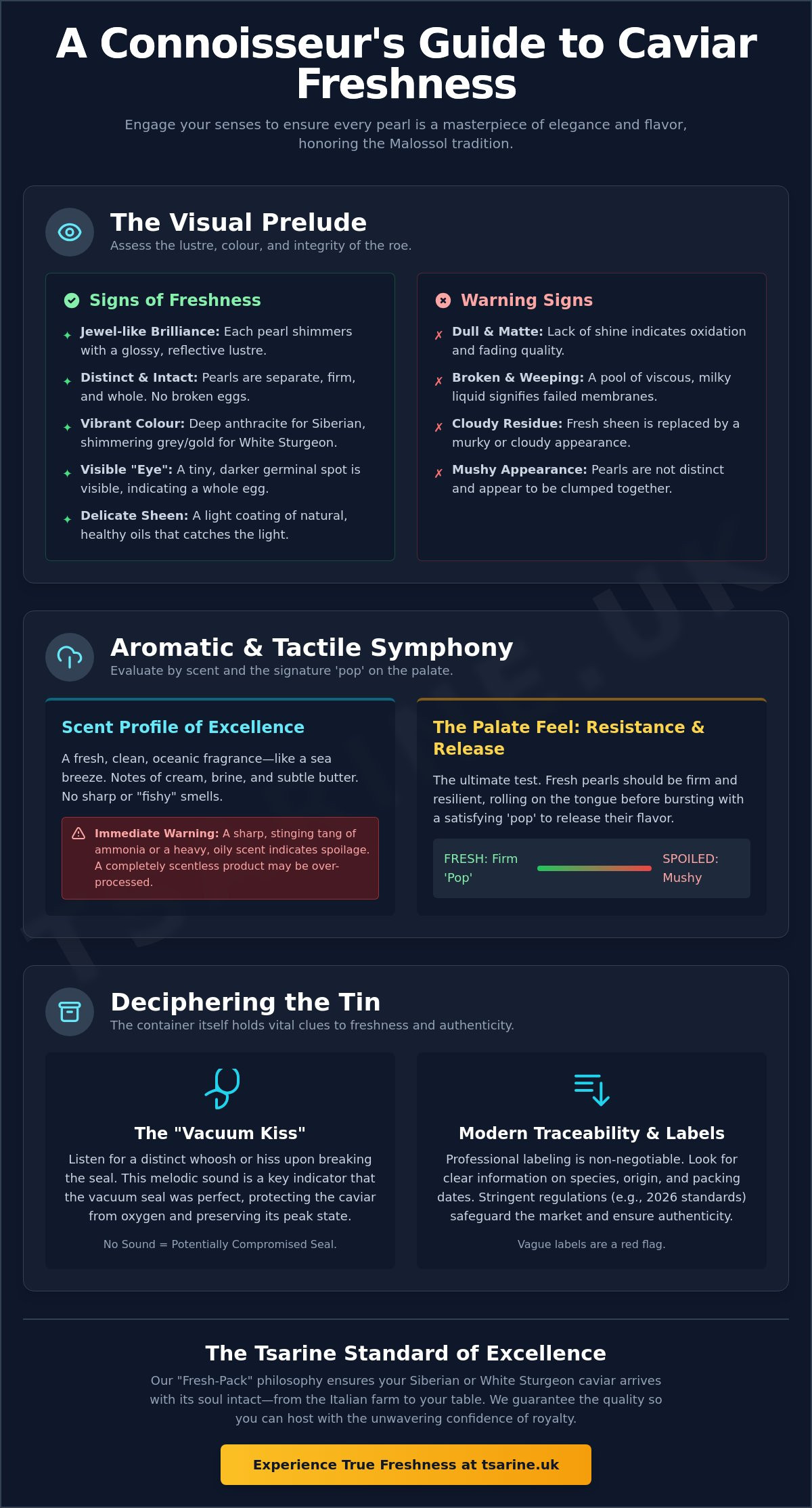
The opening of a tin is a ceremony of light. When you seek to understand how to check caviar freshness, your first teacher is the eye. Fresh sturgeon roe exists in a jewel-like state, where every individual pearl stands as a testament to its own integrity, shimmering with a quiet brilliance that hasn't yet been dimmed by time. This aesthetic perfection is often a result of the Malossol method, a traditional "little salt" preparation that allows the natural character of the roe to speak for itself. Without the heavy veil of excessive preservatives, the true palette of the Caviar remains vibrant and alive. Oxidation is the silent thief of this beauty, slowly robbing the pearls of their depth and leaving behind a dull, matte finish that suggests the luxury has begun to fade. Lustre in caviar is a clear, reflective quality without cloudiness.
Species-Specific Visual Cues
Each variety of sturgeon carries its own unique regal signature. When evaluating our Siberian Sturgeon Caviar, look for deep, dark anthracite tones that evoke the mystery of deep waters. In contrast, the White Sturgeon Caviar presents a more ethereal display of shimmering grey and subtle gold nuances. Regardless of the species, the surface should be clean and the pearls distinct. If you observe a pool of thick, viscous liquid at the bottom of the vessel, it's a sign that the delicate membranes have failed. Broken eggs are more than just a visual flaw; they're a warning that the structural soul of the product has been compromised.
The Clarity Test: Looking for the 'Eye'
A discerning host looks deeper than the surface. Within each perfect pearl, you should be able to see the "germinal spot," often referred to as the eye. This tiny, darker point indicates that the egg is whole and has been handled with the grace it deserves. It's essential to distinguish between the natural, healthy oils that coat the roe and the "weeping" of an aged tin. Freshness creates a delicate sheen that catches the light, whereas spoilage produces a milky or cloudy residue. When light hits the surface of a freshly opened 50g tin, it should dance across the curves of the pearls, reflecting a world of purity and meticulous care. This visual harmony is your first assurance of a high-art encounter.
Understanding these visual nuances allows you to move beyond mere consumption and into the realm of connoisseurship. It's about recognizing the difference between a product that's merely safe and one that's truly magnificent. As you prepare to share your Wholesale Caviar Orders with guests, these visual cues provide the foundation for an evening of absolute confidence and refined taste.
The Aromatic and Tactile Symphony: Texture and the 'Pop'
Once the eyes have been satiated by the visual brilliance of the roe, the journey of evaluation descends into a more intimate, aromatic realm. Understanding how to check caviar freshness requires a delicate nose, one capable of discerning the whisper of the sea from the shout of the fishmonger's stall. A truly fresh pearl shouldn't carry a heavy, oily scent, but rather a clean, ozonic fragrance that evokes a morning breeze over salt-dusted waters. This olfactory clarity is the hallmark of a noble product, preserved with the lightness of the Malossol technique to ensure that the subtle, buttery notes of the sturgeon’s natural fats are celebrated rather than masked. The nose is the gateway to the soul of the pearl.
The Olfactory Profile of Excellence
A sharp, stinging tang of ammonia is an undeniable signal that the luxury has surrendered to time, necessitating an immediate departure from the table. While the FDA labeling guidelines provide a framework for the correct identification of these treasures, the nose remains the final arbiter of truth in the connoisseur's hand. Conversely, a completely scentless experience can be equally telling; it often hints at over-processing or the unfortunate result of past-prime freezing which strips the roe of its character. The ideal aromatic profile is a symphony of cream and brine, a scent that feels firm yet yielding to the senses, inviting you to proceed with the tactile encounter.
The Palate Feel: Resistance and Release
The true climax of the freshness ritual occurs upon the palate, where the texture must perform a precise, melodic dance of resistance and release that distinguishes a premier harvest from a fading one. When we explore the intricate details of what is caviar, we focus heavily on the 'Caspian Pop,' a legendary sensation where individual, liquid-filled spheres roll gracefully across the tongue before yielding their treasures to a gentle, purposeful pressure. This subtle resistance of the egg wall is perhaps the most definitive method for those learning how to check caviar freshness during a tasting.
If the pearls appear sticky, feel unpleasantly grainy, or dissolve into a soft, characterless mush before you've had the chance to savor their complexity, the structural soul of the roe has sadly departed. Using a chilled mother of pearl spoon ensures that the temperature remains optimal, preserving the 'firm yet yielding' character that defines our Siberian Sturgeon Caviar. At the correct serving temperature, nestled over a bed of crushed ice, the pearls should behave like a collection of tiny, distinct jewels of art rather than a desperate, sticky mass.
Deciphering the Tin: Seals, Labels, and the 'Vacuum Kiss'
Before the first dark pearl is ever glimpsed, the vessel itself whispers secrets of its journey from the cold, pristine waters to your table. The physical integrity of the tin is the first chapter in the story of its preservation, acting as a silent guardian of the delicate cargo within. When considering how to check caviar freshness, one must first examine the exterior for any blemish of rust or the unsightly, telltale curve of a bloated lid. A lid that has lost its flat, taut profile often signals the presence of gas produced by unwanted fermentation; it's a silent scream of spoilage that no connoisseur should ignore. The seal should be absolute, a promise of an anaerobic sanctuary where the roe has rested undisturbed.
The moment of opening should be a sensory delight, characterized by what experts call the 'Vacuum Kiss.' This is the melodic sigh of air finally meeting the roe, accompanied by a distinct resistance as you pry the lid from its base. If the lid yields too easily, or if that signature hiss is absent, the seal may have been compromised long before it reached your hand. Once open, observe the 'oil line' within. While a delicate sheen is expected, pearls that appear to be drowning in a thick, cloudy pool suggest that the membranes have wept, indicating that the roe is past its prime or has suffered through improper temperature fluctuations during transit.
The Anatomy of a Luxury Caviar Tin
At Tsarine, we treat our vessels as works of art, utilizing specific internal linings designed to prevent metallic taints from ever touching the soul of the sturgeon roe. This meticulous attention to detail extends to our prestige seals, often a thick rubber band that maintains the vacuum with unwavering loyalty. It's vital to distinguish between a tin packed at the source and one that has been 're-packed,' as every transfer of the roe introduces a risk of oxidation. When you're buying caviar in London, seeking out source-packed tins ensures the shortest possible path from the artisan to your palate.
Reading the Connoisseur’s Code
The label on the reverse of the tin is a map of its heritage, etched in the universal language of CITES. Every legal tin of sturgeon roe must display this code, which includes the species (such as BAE for our Siberian Sturgeon or TRA for White Sturgeon), the country of origin, and the year of harvest. As of 2026, new regulations in major producing regions have further digitized this traceability, making it easier than ever to verify the pedigree of your purchase. You should also look for the lot number and distinguish between the 'Best Before' date, which speaks to the peak of sensory perfection, and the 'Use By' date, which marks the final threshold of safety. Understanding these nuances is essential for anyone mastering how to check caviar freshness with the authority of a true host.
Critical Warning Signs: When the Luxury Has Faded
While the opening of a tin should be a melodic invitation, there are moments when the song turns discordant, revealing that the delicate spirit of the roe has been lost to the ravages of time or neglect. Learning how to check caviar freshness involves a sober recognition of these failures, beginning with the "Ammonia Alert," a sharp, nose-stinging scent that serves as an immediate, non-negotiable ground for disposal. Any tin that 'hisses' or pops outward upon opening is compromised. Beyond the scent, your eyes must remain vigilant for visual red flags such as the presence of mould, the appearance of milky liquids, or a significant, uneven discolouration that suggests the pearls have surrendered their structural integrity. When the once-vibrant palette of the sturgeon roe turns dull and grey, the soul of the product has likely departed.
The taste of time is equally unmistakable, serving as a final, unfortunate confirmation of a faded harvest. A fresh pearl should offer a buttery, nutty embrace that lingers gracefully on the palate; however, when spoilage takes hold, this profile twists into something rancid, bitter, or unpleasantly metallic. This isn't the refined mineral finish of a high-quality harvest, but a harsh chemical dissonance that signals the end of its luxury. To ensure your table is always graced by the peak of perfection, we invite you to explore our freshly harvested Siberian Sturgeon Caviar, where every tin is a testament to artisanal excellence.
Oxidation vs. Spoilage
It's helpful for the sophisticated host to distinguish between mere oxidation and true, dangerous spoilage. You might wonder if you can eat caviar that has slightly darkened; often, minor air exposure during a long dinner might dim the lustre without making the roe unsafe, though the sensory experience will certainly be diminished. Similarly, the "drying out" effect occurs when pearls lose their plumpness and become slightly recessed, yet they may remain safe if they've been kept at the correct temperature. However, you should never risk consumption if the storage temperature has exceeded 4°C for more than two hours, as the delicate proteins of the sturgeon roe are highly sensitive to warmth and can foster rapid bacterial growth.
The Golden Rule of Discarding
In the world of high-protein delicacies, the golden rule remains: when in doubt, throw it out. The risks of Listeria and other pathogens in improperly stored seafood are far too great to ignore for the sake of a single spoonful, no matter how precious the investment. To protect your guests and your home, safely dispose of spoiled roe by sealing the tin in a separate bag before placing it in an outdoor bin, ensuring your kitchen environment remains as pure as the royal festivities that inspire our brand. This commitment to safety is the final mark of a true connoisseur, one who values the health and well-being of their guests above all else.
The Tsarine Standard: From the Italian Farm to Your Table
The journey of a Tsarine pearl is a narrative of patience and precision, beginning in the tranquil sanctuary of our sustainable Italian farm. Understanding how to check caviar freshness becomes an effortless endeavor when the provenance of the roe is as clear and pristine as the waters from which it emerged. We believe that the soul of the sturgeon must be honored through every stage of its life, and our farm is meticulously designed to mimic the natural, flowing environments of these ancient, noble creatures. This dedication to ethical mastery ensures that every tin of our Siberian or White Sturgeon roe arrives with the same vibrant, lustrous character it possessed at the moment of harvest, ready to be celebrated by the most discerning of hosts.
Our 'Fresh-Pack' philosophy is the cornerstone of this commitment, a deliberate choice to minimize the temporal distance between the artisanal curing and its arrival at your London doorstep. We don't believe in the hurried, mass-market approach; instead, we treat each harvest as a bespoke encounter, ensuring the cold chain remains an unbroken, icy embrace. This temperature-controlled logistics system is the silent guardian of the roe’s integrity, preventing the subtle butteriness of the fats from ever succumbing to the warmth that leads to spoilage. Our Tsarine Guarantee is more than a simple promise; it's a testament to a lineage of quality that has graced royal tables for centuries, ensuring that your Wholesale Caviar Orders arrive in a state of absolute perfection.
Sustainable Mastery in Every Tin
The superior quality of our roe isn't an accident of nature, but a result of artisanal curing and the use of exceptionally pure water that echoes the sturgeon's ancestral home. By prioritizing the health of the fish and the purity of their environment, we allow the pearls to develop a resilience and depth of flavor that is rarely found in the modern market. This artisanal care extends the natural window of excellence, providing you with a product that is as resilient as it is delicate. To truly appreciate the heritage behind each spoonful, we invite you to explore the Tsarine Caviar story, where the intersection of sustainability and regal history is explored in depth.
Serving Your Fresh Caviar with Grace
The final chapter of this sensory journey rests in your hands, where the 'last mile' of freshness is preserved through the grace of your own table. Even the most perfectly handled tin requires a bed of crushed ice to maintain its firm yet yielding texture until the very moment of service. When you know how to check caviar freshness, you recognize that temperature is the final key to unlocking the complex aromatic profiles we've nurtured. Once you've ensured your pearls are at their peak, follow our elegant guide on how to eat caviar to transform your evening into a high-art encounter. Experience the pinnacle of freshness—shop our Siberian and White Sturgeon collections today.
Embarking on Your Next Sensory Encounter
With the wisdom of a true connoisseur, you're now prepared to transform every gathering into an exquisite celebration of the senses. By recognizing the jewel-like lustre of the roe and listening for the melodic sigh of the vacuum seal, you ensure that every guest experiences the pinnacle of artisanal mastery. Mastering how to check caviar freshness is the final step in honoring the lineage of the sturgeon; it allows you to serve with the unwavering confidence of a host who values both tradition and safety. You've learned to seek the clean fragrance of the sea and the resilient pop that defines a truly fresh harvest, moving beyond mere consumption into a world of refined taste.
To ensure your next event is graced by this same uncompromising quality, we invite you to explore our expertly curated Malossol selection. Sourced from our sustainable Italian farms and delivered with next-day London delivery in meticulously chilled packaging, our roe is a promise of sensory delight. Step into a world where every pearl is a work of art, preserved in its most vibrant state for your enjoyment. Discover the Lustre of Fresh Tsarine Caviar and let your journey into regal magnificence begin today.
Frequently Asked Questions
How long does an unopened tin of caviar stay fresh in the fridge?
An unopened tin of our Siberian or White Sturgeon roe will typically retain its peak character for four to six weeks when nestled in the coldest part of your refrigerator. To ensure you understand how to check caviar freshness over time, always maintain a temperature between 28 and 32 degrees Fahrenheit. This steady, icy embrace preserves the delicate soul of the pearls until the moment they are called to grace your table.
Can I tell if caviar is fresh without opening the tin?
While the true revelation occurs upon opening, you may assess the physical state of the vessel to gauge its internal health. A tin that appears bloated or exhibits signs of rust suggests that the anaerobic sanctuary within has been disturbed. By examining these external cues, you're able to gain a preliminary sense of whether the luxury has been maintained with the meticulous care it deserves.
What does spoiled caviar actually smell like?
Spoiled roe betrays itself through a sharp, aggressive scent of ammonia or a sour, putrid aroma that stings the senses. This is a far cry from the clean, ozonic fragrance that characterizes a fresh harvest. If the nose encounters any hint of chemical harshness rather than a gentle oceanic breeze, it's a definitive signal that the product should be surrendered to disposal immediately.
Is it normal for caviar to have a slight fishy scent?
A truly fresh pearl should never carry a heavy or unpleasant fishy scent, but rather a subtle, buttery aroma of the sea. While a delicate hint of brine is natural, a "fishy" profile often indicates that oxidation has begun to dim the roe's brilliance. Learning how to check caviar freshness involves distinguishing between these clean, aquatic notes and the weary, sharp scent of age.
How long can I keep caviar after the tin has been opened?
Once the seal has been broken, the roe should be savored within two to three days to experience its most vibrant and refined profile. During this brief window, the tin must remain tightly sealed and kept at the lowest possible temperature. To prolong this fleeting beauty during an evening of celebration, always keep the vessel nestled in a bed of crushed ice.
Does the colour of the caviar indicate how fresh it is?
While each species possesses its own regal palette, a loss of freshness is typically signaled by a dull, matte finish rather than a change in base colour. Fresh roe should shimmer with a jewel-like lustre that catches the light. If the pearls appear cloudy or are surrounded by a milky liquid, it's a sign that the structural integrity of the delicate membranes has faded.
What should I do if my caviar tin doesn't make a 'pop' sound when opened?
If the signature "vacuum kiss" or sigh of air is absent upon opening, the integrity of the seal may have been compromised. While this doesn't always signal immediate spoilage, it necessitates a more rigorous sensory evaluation of the scent and texture. Without that protective vacuum, the pearls are more susceptible to the silent, dulling effects of air exposure and potential degradation.
Can I freeze caviar to keep it fresh for longer?
Freezing sturgeon roe is a practice that should be avoided, as it cruelly disrupts the delicate architecture of each individual egg. When the water within the pearl expands into ice, it tears the fragile membranes, resulting in a soft, characterless mush upon thawing. To preserve the legendary pop of our White Sturgeon Caviar, always rely on consistent, chilled refrigeration rather than the harshness of the freezer.