
How to Describe Caviar Texture: A Guide to Every Sensation
What if the clearest way to describe caviar texture is to follow each pearl from first contact to finish? If you’ve ever wondered how to describe caviar texture and reached only for “smooth” or “soft”, you’re not alone. A tasting can reveal much more: the pearls’ size, how they respond to gentle pressure, the delicacy of their skins and the sensation they leave behind.
Texture is personal. Impressions can vary with the caviar, the way it’s served and what you notice first. That doesn’t make your description less accurate. It makes careful sensory language useful, and you don’t need specialist jargon to express what you feel.
This guide will help you recognise distinct sensations, from a firm pearl that holds its shape to a delicate one that yields gently, and find words for each stage of a taste. We’ll explore size, firmness, delicacy and finish, so your description becomes a clear account of the experience rather than a single, uncertain adjective.
Key Takeaways
- Learn how to describe caviar texture by tracing each pearl’s sensations, from first contact to lingering finish.
- Choose precise, plain-English words for size, firmness, delicacy and cohesion instead of relying on “smooth” or “soft”.
- Compare samples one textural quality at a time, using neutral notes rather than declaring an overall winner.
- Follow a simple tasting sequence: observe, notice, select descriptors, then write a clear account of what you felt.
- Explore texture as part of a considered tasting of TSARINE Caviar, sourced from a sustainable farm in Italy and including Siberian and White Sturgeon varieties.
What does caviar texture mean when you taste it?
Caviar texture is how the pearls feel and behave in the mouth. It describes tactile sensations: whether the eggs feel small or substantial, firm or yielding, delicate or cohesive, and how their presence fades at the finish. If you’re learning how to describe caviar texture, start with what you physically notice rather than deciding immediately whether it is good or bad.
Texture is one part of a tasting, distinct from flavour, aroma and appearance. A pearl may look glossy or have a particular colour, while its mouthfeel is described separately. Likewise, “creamy” describes a sensation, not a definitive measure of quality. Texture notes record what one taster experiences; they aren’t a universal grade or a verdict every palate must share. General overviews of caviar also discuss texture and firmness among the quality factors for caviar, but your tasting description can stay focused on your own observations.
How is caviar texture different from caviar taste?
Mouthfeel words describe touch: “firm” suggests a pearl that resists gentle pressure, while “delicate” suggests one that yields readily. Flavour words describe what you taste, and aroma words describe what you smell. For example, you might note a briny flavour and a delicate mouthfeel in the same tasting. The brininess doesn’t prove that the pearls are delicate; each observation belongs to a different part of the experience. For more on the food itself, explore what caviar is.
Which moments of a tasting reveal texture?
Notice the experience in sequence. First, consider the pearls’ initial contact: do they feel distinct, fine or substantial? Next, pay attention to what happens under gentle pressure in the mouth. Do they hold their shape, yield or seem to release their contents? Finally, observe the finish: does the sensation disappear quickly, linger softly or leave a lasting impression of the pearls’ skins?
These moments don’t need to produce dramatic sensations. Differences can be subtle, and another taster may describe the same caviar differently because attention, expectation and individual perception vary. That’s not a flaw in your account. A clear description separates what you felt from what you tasted, smelled or saw, making room for precise language without presenting personal impressions as absolute.
Which words describe caviar texture most precisely?
Precise tasting notes separate the pearl’s qualities instead of asking one adjective to do everything. Consider five dimensions: size, firmness, delicacy, cohesion and finish. No single adjective captures every texture; a clear description lets several sensations speak in turn.
- Size: “Small”, “medium” and “large” compare the pearls as you perceive them. They’re relative observations, not quality grades.
- Firmness: “Firm” suggests resistance to gentle pressure; “yielding” describes a pearl that gives more readily while retaining some presence.
- Delicacy: “Delicate” conveys a fine, tender impression, often one that seems to give way easily. It isn’t a synonym for poor structure.
- Cohesion: “Distinct” suggests pearls that remain individually noticeable, while “soft” or “creamy” may describe a more unified mouthfeel. “Grainy” can note a perceptible granular sensation without deciding whether it is pleasing.
- Finish: “Quick”, “lingering” or “clean” describes how the textural impression fades. “Clean” is a personal description of the finish, not a formal standard.
How can you describe size and firmness?
Use size words comparatively: “the pearls feel larger than the last sample” says more than treating “large” as an absolute measure. Then consider how each pearl responds. A resilient texture suggests it holds its shape and gently pushes back; a delicate one yields with little resistance. These sensations can coexist, and neither is inherently superior. Avoid assuming that a particular sturgeon variety always has a specific size or firmness.
What do creamy, smooth and clean mean?
“Creamy” describes a soft, rounded mouthfeel, not a guaranteed flavour such as cream or butter. “Smooth” suggests that you perceive little roughness or graininess, so give it context: for example, smooth as the pearls move across the palate. “Clean” usually refers to a finish that feels clear or unencumbered to the taster. Since it’s subjective rather than a defined grade, pair it with what you noticed, such as a clean finish that fades quickly.
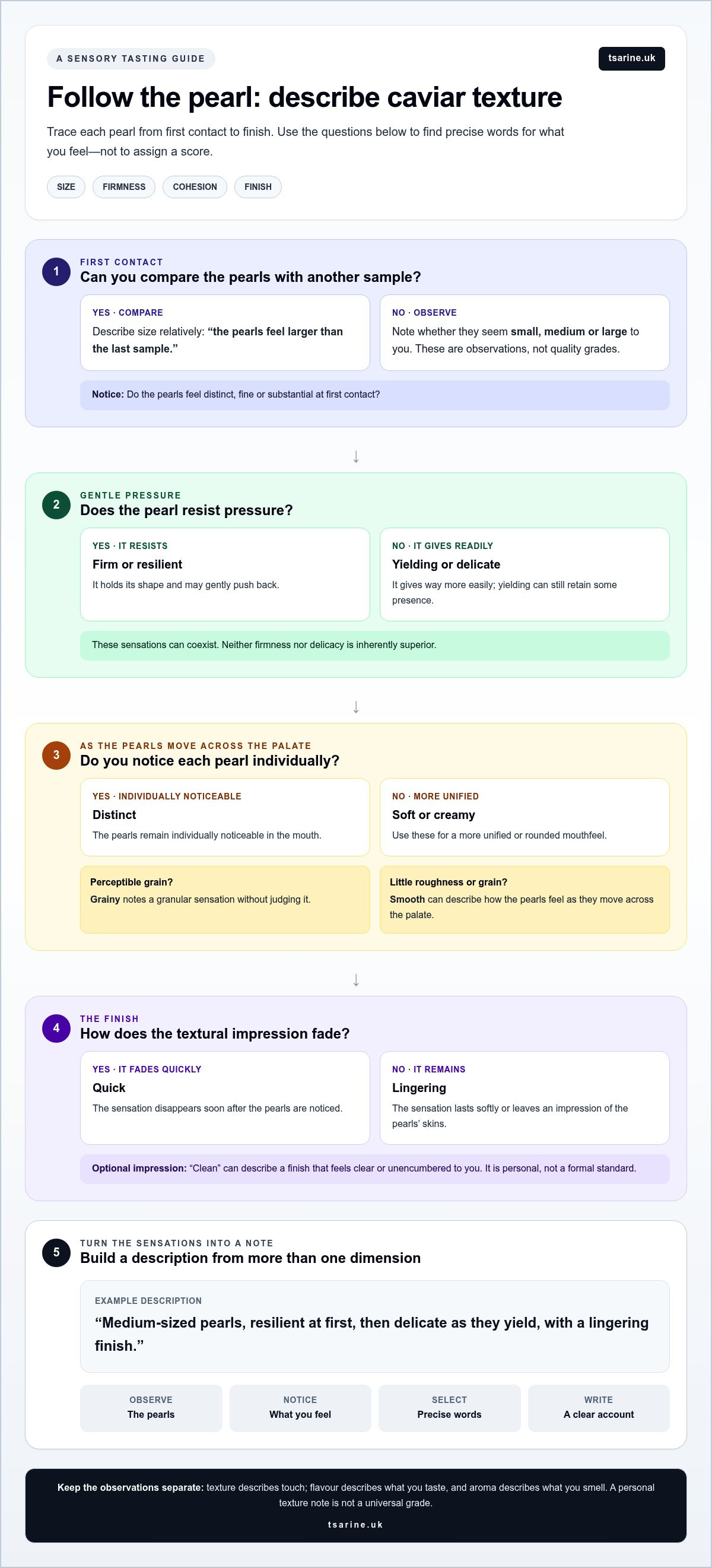
As you practise how to describe caviar texture, combine terms from different dimensions: “medium-sized pearls, resilient at first, then delicate as they yield, with a lingering finish.” The sequence gives readers a more vivid impression than “soft” alone, without turning preference into a score. Bring this attention to a tasting of TSARINE sturgeon caviar, noticing each pearl on its own terms.
How can you compare caviar textures without confusing the results?
A useful comparison is less about choosing a winner and more about placing two impressions side by side. Keep the question narrow: are the pearls different in perceived size, firmness, delicacy, cohesion or finish? Comparing one dimension at a time makes your notes clearer and helps you avoid turning a personal preference into an overall quality judgement.
| Observation | Possible descriptor | Neutral note |
|---|---|---|
| Pearls appear larger beside the other sample | Relatively large | Visible size only; assess mouthfeel separately |
| Pearls resist gentle pressure | Firm or resilient | Describe the degree of resistance you noticed |
| Pearls give way readily | Yielding or delicate | Record how they respond, without calling it better or worse |
| The sensation seems unified rather than distinct | Cohesive or creamy | Note the impression, not an assumed flavour |
| The textural impression remains after tasting | Lingering | Describe how the finish fades for you |
What should you note when comparing two caviars?
Record visible pearl size separately from the way each sample feels in the mouth. Then use the same descriptors for both: note firmness for each before turning to the finish. Keep the tasting conditions as consistent as you can, so your attention stays on the difference you’re exploring rather than a change in context.
Sturgeon species can provide useful context, but a variety name doesn’t promise a particular texture. Caviar characteristics can reflect more than species, and impressions may also be shaped by the product and its handling. For broader context, see the guide to caviar varieties.
Why can two people describe the same texture differently?
One taster may focus on a pearl’s resistance, while another notices how readily it yields or how long the sensation lingers. Both accounts can be sincere: sensory impressions are personal, and the tasting context can affect what captures someone’s attention. Rather than settling on a single “correct” adjective, make each note specific enough to compare.
For example, “Sample A feels firmer at first contact; Sample B yields more readily” identifies a contrast without ranking either one. This is a practical way to learn how to describe caviar texture with confidence: use the same lens for each sample, state what you noticed and leave room for another palate to tell its own story.
How do you describe caviar texture step by step?
A clear tasting note doesn’t need specialist language. To learn how to describe caviar texture, move from what you can observe to what you feel, then choose a few precise words to capture the experience. Keep flavour and aroma separate, and let the texture unfold in sequence.
- Observe: Notice the pearls’ visible size and whether they appear distinct. Treat this as a visual observation, not a judgement about quality.
- Notice: As you taste, focus on the pearls’ mouthfeel. Do they feel firm, yielding, delicate or cohesive? Pay attention to how the sensation changes.
- Choose descriptors: Select one or two words that best express what you noticed. “Resilient, then yielding” is more informative than a string of overlapping synonyms.
- Write: Arrange your observations in order: pearl impression, mouthfeel, then finish. Keep the note grounded in your own experience.
How do you turn a first impression into useful notes?
Begin with a feature you can describe plainly, such as pearls that seem fine or substantial, then add how they feel in the mouth. Avoid leaping from sensation to assumption: “firm” records resistance, while “fresh” or “high quality” makes a broader judgement that texture alone can’t establish. A measured note is more useful than an elaborate one.
What is an example of a clear texture description?
Use this simple template: pearl impression + mouthfeel + finish. For instance: “The pearls seem medium-sized, feel resilient at first, then yield gently, leaving a soft, lingering impression.” This is an illustrative example, not a definitive description of a particular caviar. Your own pearls may feel different, so adjust the words to match what you notice.
Let the note remain a small portrait of the moment rather than a score. For broader tasting context, read how to eat caviar. Then put your vocabulary into practice as you explore TSARINE sturgeon caviar, giving each pearl the attention its character deserves.
How can you appreciate texture in TSARINE Caviar?
Each pearl offers an individual encounter: its appearance, the way it responds in the mouth and the impression it leaves behind. Rather than searching for a single “correct” description, let your own attention guide you. A considered tasting note can be simple, precise and personal.
TSARINE Caviar is sourced from a sustainable farm in Italy, with Siberian Sturgeon and White Sturgeon varieties in its range. Those names offer context for your tasting, but they shouldn’t replace what you notice. Describe each pearl’s size, firmness and finish from your own experience rather than assuming its texture from the variety name.
How can tasting notes help you explore TSARINE Caviar?
Bring the observation sequence to your tasting: notice the pearls, attend to their mouthfeel, then describe how the sensation ends. One quality may stand out first, while another becomes clearer as you pay closer attention. Write what you perceive in your own words, whether the impression feels delicate, resilient, cohesive or something else entirely.
Keep the note descriptive rather than evaluative. “The pearls feel distinct and yield gently” records a sensation; it doesn’t claim that every taster should feel the same way or that texture establishes a formal grade. If your impression changes between tastings, that difference can be part of your record, not a reason to doubt your palate. This is the pleasure of learning how to describe caviar texture: vocabulary gives shape to your experience without limiting it.
Where can readers continue their caviar journey?
Texture is one part of appreciating caviar, alongside appearance, aroma and flavour. The more carefully you separate these impressions, the more vividly each tasting can unfold. Let curiosity lead, and allow the words to follow what you genuinely experience rather than trying to reproduce someone else’s description.
To continue exploring the story and range of TSARINE Caviar, discover TSARINE Caviar. Approach each pearl with unhurried attention, and let its individual character shape your tasting notes.
Let every pearl tell its own story
The clearest way to describe caviar texture is to follow its sensations: notice the pearls’ size, how they respond to gentle pressure and what remains at the finish. Choose precise words for each quality, and keep texture distinct from flavour, aroma or an overall judgement. Your notes don’t need to sound technical; they need to reflect what you genuinely experience.
With practice, “firm”, “yielding”, “delicate” and “lingering” become useful tools rather than fixed labels. They help you explain how to describe caviar texture clearly while leaving room for another taster’s impression to differ. Each tasting can reveal a new detail.
TSARINE Caviar is sourced from a sustainable farm in Italy, with a range that includes Siberian and White Sturgeon caviar. Let curiosity guide your next tasting, and discover TSARINE Caviar as you continue exploring the character of each pearl. Trust your senses, take your time and enjoy finding words that feel true to you.
Frequently Asked Questions
How would you describe the texture of caviar?
Describe caviar texture by noting how the pearls feel and behave in your mouth, rather than relying on one broad word. You might observe their size, whether they feel firm or yielding, how distinct each pearl seems, and whether the sensation fades quickly or lingers. A useful note could say, “The pearls feel distinct and gently yielding, with a lingering finish.” These are sensory impressions, not universal grades.
Is caviar supposed to be firm or soft?
Caviar can feel firm, soft or somewhere between, and neither word alone defines what it should be like. “Firm” describes pearls that resist gentle pressure; “soft” suggests a more yielding sensation. Notice whether the pearls remain distinct as you taste them, and describe that experience without assuming one texture is automatically better. When comparing samples, use the same terms for each and record the differences neutrally.
What does creamy caviar texture mean?
“Creamy” describes a rounded, cohesive mouthfeel, as though the texture feels less sharply defined than distinct individual pearls. It’s a tactile impression, not proof that the caviar tastes of cream or butter. To make the word more precise, explain when you notice it: for example, “a creamy sensation as the pearls yield”. Another taster may choose different language, so use the term only if it reflects your experience.
How do you describe the mouthfeel of caviar?
Describe mouthfeel in a short sequence: how the pearls first feel, how they respond to gentle pressure, and what sensation remains afterwards. Words such as “distinct”, “resilient”, “delicate”, “yielding” and “lingering” can help. For example, you might write, “The pearls feel resilient at first, then yield gently.” Keep the note focused on touch, using separate words for flavour, aroma and appearance.
Does caviar texture vary between sturgeon varieties?
Texture can vary between caviar samples, and sturgeon variety may be one factor, but a variety name alone doesn’t guarantee a specific mouthfeel. Other influences can include the fish’s diet, water conditions, harvest timing and processing. TSARINE Caviar’s range includes Siberian and White Sturgeon caviar, but describe each sample from what you notice rather than assuming its texture from the species name.
Can caviar feel different to different people?
Yes, two people can experience or describe the same caviar differently. One taster may focus on the pearls’ resistance, while another notices how readily they yield or how the sensation finishes. Neither observation needs to be dismissed. Specific wording makes personal notes easier to compare: “firm at first contact” offers a clearer point of discussion than a general label such as “nice” or “soft”.
What is the difference between caviar texture and taste?
Texture is the tactile sensation of the pearls in your mouth; taste is the flavour you perceive. You might describe a sample as “yielding” in texture and “briny” in taste, because each word refers to a different sensation. Aroma is another distinct impression, while colour describes appearance. Keeping these observations separate helps you build a clearer tasting note without treating one quality as proof of another.