
How to Store an Open Tin of Caviar: Preserving the Exquisite Pearl
Have you ever found yourself hesitating at the final spoonful of a pristine tin, wondering if the magic of those dark, glistening pearls can truly be captured and held for just one more evening? To understand the art of preservation is to understand how to eat caviar properly, treating each delicate grain with the reverence it deserves from the moment the seal is broken until the final buttery finish. You likely feel a certain trepidation as you consider the fragility of your Siberian Sturgeon or White Sturgeon, fearing that the exquisite texture might vanish if not consumed in a single, breathless sitting.
Within this guide, you will discover the refined rituals and precise techniques required to maintain the delicate flavour and texture of your opened caviar for continued indulgence. We shall guide you through the secrets of thermal stability and the graceful methods of excluding oxygen, ensuring that your roe remains safe and sublime for up to 48 hours. We will explore the vital importance of the coldest reaches of your refrigerator and the precise way to seal your vessel, allowing you to return to your indulgence with the same confidence as a guest at a royal banquet.
Key Takeaways
- Embrace the refined rituals of the connoisseur by learning how to eat caviar properly, which includes limiting the tin's exposure to room temperature to a mere fifteen minutes to protect its delicate essence.
- Master the professional "Cling Film Shield" technique to exclude intrusive air, a secret method that preserves the exquisite pop and buttery finish of your Siberian or White Sturgeon pearls.
- Navigate the "Golden Window" of indulgence, understanding why the first twenty-four hours after opening are the most sublime before the aromatics begin their inevitable transformation.
- Develop an artisanal intuition for quality by learning to distinguish the fresh, oceanic breath of prime caviar from the dulling lustre and aggressive scents of a fading pearl.
- Discover how to weave any remaining treasures into your morning repertoire, transforming simple soft-scrambled eggs or chilled pasta into a final, celebratory encounter with luxury.
The Fragile Nature of the Pearl: Why Caviar Storage is an Art
Caviar is a living, breathing testament to the sea's bounty, a biological masterpiece composed of intricate lipids and delicate proteins that begin their slow dance with oxidation the moment the vacuum seal is broken. To truly master how to eat caviar properly, one must first respect the vulnerability of these glistening spheres. Unlike more robust delicacies, the roe of the sturgeon is inherently sensitive to its environment, requiring a level of stewardship that borders on the artistic. If the internal temperature fluctuates even by a few degrees, the delicate membranes of the roe begin to soften, and that legendary, crisp pop that defines a superior harvest is lost forever. Oxidation in caviar acts as the primary thief of its oceanic sweetness and buttery texture, stealing the soul of the pearl before it can reach the palate.
The Impact of Oxygen on Sturgeon Roe
Exposure to oxygen triggers a swift breakdown of the roe's natural oils, often resulting in a sharp, metallic aftertaste or an unappealingly fishy aroma that masks the subtle notes of the sea. When air permeates the tin, it causes the eggs to lose their individual brilliance, leading to a clumping texture that lacks the elegant separation found in a fresh opening. Learning how to eat caviar properly involves understanding that the tin itself, often crafted from specific metals with protective linings, serves as a vital thermal barrier. This vessel is designed to hold the cold and repel the air, acting as a final sanctuary for the pearls during their brief transition from the ice to your spoon. For more detailed insights into the historical context of these methods, one might explore the nuances of Caviar storage and handling to appreciate how these traditions have been refined over centuries.
The Science of the Malossol Cure
The term Malossol, which translates from the Russian for little salt, represents the pinnacle of luxury, yet this very lightness makes the roe far more temperamental than mass-market alternatives. While traditional heavy salting was used as a crude preservative in eras past, the Malossol method prioritises the unadulterated flavour of the sturgeon, providing significantly less preservative power. This low-salt environment requires a symbiotic relationship with the cold; the salt lowers the freezing point of the roe, allowing it to remain in a state of suspended animation just below zero without actually crystallising. It's a delicate chemical balance that ensures the Siberian Sturgeon or White Sturgeon maintains its structural integrity, providing that celebrated buttery finish that connoisseurs adore.
The Connoisseur’s Ritual: How to Reseal an Open Tin of Caviar
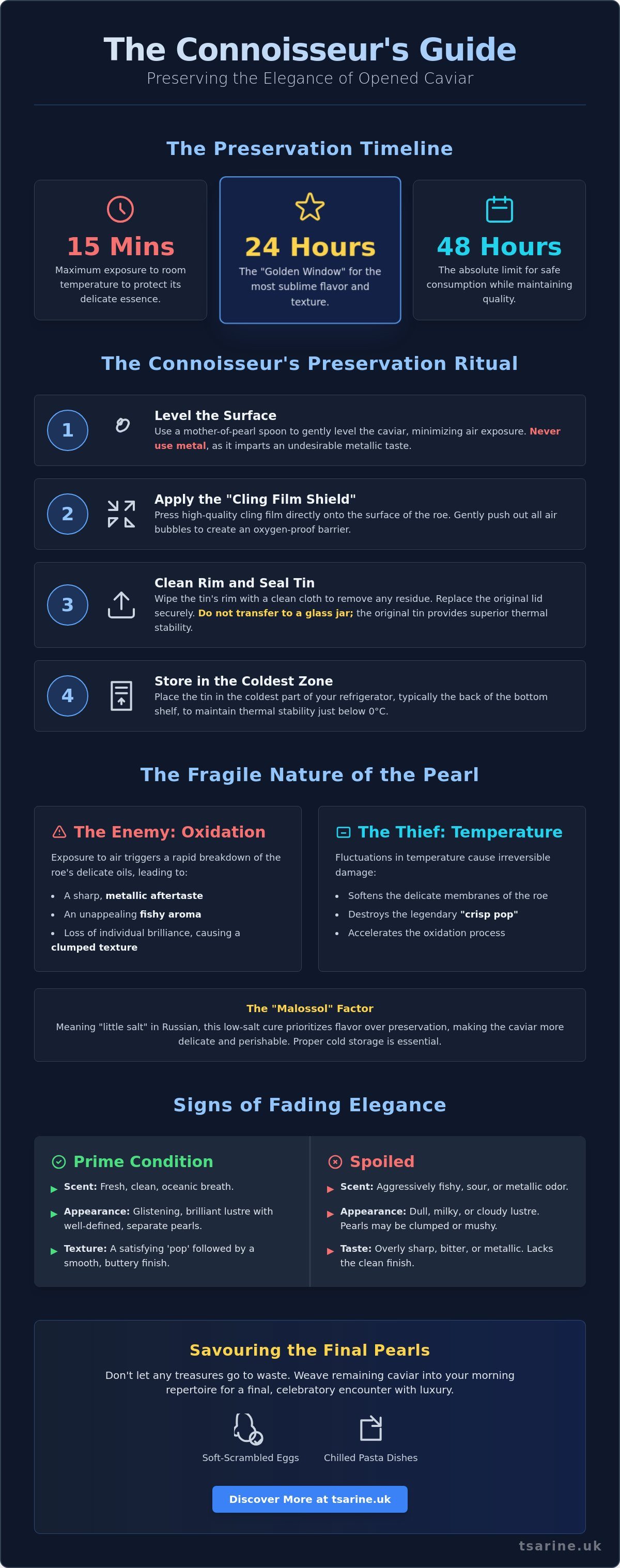
The moment the lid is lifted, the clock begins a slow, silent countdown, and the true steward of luxury knows that the preservation of the pearl is as significant as the tasting itself. Connoisseurs understand that storage begins the very second the first pearl is enjoyed. It's a hallmark of how to eat caviar properly to never allow the tin to linger in the warmth of a room for more than fifteen minutes. This brief window ensures the roe remains chilled, preventing the delicate lipids from beginning their decline into a less refined state. While it may be tempting to transfer these treasures into a decorative glass jar, the original tin is their natural sanctuary, engineered by tradition to provide a superior thermal barrier that modern glass simply cannot replicate.
Step 1: Minimising Surface Exposure
Before you return the tin to its icy home, you must prepare the surface with a quiet, focused grace. Gently level the remaining caviar with a mother of pearl spoon to reduce the total surface area exposed to the air. Metal spoons, with their reactive nature, should never touch the roe during this process, as they risk imparting a sharp, undesirable tang that ruins the buttery finish of a fine Siberian Sturgeon. Once the surface is smooth, take a clean, damp cloth and carefully wipe the rim of the tin to ensure that no stray oils or fragments interfere with the final, airtight seal. This cleanliness is paramount for maintaining the integrity of the vessel and protecting the complex aromatic profile of the remaining pearls.
Step 2: The Air-Exclusion Layer
The secret to longevity lies in a technique often whispered among London’s top sommeliers, known as the Cling Film Shield. Cut a precise circle of high-quality cling film and lay it flush against the roe, smoothing out any air bubbles with a gentle, rhythmic touch. This creates a secondary barrier, protecting the pearls from the pocket of air trapped beneath the lid. You must ensure no film hangs outside the tin's edge, as this could compromise the lid’s own seal and allow the precious chill to escape. Finally, align the lid precisely and press down firmly to recreate that authoritative seal that keeps the contents in a state of grace. For those who value the continuity of such refined moments, our Siberian Sturgeon Caviar serves as a perfect companion for your next evening of quiet, sensory indulgence.
The Golden Window: How Long Does Opened Caviar Truly Last?
Time is a delicate companion to the sturgeon's pearl, a force that both matures the roe in its sealed tin and begins to gently dismantle its complexity once the air is invited in. To understand how to eat caviar properly is to recognise the existence of the Golden Window, that fleeting period where the aromatics and texture exist in perfect, harmonious equilibrium. The first twenty-four hours after the vacuum seal is broken offer the only true opportunity to experience the full, intended TSARINE Caviar profile, where every note of brine and cream is as vivid as a morning on the Caspian shore. As the clock moves toward the forty-eight-hour mark, the delicate aromatics begin a slow retreat, leaving behind a profile that is increasingly saline and less nuanced. While safe for up to 3 days, the soul of the caviar departs after 48 hours.
Longevity by Caviar Type
The character of the fish itself dictates the pace of this decline. Siberian Sturgeon Caviar (Acipenser Baerii), with its robust and nutty presence, possesses a quiet resilience, holding its structural integrity slightly longer under the watchful eye of a cold refrigerator. In contrast, the White Sturgeon (Acipenser Transmontanus) offers a more ethereal experience; its buttery, creamy notes are notoriously volatile, vanishing like a summer mist if not savoured with haste. These high-fat varieties demand a devotion to temperature control that leaner roes don't, as the very oils that provide their luxury are the first to succumb to the touch of oxygen.
The Myth of the One-Week Shelf Life
One must look past the common misconception that a standard domestic refrigerator can halt the march of time for a full week. In the world of fine dining, there's a vast chasm between what is technically safe to consume and what is truly pleasurable to the palate. Professionals who manage wholesale caviar orders for the finest London establishments never permit a tin to be served if it was opened more than twenty-four hours prior. They know that to offer anything less would be to betray the artisanal heritage of the harvest. True mastery of how to eat caviar properly requires the courage to finish the tin while its spirit remains vibrant, rather than hoarding it until it becomes a shadow of its former self.
Signs of Fading Elegance: How to Detect Spoiled Caviar
Even the most devoted guardian of the sturgeon’s harvest must eventually face the reality that luxury is, by its very nature, ephemeral. Learning how to eat caviar properly requires a refined sensory intuition, allowing you to distinguish between a vibrant, living delicacy and one that has begun its quiet descent into spoilage. The first and most evocative test is olfactory; a fresh tin should exhale a gentle, bracing scent of a clean sea breeze, reminiscent of the spray against a noble vessel. Should you encounter an aggressive, sour, or overly fishy odour, it's a clear signal that the delicate lipids have surrendered to the air. The perfect pearl is a glistening jewel that should never appear cloudy or grey, as such dullness suggests the soul of the roe has already departed.
Visual cues offer a silent narrative of the caviar's condition. Observe the surface for any tell-tale oil slicks or a pervasive dulling of the pearl’s natural, translucent lustre. When you gently press a mother-of-pearl spoon against the roe, the resistance should be firm and proud. If the signature pop has vanished, replaced by a soft, mushy consistency that indicates a total membrane collapse, the experience will no longer mirror the high-art encounter you seek. This degradation is more than a loss of texture; it's a sign that the biological masterpiece has reached its final chapter.
The Sensory Warning Signs
As the oxidation of lipids advances, the flavour profile shifts from a buttery, oceanic sweetness to a sharp bitterness that lingers on the back of the tongue. You might also notice the presence of a milky brine or excess liquid pooling at the bottom of the tin, a sign that the roe is no longer holding its internal essence. Any shift in the natural colour of the pearls, such as a darkening or an uncharacteristic greying, should be treated with immediate suspicion. These are the whispers of a fading elegance that no amount of chilling can restore.
The Back of the Fridge Strategy
To delay this inevitable fading, one must understand the geography of the modern kitchen. The refrigerator door is the most perilous environment for an open tin, as the constant movement and influx of warm air create a volatile climate for the roe. Instead, seek the sanctuary of the very back or the lowest shelf, where the air is still and heavy with cold. Creating a micro-ice-bath by nestling your tin into a bowl of crushed ice within the refrigerator is the connoisseur’s preferred method. The ideal temperature range for preservation is a precise 0°C to 2°C, a sweet spot that keeps the roe in a state of grace without the risk of freezing. To ensure your next encounter begins with the freshest possible pearls, consider our White Sturgeon Caviar, harvested with the utmost respect for tradition.
Savouring the Remainder: Creative Ways to Finish Your Tin
When the initial flourish of the opening has passed, the remaining pearls offer a new opportunity for a more intimate, quiet celebration. Even as the salinity deepens after twenty-four hours, the roe remains a gift to the senses if one knows how to eat caviar properly. You must remember that you should never subject these delicate spheres to the direct heat of a pan. Cooking them would only result in a tragic loss of their structural integrity and a hardening of the heart of the pearl. Instead, allow the residual warmth of a dish to gently wake the oils, keeping the roe in its pristine, raw state. It's a final act of respect for the sturgeon's long journey to your table.
The Perfect Brunch Integration
The soft, velvet texture of eggs provides a perfect canvas for the cooling presence of Siberian Sturgeon caviar. As the gentle heat of soft-scrambled eggs meets the roe, it releases a subtle, nutty aroma that is truly sublime. To mask any slight softening of the membrane, a dollop of chilled Crème Fraîche acts as a graceful bridge between the warmth of the plate and the coolness of the tin. We often suggest the creation of a TSARINE Caviar Toast. This involves a thick slice of toasted sourdough, spread with unsalted cultured butter, topped with a cloud of eggs and the remaining pearls. It's an effortless way to transform a simple morning into a sensory delight.
For a more evening-focused ritual, consider the Cold Pasta Ritual. Fold your leftover treasures into a chilled capellini tossed with lemon zest, fresh chives, and a whisper of olive oil. The bright acidity of the lemon cuts through the increased saltiness of the 24-hour-old roe, creating a dish of effortless sophistication. Pairing this encounter with a glass of crisp, dry Champagne is essential. The lively effervescence cleanses the palate, allowing the buttery finish of the roe to shine once more as it dances against the bubbles.
Final Thoughts on Sustainable Indulgence
To ensure you always experience what is caviar at its absolute peak, we recommend selecting smaller tins that suit the occasion, rather than risking the fading of a larger harvest. At TSARINE Caviar, our commitment to sustainable Italian farming ensures that every pearl is a result of years of patient stewardship. This makes each spoonful worthy of your careful preservation and focused attention. We invite you to explore our caviar london collection for your next celebratory evening, where tradition and taste meet in a world of regal magnificence. Mastering how to eat caviar properly is not merely about the first bite, but about the grace with which you savour the very last grain.
A Legacy of Lasting Brilliance
The journey of the sturgeon’s pearl doesn't end with the first breath of air; it merely enters a new, more delicate chapter of stewardship. By embracing the secret of the air-exclusion layer and respecting the sanctuary of the refrigerator’s coldest reaches, you ensure that the soul of the roe remains vibrant. You've learned that the true essence of the harvest is found within the first forty-eight hours, and that even the smallest remaining treasures can be woven into a celebratory brunch. To truly master how to eat caviar properly is to treat the final grain with the same reverence as the first, preserving that legendary pop and buttery finish for a second, equally enchanting encounter.
Every pearl we offer is ethically sourced from sustainable Italian farms and packed with artisanal mastery to ensure it arrives at your door in a state of absolute grace. We invite you to explore the TSARINE Caviar Collection for your next exquisite encounter, with the convenience of next-day delivery across London and the UK. Let your next celebration be defined by the timeless elegance and sensory delight that only the finest harvest can provide. May your future tastings be as enduring and magnificent as the history that inspired them.
Frequently Asked Questions
Can I freeze an open tin of caviar to make it last longer?
Freezing is a harsh intrusion that shatters the delicate membrane of the sturgeon roe, and you should never subject a fine harvest to such conditions. While it might prolong safety, it irreversibly damages the luxurious pop and buttery finish of the pearls. High-quality sturgeon caviar should always be kept in a state of chilled grace, never subjected to the crystalline violence of a domestic freezer.
Is it safe to eat caviar that has been open for 3 days?
It's generally safe to consume within 72 hours if kept properly chilled, though the soul of the pearl begins its retreat after the second day. To understand how to eat caviar properly, one must recognize that the peak of sensory delight occurs within twenty-four hours of opening. Beyond this window, the aromatics fade, leaving a more pronounced saline profile that lacks the original complexity.
What is the best temperature for storing an open caviar tin?
The ideal temperature for your opened treasure is between 0°C and 2°C, a precise chill that keeps the lipids stable and the flavour pure. Most domestic refrigerators are slightly too warm for this delicate task, so nestling the tin in a bowl of crushed ice at the back of the shelf is the preferred ritual. This thermal stability ensures the roe remains in its most exquisite state.
Should I move leftover caviar to a Tupperware container?
You should never transfer these delicate pearls to plastic containers, as the original tin is their natural sanctuary and most effective protector. The metal vessel is specifically designed to provide a superior thermal barrier and prevent the absorption of unwanted aromas from your kitchen. Plastic can impart a subtle, unrefined taste that interferes with the pure, oceanic sweetness of the Siberian or White Sturgeon roe.
Why does my opened caviar taste metallic after one day?
A metallic aftertaste is often the result of lipid oxidation or the unfortunate use of reactive metal spoons during the initial service. Once the vacuum seal is broken, the oils in the roe begin a slow chemical transition when exposed to air. To prevent this, always use a mother-of-pearl spoon and ensure the cling film shield is pressed directly against the surface of the pearls before resealing.
How can I tell if my caviar has gone bad?
Trust your senses to detect the fading elegance of a harvest that has passed its prime through scent, sight, and touch. An aggressive fishy odour, a dulling of the pearl’s natural lustre, or a soft, mushy consistency are all tell-tale signs of spoilage. A fresh tin should always exhale a clean, bracing scent of the sea, with each pearl remaining a glistening, resilient jewel.
Does the type of sturgeon affect how long the tin stays fresh?
The lineage of the sturgeon plays a significant role in how the roe responds to the passage of time and oxygen. Siberian Sturgeon Caviar possesses a more robust oil profile that holds its character slightly longer than the ethereal White Sturgeon. Learning how to eat caviar properly involves appreciating these nuances, as the creamy notes of the White Sturgeon are notoriously volatile and vanish with haste.
Can I use a regular spoon to level the caviar before resealing?
A regular metal spoon should never touch the roe, as it risks bruising the delicate membranes and imparting an undesirable metallic tang. Instead, use a mother-of-pearl or bone implement to gently level the surface before you apply the air-exclusion layer. This small act of devotion protects the integrity of the remaining pearls, ensuring their buttery finish remains unblemished for your next tasting.