
The Second Act: What to Do With Leftover Caviar to Preserve Its Majesty
What if the final, shimmering pearls at the bottom of an ornamental vessel weren't a source of quiet anxiety, but rather the opening notes of an even more intimate culinary ritual? Many sophisticated hosts feel a familiar pang of hesitation as a gala concludes, wondering how to honor the remaining gems without sacrificing their regal character or delicate texture. It's a common dilemma to contemplate what to do with leftover caviar when the initial celebratory moment has passed, as the fear of wasting such a storied luxury often weighs as heavily as the desire to preserve its sensory perfection.
You'll soon discover that the life of your Siberian Sturgeon or White Sturgeon can be gracefully extended by twenty-four hours, allowing these oceanic treasures to find a second life that's just as magnificent as their first. We'll guide you through the professional secrets of preservation and provide an elegant preview of how small quantities can be woven into sophisticated, intentional recipes. By mastering these refined storage techniques and creative applications, you'll ensure that every exquisite pearl remains a testament to technical mastery and timeless elegance, long after the first toast has been made.
Key Takeaways
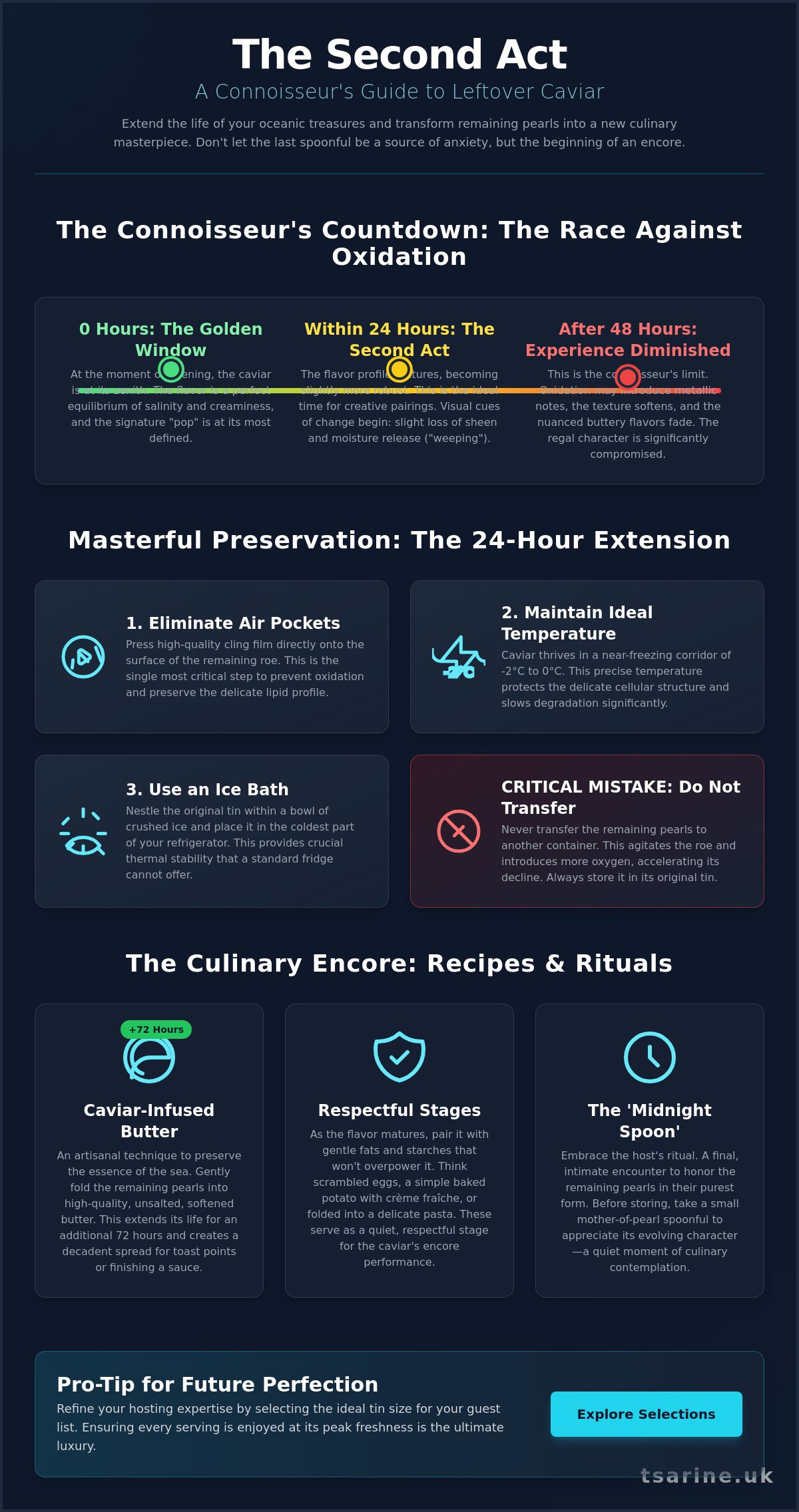
- Protect the delicate, signature pop of your Siberian Sturgeon by mastering the art of eliminating air pockets within the tin, a simple gesture that ensures the roe remains at its zenith for another twenty-four hours.
- Explore the sophisticated philosophy of what to do with leftover caviar by selecting gentle fats and starches that serve as a quiet, respectful stage for the maturing flavor profile.
- Learn to transform remaining pearls into a decadent caviar-infused butter, an artisanal technique that preserves the essence of the sea for an additional seventy-two hours of sensory delight.
- Refine your hosting expertise by selecting the ideal tin size for your guest list, ensuring that every serving of White Sturgeon is enjoyed at the precise moment of its peak freshness.
- Embrace the ritual of the 'Midnight Spoon,' a final, intimate encounter that honors the remaining pearls in their purest form before the morning light.
The Ephemeral Nature of the Pearl: Why Leftover Caviar Requires Grace
The moment the seal of a tin is broken, a countdown of exquisite precision begins, marking the start of what connoisseurs call the "Golden Window." For those who understand What is Caviar, this initial encounter represents the zenith of the sturgeon's gift, where the salinity and creaminess exist in a perfect, fragile equilibrium. It's a common occurrence for the discerning host to find themselves with a small portion of remaining pearls, as the priority is always the quality of the experience rather than the sheer volume consumed. Learning what to do with leftover caviar is not merely a task of kitchen management, but a philosophical shift where we treat these remaining gems as a curated encore, a second movement in a grand culinary symphony.
The legendary "pop" that defines a superior roe is a testament to the integrity of its delicate membrane. Once exposed to the atmosphere, this membrane begins to lose its tension, slowly softening as it interacts with the surrounding air. This transition is why the first spoonful feels like a revelation, while subsequent encounters require a more thoughtful approach to maintain that regal essence. We must treat these pearls with the same grace they bestowed upon our guests during the first act.
The Cruel Reality of Oxidation
Oxygen is the silent thief of sensory delight, working quickly to alter the complex lipid profile of the sturgeon roe. As these fats oxidize, the deep, nutty undertones can shift toward an uninviting metallic finish that masks the artisanal heritage of the harvest. Sturgeon roe begins to lose its buttery nuance within 24 hours of opening. You'll recognize this fading majesty through specific visual cues:
- A noticeable loss of the signature high-gloss sheen that reflects the light.
- A gentle "weeping" where the egg begins to release its internal moisture.
- A subtle softening of the membrane that diminishes the characteristic pop.
The 48-Hour Rule for Connoisseurs
While modern refrigeration might keep the pearls "safe" for several days, the window for a refined experience is much narrower, typically closing after forty-eight hours. For those accustomed to the standards of the Tsarine lineage, two days is the absolute limit for maintaining a profile that still evokes prestige and sensory delight. There is a vast distinction between a product that is merely safe to eat and one that is still refined to experience. When planning your "Second Act," expect a flavor profile that is slightly more pronounced and robust, which is why deciding what to do with leftover caviar often involves pairing it with ingredients that can harmonize with this maturing character.
Masterful Preservation: How to Store Your Remaining Caviar
The preservation of these ebony pearls is an act of devotion, requiring a meticulous hand to maintain the majesty of the first encounter. When considering what to do with leftover caviar, the primary adversary is not time itself, but the air that lingers within the vessel. A professional secret involves the use of high-quality cling film, pressed gently and directly onto the surface of the remaining roe to eliminate every trace of an air pocket. This intimate barrier prevents the oxidation that dulls the palate, ensuring the lipids remain creamy and the aroma stays as pure as the moment the seal was first broken.
While a domestic refrigerator is a marvel of modern convenience, its standard settings are often a compromise for a product of such regal lineage. Caviar thrives in a narrow, near-freezing corridor of -2°C to 0°C, a temperature rarely found in the center of a household kitchen appliance. To bridge this gap, nestle the original tin within a bowl of crushed ice before placing it in the deepest, coldest corner of your fridge. This ice bath technique provides the thermal stability necessary to protect the delicate cellular structure of the Siberian Sturgeon Caviar you've so carefully selected. It's a simple ritual that pays significant dividends in flavor longevity.
Transferring the remaining gems to a smaller container is a frequent mistake that can lead to culinary heartbreak. Each movement of the pearls risks rupturing the fragile membranes, causing the "weeping" that ruins the texture and pools the precious oils. It's far better to keep the roe in its original, ornamental vessel, which was designed for this very purpose and maintains the artisanal integrity of the product.
The Art of the Re-Seal
Before closing the tin, use the back of a small mother-of-pearl spoon to smooth the surface of the roe into a level plane, reducing the exposed surface area to its absolute minimum. Once the cling film is applied and the lid is replaced, secure the perimeter with a heavy-duty rubber band or a strip of specialized tape. This mimics the original vacuum seal, creating a pressurized environment that helps the pearls retain their signature pop for the upcoming "Second Act." It's these small, graceful gestures that distinguish a true connoisseur from a casual consumer.
Avoiding the Common Pitfalls of Storage
The refrigerator door is a treacherous place for luxury, as the frequent opening and closing creates a fluctuating thermal environment that accelerates degradation. Never succumb to the temptation of freezing your leftovers, as this is a culinary sacrilege that causes the water within the eggs to expand and shatter the delicate membranes, leaving you with a lifeless paste. If you notice a sharp, uninviting odor or a heavy, oily sheen that wasn't present upon opening, the pearls have likely crossed the threshold into unpalatability and should no longer be served. Knowing what to do with leftover caviar means recognizing when the window of elegance has finally closed, though with these methods, you'll find that window stays open just a little longer.
The Art of the 'Second Act': Culinary Pairings for Remaining Roe
The transition from a grand evening to a more intimate "Second Act" requires a shift in culinary philosophy, moving from the celebratory display of the first tin to a nuanced exploration of harmony. When you're deciding what to do with leftover caviar, the guiding principle should always be "Harmony Over Power." Rather than seeking ingredients that compete for attention, we must select companions that serve as a quiet, respectful stage for the maturing pearls. Fats and starches are the most loyal allies in this endeavor, as their creamy textures and neutral profiles provide a luxurious canvas that allows the brine and complexity of the roe to remain the protagonist of the plate.
As the pearls age slightly, their flavor profile often becomes more pronounced and robust, which can be beautifully balanced with a "Freshness Refresh." A mere whisper of citrus zest or a singular micro-herb can brighten the palate, masking any subtle softening of the membrane while highlighting the inherent character of the variety. For instance, the distinctive, nutty notes found in Siberian Sturgeon Caviar are amplified when paired with the gentle sweetness of a cultured butter or the earthy warmth of a heritage potato, creating a sensory experience that feels entirely intentional rather than a mere use of remnants.
The Breakfast of Sovereigns
There's perhaps no marriage more classic or comforting than the union of soft-scrambled eggs and the remaining treasures of the tin. To achieve a result worthy of a royal household, the eggs should be whisked into a velvet-like consistency and cooked over the lowest possible flame until they resemble a warm custard. This delicate warmth is essential, as the eggs must never be hot enough to "cook" the roe, which would destroy its fragile texture and oceanic essence. A ribbon of chilled crème fraîche serves as the perfect intermediary, providing a cool foundation for a crown of pearls that pop against the warmth of the plate.
Starch and Salt: The Potato and Pasta Pairings
The humble potato, when treated with artisanal care, becomes an extraordinary vessel for the "last scoop" of a fine harvest. A jacket potato can be redefined by whipping its interior with excessive amounts of unsalted butter and a touch of heavy cream until it reaches a cloud-like state, then punctuating the rich mash with small mounds of caviar. For those seeking a lighter encounter, a cold pasta salad featuring lemon-butter linguine offers a bright and sophisticated second life for the roe. If a more informal yet decadent moment is desired, high-quality, thick-cut potato chips provide a satisfying crunch that contrasts beautifully with the silky lipids of the roe, proving that what to do with leftover caviar can be as simple as it is sublime.
Exquisite Recipes to Elevate Your Leftover Caviar
Deciding what to do with leftover caviar often reveals that the most exquisite encounters occur in the quietest moments, away from the grand spectacle of a gala. When only a small portion remains, we transition from the abundance of the first act to a series of highly intentional, miniature masterpieces. The "Midnight Spoon" is perhaps the most romantic of these rituals, an intimate, solitary encounter where the final pearls are enjoyed directly from the tin in their purest form. It's a moment of reflection that honors the artisanal heritage of the harvest, allowing the complex aromatic profile to linger on the palate without the interference of other ingredients.
For those who wish to extend this sensory delight, creating a caviar-infused butter is a masterful technique that preserves the essence of the sea for an additional 72 hours. By folding the remaining roe into high-quality, unsalted cultured butter, you create a rich, briny spread that can be used to crown a simple piece of toasted sourdough. This "Tsarine Tartine," adorned with paper-thin slices of radish for a peppery crunch, transforms the modest remnants into a breakfast worthy of nobility. To ensure your next gathering is just as memorable, you might consider the Tsarine Caviar Luxury Gift Set, which provides the perfect vessel for these ritualistic experiences.
The 10-Gram Mastery
Even a single teaspoon of remaining roe possesses the power to transform a culinary moment. When you have only ten grams left, consider the "Caviar Bump," a playful yet sophisticated kitchen-side treat for a favored guest where the roe is enjoyed off the back of the hand to warm the lipids slightly. This method highlights the technical mastery of the cure, as the skin's warmth releases the deeper, nutty nuances of the White Sturgeon. You might also place this small treasure atop a warm, miniature blini. The sensory contrast between a cold, firm pearl and a warm, pillowy blini creates a textural symphony that belies the small quantity used.
The Seafood Symphony
Leftover pearls find their most natural sanctuary when reunited with the treasures of the ocean. A single seared scallop, caramelized to a golden hue, serves as a magnificent pedestal for a crown of remaining roe, where the scallop's sweetness balances the caviar's salt-forward profile. If your remaining portion is particularly delicate, use it as a finishing touch for a white fish carpaccio or a small serving of steak tartare. In these instances, the brine of the caviar acts as a noble substitute for salt, seasoning the dish from within while adding a visual elegance that treats the consumption experience as a high-art encounter. By focusing on these small-scale applications, you ensure that what to do with leftover caviar is never a question of waste, but always an opportunity for grace.
Ensuring Future Freshness: The Tsarine Approach to Selection
The most enlightened hosts understand that the journey of a thousand pearls begins with a single, thoughtful choice, and that the ultimate answer to what to do with leftover caviar is often found in the wisdom of the initial acquisition. By selecting a tin size that mirrors the intimacy of the gathering, you honor the sturgeon's gift by ensuring every gem is savored at the precise moment of its peak vitality. Our collection offers a curated range of sizes, where the thirty-gram tin serves as a perfect solitary indulgence, the fifty-gram vessel accompanies a small circle of friends, and the one-hundred-and-twenty-five-gram offering provides a generous centerpiece for grander London celebrations.
For those hosting prolonged events where guests may arrive in waves, a strategic approach involves purchasing multiple smaller tins rather than a single, expansive vessel. This method allows you to break the seal only as needed, preserving the vacuum-sealed integrity of the remaining pearls and preventing the dilemma of what to do with leftover caviar by keeping the majority of your stores in their pristine, unopened state. When calculating the perfect amount for your next soirée, a standard guide for a generous experience is approximately thirty grams per guest, ensuring that the luxury feels abundant yet remains manageable. For those seeking to extend this elegance to others, our Ultimate Guide to Gifting Caviar provides a sophisticated roadmap for selecting the perfect gift set for any distinguished recipient.
The Tsarine Delivery Promise
Every pearl we offer originates from our sustainable Italian farm, where technical mastery meets a deep respect for the natural world to produce a product of undeniable high status. Our London delivery service operates with a quiet, melodic efficiency, ensuring that your Siberian or White Sturgeon arrives in a state of royal perfection, cocooned in temperature-controlled packaging. Our signature ornamental vessels are not merely works of art; their textured glassware is specifically engineered to maintain a stable, near-freezing environment far more effectively than standard metal tins, protecting the delicate membrane of the roe from the moment it leaves our care until it reaches your table.
A Final Toast to the Royal Roe
Concluding the narrative of the "Second Act" is a testament to the connoisseur's respect for artisanal craft and the centuries-old origins of this regal ritual. For the final spoonfuls of a maturing profile, consider a shift in your liquid accompaniment. While a crisp Champagne is the traditional partner for a fresh tin, a bone-dry, premium vodka, served at a near-freezing temperature, possesses the strength to harmonize with the more robust, concentrated flavors of the second day. As you prepare for your next significant festivity, we invite you to visit the Tsarine Caviar homepage to replenish your stores and continue your journey into a world of regal magnificence and refined taste.
A Legacy Continued in Every Shimmering Pearl
The final shimmering pearls of a grand evening shouldn't be viewed as a closing curtain, but rather as an invitation to a more intimate, sensory ritual that honors the soul of the sturgeon. By embracing the technical mastery of proper storage and exploring the creative potential of small-scale pairings, you ensure that the artisanal heritage of each harvest is celebrated to its very last breath. Mastering what to do with leftover caviar transforms a moment of potential hesitation into a secondary culinary masterpiece, allowing the delicate membrane and complex aromatic profile of the roe to shine with a renewed, quiet brilliance.
Whether you're finishing the vessel with the ritualistic "Midnight Spoon" or crafting a decadent caviar-infused butter, every encounter remains a testament to a lifestyle defined by grace and prestige. Our award-winning Siberian and White Sturgeon varieties are ethically sourced from sustainable Italian farms and hand-packed with royal precision for seamless London delivery. To ensure your next gathering is defined by this same aura of timeless elegance, we invite you to replenish your collection with a fresh tin of Tsarine Caviar. Step back into a world where every sensory detail is treated as a high-art encounter and every pearl tells a story of regal magnificence.
Questions of Preservation and Prestige
How long does caviar last once the tin has been opened?
Once the initial seal is broken, these ebony pearls should be enjoyed within twenty-four to forty-eight hours to ensure the sensory profile remains worthy of its noble heritage. While the roe may technically remain safe for a short period beyond this window, the delicate membrane begins to soften and the complex aromatic notes lose their clarity after the second day of exposure to the atmosphere.
Can you freeze leftover caviar to save it for later?
Freezing is a culinary sacrilege that irrevocably damages the delicate cellular structure of the roe, causing the internal moisture to expand and shatter the fragile membranes. This process leaves the pearls lifeless and mushy upon thawing, stripping them of the signature pop that defines a high-art encounter. It's far better to enjoy the remaining gems in a secondary culinary masterpiece than to subject them to such a harsh thermal transition.
What is the best way to eat a small amount of leftover caviar?
When deciding what to do with leftover caviar in small quantities, the most refined approach is to enjoy it in its purest form using a mother-of-pearl spoon. This ritualistic method, often called the "Midnight Spoon," allows you to savor the nuances of the Siberian Sturgeon or White Sturgeon without distraction, honoring the artisanal craft of the harvest in a quiet, intimate moment.
Is it safe to eat caviar if the eggs have become soft or oily?
Soft or oily eggs typically indicate that the lipids have begun to oxidize, a natural transition that signifies the "Golden Window" of peak freshness has passed. While the roe is often still safe to consume if it's been kept at precise temperatures, it'll have lost the regal essence and textural integrity that characterize a prestige product. You should trust your palate; if the flavor remains clean, it can still serve as a beautiful garnish.
Should I keep the leftover caviar in its original tin or move it?
You should always keep the remaining pearls in their original, ornamental vessel to minimize unnecessary handling and prevent the rupture of the delicate membranes. Moving the roe to a new container increases the surface area exposed to oxygen, which accelerates the loss of the liquid’s visual beauty and complex flavor profile. Simply smooth the surface and seal it tightly within the tin that was designed to protect its soul.
What are the best crackers or breads for leftover caviar?
The most loyal companions for your remaining roe are neutral, high-quality bases such as warm blinis, unsalted water crackers, or a thin slice of toasted sourdough. These selections provide a quiet stage that allows the salt-forward brilliance of the pearls to remain the protagonist of your experience. Avoid flavored or heavily salted accompaniments that might compete with the maturing character of the maturing roe.
Can I use leftover caviar in hot dishes like pasta or soup?
You may certainly use your remaining pearls to elevate a lemon-butter linguine or a velvet-like potato soup, provided they're added as a final, delicate garnish just before serving. The heat of the dish must never cook the roe, as excessive temperature will destroy the texture and turn the precious oils into a heavy, uninviting brine. Treat the caviar as a finishing touch of grace rather than an ingredient to be simmered.
How do I know if my leftover caviar has gone bad?
A sharp, uninviting odor or a sour, metallic taste are clear indicators that the pearls have crossed the threshold into unpalatability. Determining what to do with leftover caviar requires a discerning eye; if the roe exhibits an unusual sliminess or a heavy, dull appearance that lacks its signature gloss, it's best to bid the tin a respectful farewell. A true connoisseur knows that when the melody of the sea turns discordant, the performance must end.