
Understanding Caviar Grades: A Connoisseur’s Guide to the Jewel of the Sea
The most exquisite tin in a collection isn't always the one that will dance most gracefully upon your palate. It's a quiet frustration shared by many who stand before a shimmering display, only to be met with a labyrinth of marketing terms like Imperial or Royal that seem to whisper of quality without ever truly explaining the character of the pearl. You likely feel that a true connoisseur should be able to look past the gilded labels to the soul of the roe itself. By masterfully understanding caviar grades, you transform a moment of hesitation into a confident selection of the sea's most precious treasures, ensuring your next celebration is draped in authentic luxury.
This guide will unlock the secrets behind the nomenclature used by the world's most prestigious houses, allowing you to identify the finest pearls for your next indulgent encounter. We'll explore how the size, color, and firmness of the individual harvest create a sensory hierarchy that celebrates the visual and textural perfection of the harvest. From the delicate nuances of Siberian Sturgeon to the buttery depths of White Sturgeon, you'll learn to read every label with the discerning eye of a noble host; this ensures that every selection matches your specific, refined taste.
Key Takeaways
- Discover how the Master Grader’s artisanal evaluation transcends mere marketing jargon to define the true sensory character and soul of every individual pearl.
- Master the art of understanding caviar grades by evaluating the dramatic textural pop of larger pearls and the rare, shimmering golden hues that signify the most elite harvests.
- Learn to decipher prestigious terms like "Imperial" and "Royal," which represent the top 5-10% of a harvest and promise a more profound, lingering finish.
- Uncover how the traditional Malossol curing method acts as a delicate catalyst to release the complex fats and nuanced aromas hidden within the jewel-like roe.
- Gain the confidence to select a tin that matches your unique palate, choosing between the nutty depths of Siberian Sturgeon or the buttery grace of White Sturgeon.
Beyond the Label: The Art of Understanding Caviar Grades
To step into the world of fine roe is to enter a dialogue with nature's most delicate craftsmanship, where every tin tells a story of patience, heritage, and sensory brilliance. Many enthusiasts find themselves captivated by the lustrous sheen of the pearls, yet they often feel a sense of hesitation when faced with the complex terminology of the trade. Mastering the nuances of understanding caviar grades allows the discerning host to curate an experience that is as consistent as it is breathtaking, ensuring that every spoonful reflects the prestige of the occasion. The rich tapestry of Caviar types and history reveals that while the species provides the foundation, it is the grading process that elevates a simple harvest into a work of high art.
This selection process is far more than a clinical measurement of size or weight; it is an artisanal evaluation that honors the unique soul of the product. No two sturgeons produce identical roe, even when raised in the same pristine waters. One fish may offer pearls of a deep, obsidian hue with a sharp, briny clarity, while another provides a softer, golden treasure with a buttery finish that lingers on the palate. Grading serves as the bridge between this natural variation and the unwavering expectation of the luxury consumer, providing a sensory hierarchy that guarantees excellence in every ornamental vessel.
The Master Grader: The Guardian of Quality
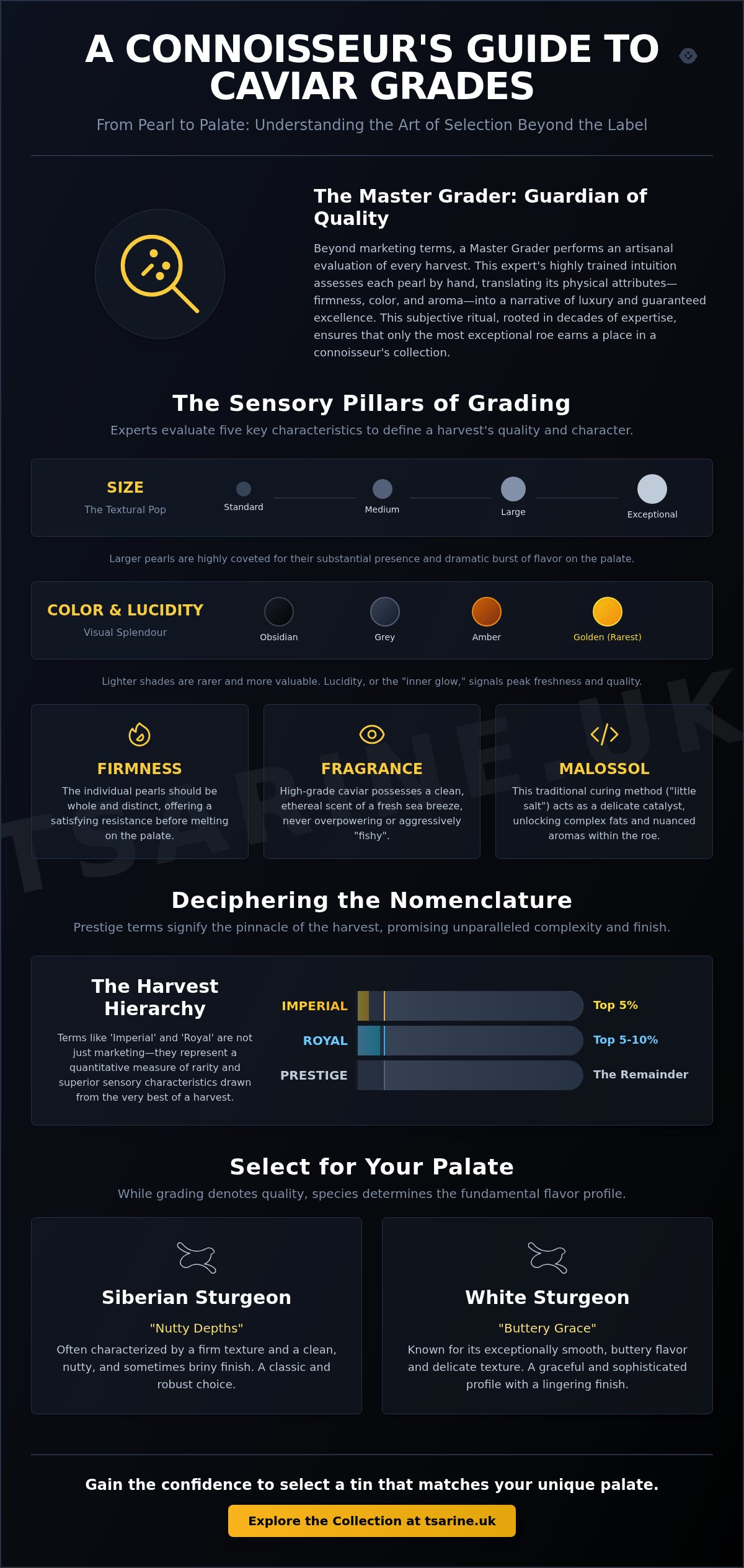
The Master Grader acts as a silent poet, translating the physical attributes of a harvest into a narrative of luxury that the consumer can trust. This expert evaluates every batch by hand, using a highly trained intuition to assess the firmness of the membrane, the clarity of the color, and the aromatic profile of the oils. At Tsarine, we maintain a lineage of quality through this rigorous selection, ensuring that only the most exceptional pearls from our Siberian and White Sturgeon harvests earn their place in our collections. It is a subjective ritual rooted in decades of specialized expertise, where the touch of a finger and the glint of light determine the destiny of the tin.
Why Grading Matters for the London Connoisseur
In a city defined by its regal history and culinary sophistication, the expectation of excellence is non-negotiable. For those seeking the pinnacle of refinement, our A Guide to Buying Caviar in London explores how these grades manifest in the city's most prestigious dining environments. Understanding caviar grades is essential for the London connoisseur because it explains the relationship between rarity and price; a higher grade often represents the top five percent of a harvest, possessing a complexity and size that is truly extraordinary. By choosing a specific grade, you aren't just buying a product; you're selecting a specific sensory journey that has been vetted by the world's most discerning palates.
The Sensory Pillars: How Experts Grade Every Pearl
The journey toward understanding caviar grades is an invitation to refine your senses, transforming a simple tasting into a profound exploration of nature's most delicate textures and hues. While the species provides the initial blueprint, it's the mastery of the five sensory pillars, size, colour, firmness, lucidity, and fragrance, that allows the connoisseur to distinguish a merely good harvest from an extraordinary one. Larger pearls are frequently the most coveted because they offer a more substantial and dramatic presence on the tongue, creating a moment of anticipation before they surrender their liquid gold. This experience is complemented by a fragrance that should never be aggressive; a high-grade malossol selection carries the clean, ethereal scent of a fresh sea breeze, grounding the luxury in its oceanic origins.
The Visual Splendour: Colour and Lucidity
Lighter shades such as amber, grey, and the legendary golden hues are the rarest treasures of the sea, often appearing in only a small fraction of the total harvest. Lucidity is equally vital, as it represents the visual brilliance and inner glow of the egg skin when held to the light, signaling a pearl that's at the peak of its freshness. Because international caviar trade regulations maintain strict oversight on the authenticity of these species, you can trust that the shimmering brilliance you see is a mark of true heritage. When you lift the lid of a tin of Tsarine Siberian Sturgeon Caviar, the lucidity of the dark, glossy pearls serves as a visual promise of the exquisite quality and meticulous care that went into every stage of the curing process.
Texture and the "Pop": The Architecture of Taste
The tactile sensation of caviar is often described as its architecture, where the structural integrity of the pearl determines the rhythm of the flavour release. Grade 1 selections are characterized by a clean separation of grains, ensuring that each pearl remains distinct rather than merging into a uniform mass. Firmness is the resistance of the egg wall before it releases its creamy interior. This delicate snap is the hallmark of a mature harvest, providing a satisfying contrast to the velvety richness that follows. Refining your eye for these pillars is the ultimate secret to understanding caviar grades, allowing you to curate a dining experience that is as visually stunning as it is delicious. If you're ready to experience this structural perfection for yourself, exploring our luxury selections will reveal the true heights of artisanal grading.
Deciphering the Nomenclature: Imperial, Royal, and Prestige
The language of luxury is often written in whispers, yet few words carry as much weight as Imperial or Royal when etched upon a shimmering tin. These titles aren't mere marketing flourishes; they're traditional quality descriptors that have guided connoisseurs through the centuries. In the pursuit of understanding caviar grades, one must recognize that these names are reserved for the most exceptional portions of a harvest, typically representing the top 5 to 10 percent of the pearls. Historically, the term Imperial was more than a grade; it was a decree. It signified the very best roe, often featuring the largest and most luminous pearls, which were strictly reserved for the tables of royalty and the highest nobility. This heritage remains alive today, as these terms continue to signal a level of visual and textural perfection that transcends the ordinary.
While these titles evoke a sense of regal magnificence, the modern enthusiast should be wary of brands that use generic "Grade A" labels without offering species transparency. A true house of heritage will always celebrate the lineage of the fish alongside the grade of its bounty. Opaque labels often hide a lack of artisanal mastery, whereas a transparent grade tells you exactly where a harvest sits within the sensory hierarchy. Avoiding these vague commercial terms ensures that you're investing in an authentic experience rather than a simple approximation, allowing the true soul of the roe to shine through.
Imperial vs. Royal: What Is the Difference?
The distinction between these two tiers is a matter of sensory intensity and rarity. We view the Royal grade as the standard-bearer of excellence for a species, offering a consistent and beautiful expression of its character. Imperial, however, is the exceptional tier. It's characterized by pearls that have reached a grander size and often possess those rare, lighter-coloured hues that catch the light like polished gems. When we curate our Luxury Gift Sets, we select only these elite grades to ensure your gift carries the weight of history and the grace of a truly regal offering. Choosing between them is often a choice between a classic, refined experience and one that is purposefully dramatic.
Species vs. Grade: Avoiding Common Confusion
A common point of confusion for those beginning their journey is the difference between the species and the grade. It's helpful to remember that names like Siberian or White Sturgeon tell you about the noble figure who provided the roe, while Royal or Imperial tells you about the quality of her specific harvest. You can, for instance, enjoy a Royal Siberian or an Imperial Siberian; both are exquisite, but the latter will offer a more dramatic visual and textural profile. Reading a label correctly requires looking for the species name first, followed by the artisanal grade. This clarity is the cornerstone of understanding caviar grades, allowing you to choose a tin that perfectly complements the mood and scale of your next indulgent encounter.
The Malossol Tradition: How Curing Affects Grade and Character
The word "Malossol" carries with it a weight of history, a Russian term translating simply to "little salt." This is far more than a technical specification; it's a testament to the purity of the roe itself. When you're dedicated to understanding caviar grades, the presence of this term signals a harvest that was exceptional enough to require only the lightest of touches. Salt acts as a silent catalyst, gently drawing forth the complex, hidden fats within each pearl to create a profile that's both profound and ethereal. This whispered seasoning allows the natural character of the sturgeon to speak, ensuring that the brine never masks the delicate, nutty essence of the jewel. True mastery in understanding caviar grades involves recognizing that a lower salt content is only possible with the highest tiers of fresh roe, as only the most pristine pearls possess the structural integrity to shine under such a delicate cure.
Contrast this with the more common "Pressed" or "Pasteurised" tiers, which tell a different story altogether. While these methods have their place in the broader market, they often represent a compromise in texture and aromatic depth. A Malossol cure is a celebration of the present moment, a living product that requires meticulous handling and an unwavering commitment to freshness. It's the gold standard for those who view the consumption of caviar as a high-art encounter, where the subtlety of the salt serves only to elevate the nobility of the fish.
The Chemistry of Elegance: Salt and Fat
The curing process is a transformation where time and temperature dance in perfect harmony. Every grain must be treated with a reverence that borders on the sacred, as the salt slowly migrates through the membrane to season the rich oils within. Maintaining a precise, near-freezing environment during this phase is essential; it prevents the oils from becoming heavy while allowing the buttery finish to develop its characteristic grace. A perfect Malossol cure results in a texture that's neither oily nor dry, but rather a velvety sensation that coats the palate in a lingering, celebratory embrace. This balance is what defines the sensory delight of a premium harvest, turning a raw ingredient into a culinary masterpiece.
Pasteurisation: The Sacrifice of Texture
While some producers opt for pasteurisation to extend shelf life or stabilize lower-grade harvests, this process inevitably demands a sacrifice of the pearl's soul. The application of heat, however gentle, alters the architecture of the egg, turning a delicate snap into a rubbery resistance that lacks the vibrancy of fresh roe. This thermal intervention mutes the complex aromatic profiles that we work so hard to preserve, resulting in a product that feels static rather than alive. At Tsarine, we believe that the true spirit of the sea is best captured in its unadulterated state. We focus exclusively on fresh, unpasteurised Malossol caviar to ensure that every tin delivers the structural integrity and sensory brilliance our patrons expect. To experience the unadulterated elegance of a traditional cure, we invite you to explore our collection of fresh Malossol pearls.
Selecting Your Perfect Tin: The Tsarine Approach to Graded Excellence
The final movement in the art of the connoisseur is the selection of the vessel itself, a choice that should be guided by both the spirit of the occasion and the nuances of one's own palate. At Tsarine, our foundation of excellence begins in the pristine, sun-drenched waters of sustainable Italian farms, where the lineage of every sturgeon is protected with a devotion that mirrors the royal courts of old. This commitment to provenance ensures that when you're understanding caviar grades, you're not merely looking at a label; you're tracing the history of a pearl from its origin to its ultimate presentation. Whether you seek the sharp, bracing clarity of a briny harvest or the deep, resonant richness of a nutty selection, the perfect tin is one that harmonizes with the atmosphere of your gathering. From intimate, candlelit tastings to grand, celebratory feasts, the grade you choose serves as the silent conductor of the evening's sensory narrative.
The Connoisseur’s Choice: Siberian vs. White Sturgeon
Choosing between our noble offerings is an exercise in sensory preference, as each species possesses a distinct character that appeals to different facets of the soul. Our Siberian Sturgeon Caviar is celebrated for its bold, earthy notes and a sophisticated nuttiness that lingers beautifully, making it a favorite for those who appreciate a more traditional, robust profile. Conversely, the White Sturgeon Caviar offers a buttery silkiness and a larger pearl that feels like a velvety caress upon the tongue, providing a gentler, more indulgent introduction for the first-time taster. If you're still exploring the foundational mysteries of this delicacy, our guide on What is Caviar? provides the deeper species context needed to make an informed, elegant choice that matches your specific taste.
A Royal Experience Delivered to Your Door
The journey from our house to your table is handled with the same reverence as the harvest itself, particularly for our patrons within the heart of London who expect nothing less than perfection. We understand that the integrity of a grade is a fragile thing, easily diminished by improper care; therefore, every shipment is nestled in meticulously prepared, temperature-controlled packaging to ensure the pearls remain in a state of suspended perfection. Once it arrives, keeping the tin in the coldest part of your refrigerator is essential to maintain the structural "pop" and the aromatic clarity of the Malossol cure until the very moment of serving. This unwavering attention to detail ensures that the moment the seal is broken, you're met with the same brilliance that the Master Grader first witnessed at the source. To begin your own journey into the heights of sensory delight, we invite you to explore our collection of graded sturgeon caviar and discover the jewel that speaks to your unique, refined taste.
Embrace the Legacy of the Perfect Pearl
The journey toward mastery is as rewarding as the tasting itself, as each nuance you've discovered brings you closer to the soul of the sturgeon. By understanding caviar grades, you've moved beyond the surface of marketing jargon to appreciate the delicate architecture of the pop, the shimmering lucidity of the color, and the whispered elegance of a Malossol cure. These insights ensure that every ornamental vessel you open becomes a high-art encounter; it's a moment where the heritage of the founding house meets your own refined expectations. You now possess the discerning eye required to distinguish the truly exceptional from the merely fine, allowing you to host with the grace and confidence of a historic institution.
Every selection from our house is ethically sourced from sustainable Italian farms and hand-selected by London experts to ensure that only the most regal pearls reach your table. Whether you're drawn to the nutty depths of Siberian Sturgeon or the buttery grace of White Sturgeon, our commitment to excellence is delivered with the convenience of next-day delivery across the UK. We invite you to Savour the Excellence of Graded Tsarine Caviar and transform your next gathering into a celebration of timeless taste. Step into a world where every spoon is a tribute to noble tradition and sensory delight.
Frequently Asked Questions
What does "Imperial" caviar actually mean?
"Imperial" caviar denotes the most exceptional selection from a harvest, possessing a radiance and size that once graced only the tables of emperors. It typically represents the finest 5 to 10 percent of the pearls, chosen for their luminous color and statuesque stature. This designation is a promise of a more complex sensory journey, where the rarity of the grain meets the height of artisanal mastery and historical prestige.
Is Grade 1 caviar always better than Grade 2?
Grade 1 caviar represents the pinnacle of physical and structural perfection within a specific batch. While Grade 2 offers a delightful experience, Grade 1 is distinguished by its larger pearls and a firm, resilient membrane that ensures a clean separation of grains. For those dedicated to understanding caviar grades, Grade 1 is the technical gold standard, though your personal palate might occasionally favor the softer nature of a different tier.
Why is some caviar golden while others are black?
The spectrum of color is a natural gift from the sturgeon, influenced by her age, genetics, and the pristine waters she inhabits. While deep obsidian is the classic expression of beauty, the rare golden and amber hues are often found in older, more mature fish. It's a rare, shimmering beauty. These lighter shades are highly prized for their rarity, often earning the Imperial title due to their jewel-like appearance.
Does the size of the egg affect the taste?
While the size of the pearl doesn't change the base flavor profile, it profoundly alters the architecture of the taste and the rhythm of flavor release. Larger eggs are cherished for their dramatic "pop," which releases a more substantial burst of creamy, nutty fats across the tongue. This textural grandeur creates a longer, more indulgent finish, making the size a primary factor in the sophisticated hierarchy of luxury roe.
What is Malossol and why is it on every label?
Malossol is the traditional Russian term for "little salt," serving as an essential marker of quality and freshness on every label. It indicates that the caviar has been cured with a minimal amount of salt, usually between 3 and 5 percent, to preserve its delicate essence. For those understanding caviar grades, this light touch is only possible with the finest harvests, as it allows the soul of the pearl to emerge.
Can I tell the grade of caviar just by looking at it?
You can identify key markers of a grade through visual inspection, particularly by observing the lucidity and uniformity of the pearls. A high-grade selection will display a brilliant glow and grains that remain distinct rather than clumping together. However, the true grade is a holistic evaluation that also considers the subtle fragrance and the structural resistance of the egg wall during the tasting experience.
How does the grading of sustainable caviar differ from wild caviar?
Sustainable aquaculture provides a level of consistency and purity that was rarely achievable with wild harvests. In a controlled environment, Master Graders can monitor the health and diet of the sturgeon, leading to more uniform sizes and cleaner flavor profiles. While wild caviar carried a sense of rugged unpredictability, modern sustainable grading ensures that every tin of Siberian or White Sturgeon meets a regal standard of excellence.
What is the rarest grade of caviar in the world?
The rarest grade is often considered to be the "Imperial Gold," a selection characterized by its extraordinary size and a shimmering, pale amber hue. These pearls are exceptionally scarce, appearing only in a tiny fraction of harvests from the most mature sturgeons. Finding such a treasure is a moment of pure serendipity, representing the very zenith of what the sea can offer to the discerning and cultured connoisseur.